
Bell's palsy physiotherapy: recovery timeline, synkinesis prevention, and active facial neuromuscular retraining
In short
Bell's palsy causes sudden unilateral facial paralysis due to inflammation of the seventh cranial nerve. While 85% of patients achieve spontaneous recovery, improper therapy such as aggressive electrical stimulation can trigger permanent facial synkinesis. Learn the House-Brackmann scale, mirror biofeedback protocols, and gentle facial neuromuscular retraining.
In this guide (6 sections)
Functional anatomy and pathology of Cranial Nerve VII
The facial nerve (Cranial Nerve VII) controls all muscles of facial expression, taste sensation on the anterior two-thirds of the tongue, and parasympathetic tear and saliva production. On its path to the face, the nerve traverses the narrow fallopian canal within the temporal bone before exiting at the stylomastoid foramen.
Bell's palsy is an acute lower motor neuron peripheral neuropathy triggered by viral reactivation (most commonly Herpes Simplex Virus Type 1), causing inflammatory edema. Because the rigid bony fallopian canal cannot expand, neural swelling creates acute ischemia and axonal conduction block (neuropraxia or axonotmesis), resulting in unilateral facial drooping, inability to close the eye, and difficulty speaking and eating.
The House-Brackmann Facial Nerve Grading Scale
Neurologists and physiotherapists grade facial nerve impairment from Grade I (normal) to Grade VI (total paralysis).
| Grade | At Rest Appearance | Forehead & Brow Motion | Eye Closure Capabilities | Mouth & Smile Symmetry | |
|---|---|---|---|---|---|
| Grade I (Normal) | Completely symmetrical facial features. | Normal, full active movement. | Complete, effortless closure. | Normal symmetrical smiling and puckering. | |
| Grade II (Mild Dysfunction) | Normal symmetry and tone at rest. | Moderate to good brow movement. | Complete eye closure with minimal effort. | Slight asymmetry during forced smiling. | |
| Grade III (Moderate Dysfunction) | Normal symmetry at rest; slight droop. | Slight to moderate forehead movement. | Complete eye closure only with maximal effort. | Noticeable mouth weakness with maximal exertion. | |
| Grade IV (Moderately Severe) | Obvious facial asymmetry and tone loss. | Zero forehead movement. | Incomplete eye closure (lagophthalmos). | Asymmetrical mouth movement with effort. | |
| Grade V (Severe Dysfunction) | Severe facial droop, mouth pulled to sound side. | Zero movement. | Incomplete eye closure; eyeball rolls upward (Bell phenomenon). | Barely perceptible mouth twitch. | |
| Grade VI (Total Paralysis) | Complete flaccid loss of tone; sagged face. | Zero movement. | Zero eye closure. | Zero movement across all facial branches. |
In many clinics across India, patients with Bell's palsy are subjected to high-intensity electrical stimulation. Contemporary neurology consensus guidelines strictly advise against electrical stimulation. Stimulating regenerating facial axons disrupts delicate sprout guidance, causing misdirected nerve fibers to cross-innervate wrong muscle groups. This triggers permanent facial synkinesis (such as the eye involuntarily slamming shut whenever the patient smiles or chews).
Evidence-based facial neuromuscular retraining (Mirror Biofeedback)
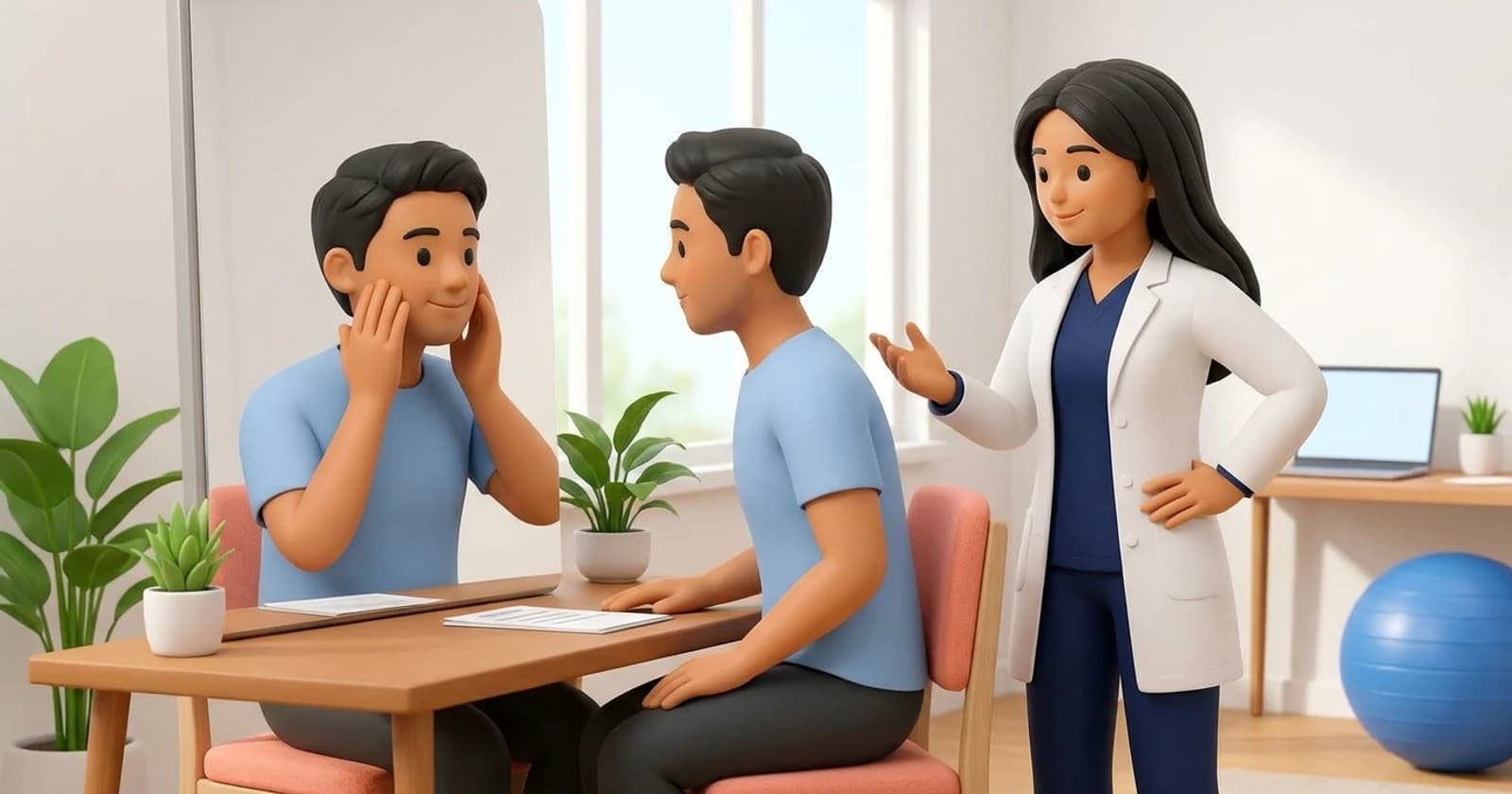
Active, low-amplitude motor re-education conducted in front of a mirror restores cortical motor maps while preventing mass abnormal movements.
- Mirror Biofeedback Drills: Sit in front of a mirror in a quiet room. Practice small, gentle, symmetrical movements. Focus on moving only the paralyzed side to match the healthy side, stopping immediately if the eye starts squinting during smile attempts.
- Isolated Muscle Sequence: Perform 5 slow repetitions of: 1) gentle brow elevation without wrinkling, 2) slow soft eye blinking without forceful squeezing, 3) gentle flaring of nostrils, 4) closed-lip symmetrical smile, 5) gentle pouting as if whistling.
- Manual Facial Mobilization and Massage: Gently stroke the cheek, forehead, and jawline with warm fingertips in an upward, circular motion for 5 minutes daily to maintain tissue suppleness and prevent muscular contractures.
Eye protection protocols: Preventing corneal ulceration
Inability to close the eyelid (lagophthalmos) leaves the cornea exposed to dust, air drying, and trauma, which can cause permanent blindness from corneal ulceration within days.
- Daytime Artificial Tears: Instill preservative-free lubricating eye drops every 1 to 2 hours during waking hours to maintain corneal moisture.
- Nocturnal Eyelid Taping: Apply ophthalmic lubricating ointment at bedtime, gently pull the upper eyelid down over the eye, and tape it closed with hypoallergenic micropore tape horizontally across the lid.
- Protective Eyewear Outdoors: Wear wraparound sunglasses outdoors to shield the exposed cornea from wind, glare, and vehicle pollution.
Frequently asked clinical questions
How long does Bell's palsy take to recover with physiotherapy?
Most patients begin experiencing voluntary motor twitches within 2 to 3 weeks. Full functional recovery typically occurs between 2 and 6 months when managed with oral corticosteroids prescribed in the first 72 hours alongside structured physiotherapy.
What is the difference between Bell's palsy and a stroke?
In Bell's palsy, the entire half of the face is paralyzed, including the forehead and eyebrow. In a cortical stroke, the forehead muscles are spared (the patient can still wrinkle their forehead symmetrically) due to bilateral cortical innervation of upper facial motor neurons.
Evidence sources and clinical references
- Cochrane Database of Systematic Reviews: Physiotherapy for Bell's palsy (idiopathic facial paralysis): https://cochranelibrary.com
- American Academy of Otolaryngology: Clinical Practice Guideline on Bell's Palsy: https://aao-hns.org
- Indian Association of Physiotherapists: Clinical Standards for Facial Nerve Rehabilitation: https://physiotherapyindia.org
Related condition guides


Related recovery guides & articles
BookPhysio.in Editorial Team
The BookPhysio.in editorial team writes and maintains this content, checking it against reliable clinical sources. Content follows our medical review policy: general information only, and no page claims a clinical review until a named registered physiotherapist has signed it off.
Read our medical review policy