
Bell's Palsy: House-Brackmann Staging, Synkinesis Prevention and Mime Therapy
In short
Bell's palsy causes acute unilateral facial paralysis. Learn House-Brackmann staging, why aggressive electrical stimulation is dangerous, and evidence-based mime therapy.
In this guide (5 sections)
Patho-Anatomy of Acute Facial Nerve Paralysis
Bell's palsy is an acute, unilateral peripheral facial nerve (Cranial Nerve VII) paralysis, most commonly triggered by herpes simplex virus (HSV-1) reactivation causing edema and inflammation within the narrow bony Fallopian canal of the temporal bone.
The onset is rapid, reaching maximal weakness within 48 to 72 hours, resulting in flaccid paralysis of all facial expression muscles on the affected side.
Clinical manifestations include an inability to close the eye (lagophthalmos), loss of forehead wrinkling, flattening of the nasolabial fold, drooping mouth corner with saliva drooling, hyperacusis (stapedius paralysis), and altered taste on the anterior two-thirds of the tongue.
House-Brackmann Facial Nerve Grading Scale
The House-Brackmann scale is the universally validated clinical grading system used to track facial nerve recovery.
| Grade Level | Degree of Injury | Clinical Presentation at Rest & Motion | Synkinesis & Functional Recovery | |
|---|---|---|---|---|
| Grade I | Normal | Normal facial function in all expressive areas | Complete recovery; zero synkinesis. | |
| Grade II | Mild Dysfunction | Normal symmetry at rest; slight weakness on close inspection; full eye closure | Complete or near-complete recovery with minimal effort. | |
| Grade III | Moderate | Normal symmetry at rest; noticeable but not disfiguring difference; complete eye closure with effort | Noticeable synkinesis or hemifacial contracture may develop. | |
| Grade IV | Moderately Severe | Obvious disfiguring asymmetry at rest; incomplete eye closure; forehead paralyzed | Marked synkinesis; mass action movement patterns. | |
| Grade V | Severe Dysfunction | Barely perceptible facial motion; asymmetrical mouth at rest; incomplete eye closure | Severe functional impairment; incomplete recovery. | |
| Grade VI | Total Paralysis | Complete loss of facial tone and movement; zero forehead or mouth motion | Persistent flaccidity or aberrant axonal re-growth. |
The Danger of Electrical Stimulation and the Rise of Synkinesis
In clinical practice across India, many patients are erroneously subjected to aggressive galvanic or faradic electrical stimulation on paralyzed facial muscles.
International clinical practice guidelines strongly advise against electrical stimulation in Bell's palsy. Electrical stimulation triggers non-selective motor axonal sprouting, causing aberrant re-innervation and severe synkinesis (such as the eye involuntarily closing tightly whenever the patient smiles or chews, or the mouth twitching when blinking).
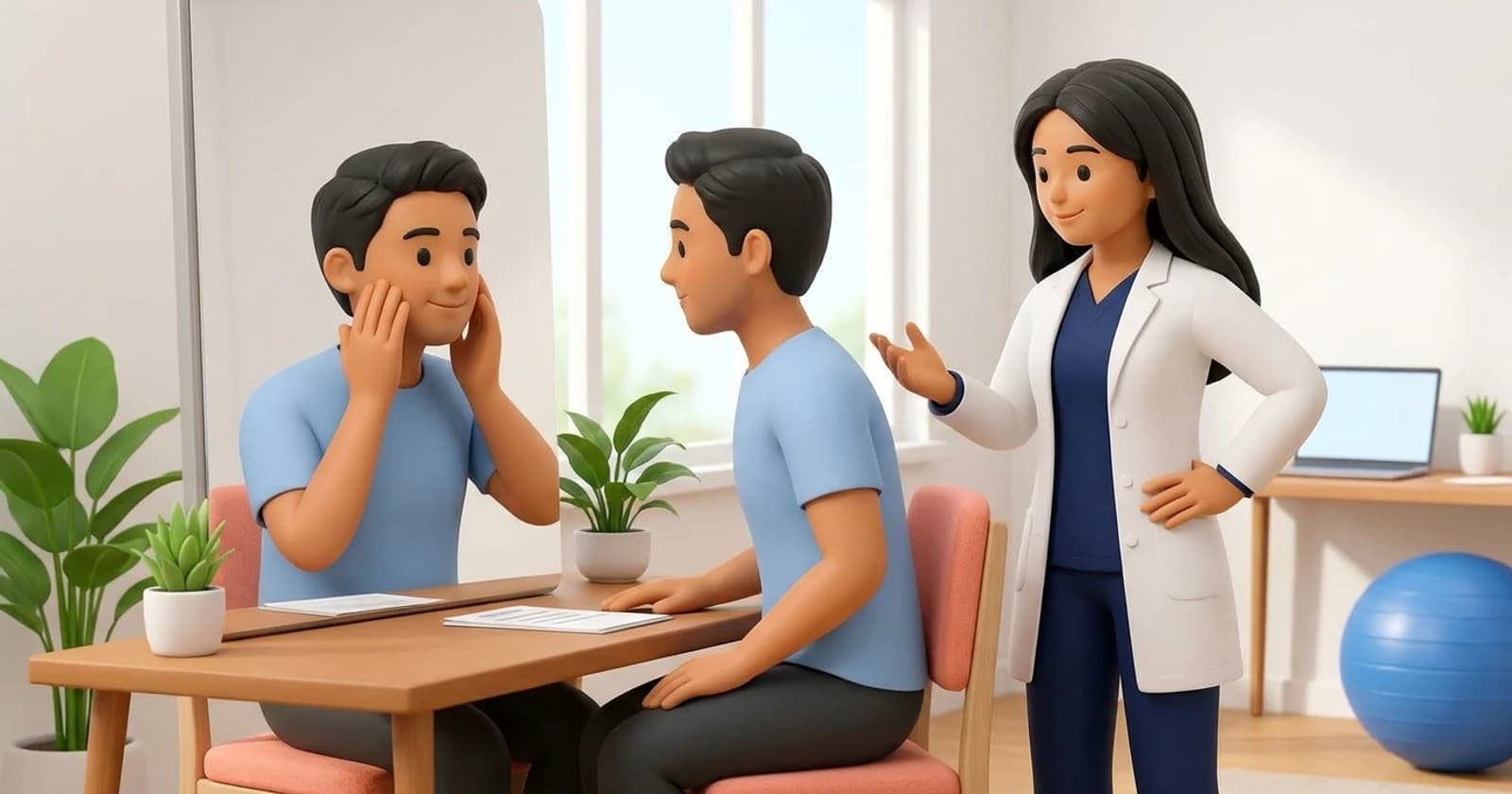
Evidence-based facial rehabilitation relies on Mime Therapy and Neuromuscular Re-education (NMR) utilizing visual feedback.
- Mirror-Assisted Selective Muscle Activation: Practice isolated, small-amplitude facial expressions in front of a mirror, ensuring that one muscle moves without triggering unwanted contractions in neighboring muscles.
- Manual Assistance for Symmetric Motion: Use fingertips to physically assist the paralyzed side into a gentle smile or eye squint, matching the exact excursion of the healthy side.
- Avoid Gross Mass Action Movements: Never instruct the patient to grimace, clench teeth, or chew gum aggressively, as gross strain promotes abnormal mass motor patterns.
- Meticulous Eye Protection Protocol: Because the eye cannot close, the cornea is vulnerable to drying and ulceration. Prescribe daytime lubricating artificial tears every 2 hours, moisture goggles, and nighttime eye taping.
Differentiating Bell's Palsy from Acute Stroke
In acute stroke (upper motor neuron lesion), the forehead muscles receive bilateral cortical innervation and are spared: the patient can still wrinkle their forehead and close their eye tightly.
In Bell's palsy (lower motor neuron lesion), all branches of the facial nerve are impaired, resulting in complete paralysis of both the upper and lower face, including the forehead.
Frequently Asked Questions
How long does Bell's palsy take to resolve?
Approximately 70 to 80 percent of patients begin showing spontaneous recovery within 2 to 3 weeks and achieve full recovery within 3 to 6 months, particularly when oral corticosteroids are initiated within 72 hours of symptom onset.
Why should electrical stimulation be avoided on the face?
High-intensity electrical stimulation forces all facial muscle groups to contract simultaneously, disrupting selective cortical motor maps and causing aberrant axonal re-growth that leads to disfiguring facial synkinesis.
What is Bell's phenomenon?
Bell's phenomenon is a normal physiological reflex: when an individual attempts to close their eyes, the eyeball automatically rolls upward and outward to protect the cornea. In Bell's palsy, because the eyelid remains open, this upward rolling of the white sclera is clearly visible.
Related condition guides


Related recovery guides & articles
BookPhysio.in Editorial Team
The BookPhysio.in editorial team writes and maintains this content, checking it against reliable clinical sources. Content follows our medical review policy: general information only, and no page claims a clinical review until a named registered physiotherapist has signed it off.
Read our medical review policy