
Bending and Lifting with Lower Back Pain and Sciatica: Biomechanics, Safe Techniques and Daily Work
In short
Bending forward from the waist with straight legs spikes pressure on lumbar discs by up to 400 percent, frequently triggering acute disc bulges and sciatica. Learn the biomechanics of spinal loading, three proven lifting techniques for light, medium, and heavy objects, and how to protect your back during everyday household chores.
In this guide (6 sections)
The Biomechanics of Bending: Why Forward Flexion Spikes Disc Pressure
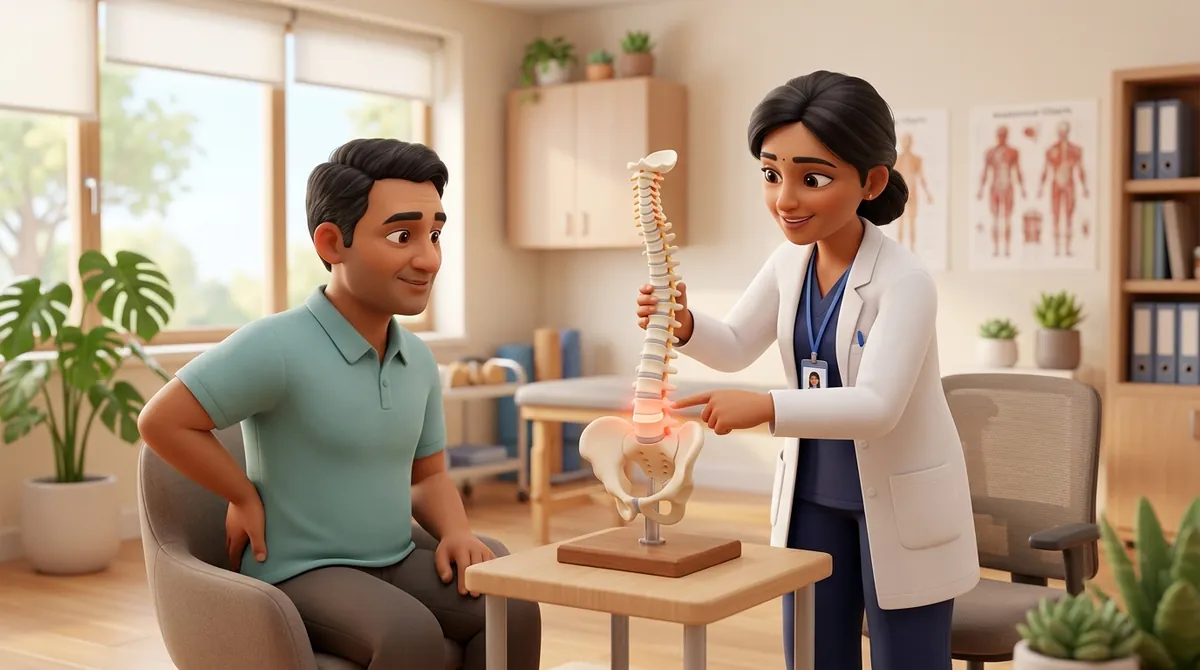
Bending down to tie shoelaces, retrieve a dropped pen, or lift a heavy grocery bag is an automatic movement for most people. However, for someone with a posterior disc bulge, lumbar facet syndrome, or sciatica, bending forward is often the single most provocative trigger of sharp, disabling pain.
When you bend forward from the waist with your knees locked straight, your lumbar spine acts as a cantilever beam. The intervertebral discs between L4-L5 and L5-S1 endure massive anterior compression while the posterior fibrous annulus is stretched taut under tension. This mechanical combination forces the gelatinous nucleus pulposus backward against sensitive spinal nerve roots.
| Posture and Lifting Action | Internal Disc Pressure (Percentage) | Mechanical Stress on Posterior Discs | |
|---|---|---|---|
| Lying Supine (Flat on Back) | 25 percent | Lowest pressure; intervertebral discs rehydrate naturally | |
| Standing Upright (Neutral Spine) | 100 percent (Baseline) | Even hydrostatic distribution across disc nucleus | |
| Bending Forward (Knees Straight, Rounded Back) | 220 percent | Anterior disc wedging; nucleus pulposus migrates posteriorly toward nerve roots | |
| Lifting 20 kg with Rounded Back (Faulty Lifting) | 380 to 450 percent | Extreme shear strain on annulus fibrosus; highest risk of annular tear and disc rupture | |
| Lifting 20 kg with Neutral Spine & Bent Knees (Power Squat) | 180 to 220 percent | Spinal load distributed to gluteals, quads, and abdominal core musculature |
Three Evidence-Based Lifting Techniques for Everyday Objects
Lifting needs vary depending on whether an object is a lightweight dropped item, a low laundry basket, or a dense water bucket. Physiotherapists recommend three distinct techniques tailored to object weight.
- The Golfer's Lift (For Light Objects Under 2 kg): Used for picking up dropped keys, a mobile phone, shoes, or loose laundry. Shift your bodyweight onto one leg. As you reach down with the opposite arm, allow your non-weight-bearing leg to swing straight out behind you like a counterbalance. Keep your spine in a straight, neutral line from head to heel, resting one hand on a table or thigh for support. This eliminates lumbar flexion entirely.
- The Half-Kneeling Lunge (For Mid-Weight Objects from 2 to 10 kg): Ideal for lifting packages, grocery bags, or pulling an object out of a low cabinet. Step one foot forward into a 90-degree lunge and drop the opposite knee to the floor on a cushioned mat. Pull the object onto your front thigh, hug it close against your chest, and stand up by pressing through your front heel using your quadriceps and gluteals.
- The Power Squat and Hug (For Heavy Objects Over 10 kg): Essential for heavy household items like a 20-litre water container, 15 kg bag of atta, or an LPG cylinder. Stand with feet slightly wider than shoulder-width, straddling the object. Drop down into a deep squat by hinging at your hips and bending your knees while keeping your chest upright and lumbar spine neutral. Pull the object tight against your pelvic center of gravity before standing upright. Never twist your torso while lifting.
Common Household Bending Mistakes and Simple Workarounds
Many back flare-ups occur not during heavy gym workouts, but during ordinary morning routines and household cleaning.
- Morning Washbasin Bending: Bending over a low sink to brush teeth or wash your face within 30 minutes of waking places peak stress on fluid-gorged, morning discs. Instead of rounding your back, place one palm firmly on the basin counter rim to bear upper-body weight, or take a wide stance and soften your knees.
- Mopping and Sweeping with Short Handles: Using short traditional brooms (jhadu) forces continuous sustained spinal flexion. Replace them with long-handled brooms and upright mops that allow you to stand upright and clean using walking lunges rather than hunched waists.
- Lifting Out of Car Boots or Low Couches: Reaching into a car boot or deep sofa combines forward flexion with horizontal reaching, creating a massive lever arm on the lower back. Slide the luggage or bag as close to the edge of the boot as possible before attempting to lift.
Active Exercises to Restore Safe Hip-Hinge Mechanics
Learning to hinge at the hips rather than rounding the lumbar spine is the foundation of long-term back protection. Practice these three physiotherapist-approved motor control drills.
- The Dowel Rod Hip Hinge Drill: Hold a lightweight wooden broomstick along your spine touching three points: the back of your head, your upper thoracic spine between your shoulder blades, and your sacrum (tailbone). Practice pushing your hips backward toward a wall behind you with soft knees while maintaining all three points of contact. If the rod loses contact with your tailbone, you are rounding your lower back.
- McGill Bird-Dog Quadruped Extension: On hands and knees with a flat back, slowly extend your right arm forward and left leg backward until both are parallel to the floor. Hold for 5 seconds without letting your pelvis dip or your lower back arch excessively. Perform 8 controlled repetitions per side to build deep multifidus stability.
- Suitcase Farmer's Carry: Hold a moderately weighted object (5 to 10 kg) in one hand by your side like a suitcase. Walk forward with an upright posture and level shoulders for 30 seconds without leaning toward or away from the weight. This strengthens the quadratus lumborum and obliques against lateral spinal shear.
Clinical Red Flags: When Bending Pain Demands Urgent Medical Attention
While localized back stiffness usually responds well to physiotherapy and pacing, certain symptoms indicate acute nerve root compromise or disc extrusion requiring immediate medical evaluation.
Seek prompt emergency medical care if you experience: loss of bowel or bladder control, sudden numbness in your groin or saddle area (inability to feel toilet paper when wiping), progressive weakness in your leg such as foot drop (inability to lift the front of your foot while walking), or severe unrelenting pain that does not ease in any resting position.
Frequently Asked Questions
Can I ever bend forward normally again after suffering a slip disc?
Yes. In the acute and subacute phases (first 6 to 12 weeks), avoiding loaded spinal flexion allows the annular tear to heal and inflammation to subside. Once pain centralises and core endurance is restored, your physiotherapist will introduce controlled, progressive lumbar flexion so your spine regains its natural flexibility without fear.
Should I wear a lumbar support belt when doing heavy chores or lifting at home?
A firm lumbar support belt can provide beneficial tactile feedback and intra-abdominal support during acute flare-ups or when lifting unavoidable heavy loads like shifting furniture. However, avoid wearing it continuously throughout the day, as your deep spinal stabilizing muscles can become reliant on external support.
What should I do immediately if my back suddenly catches or locks while bending?
Do not panic or force yourself to bend straight. Gently walk with small steps to an upright position. Lie down on a firm bed or floor on your back with your lower legs elevated on a chair or pile of pillows (90-degree hip and knee psoas rest position). Apply an ice pack for 15 minutes to reduce acute protective spasm, take deep diaphragmatic breaths, and contact a registered physiotherapist for guided relief.

Related recovery guides & articles
BookPhysio.in Editorial Team
The BookPhysio.in editorial team writes and maintains this content, checking it against reliable clinical sources. Content follows our medical review policy: general information only, and no page claims a clinical review until a named registered physiotherapist has signed it off.
Read our medical review policy