
Lachman test for ACL tear: how to perform, grading, and accuracy
In short
The Lachman test is the clinical gold standard for detecting an anterior cruciate ligament (ACL) tear. Performed with the knee flexed to 20 to 30 degrees, it evaluates anterior tibial translation and endpoint quality with greater diagnostic sensitivity than the anterior drawer test.
In this guide (5 sections)
What is the Lachman test?
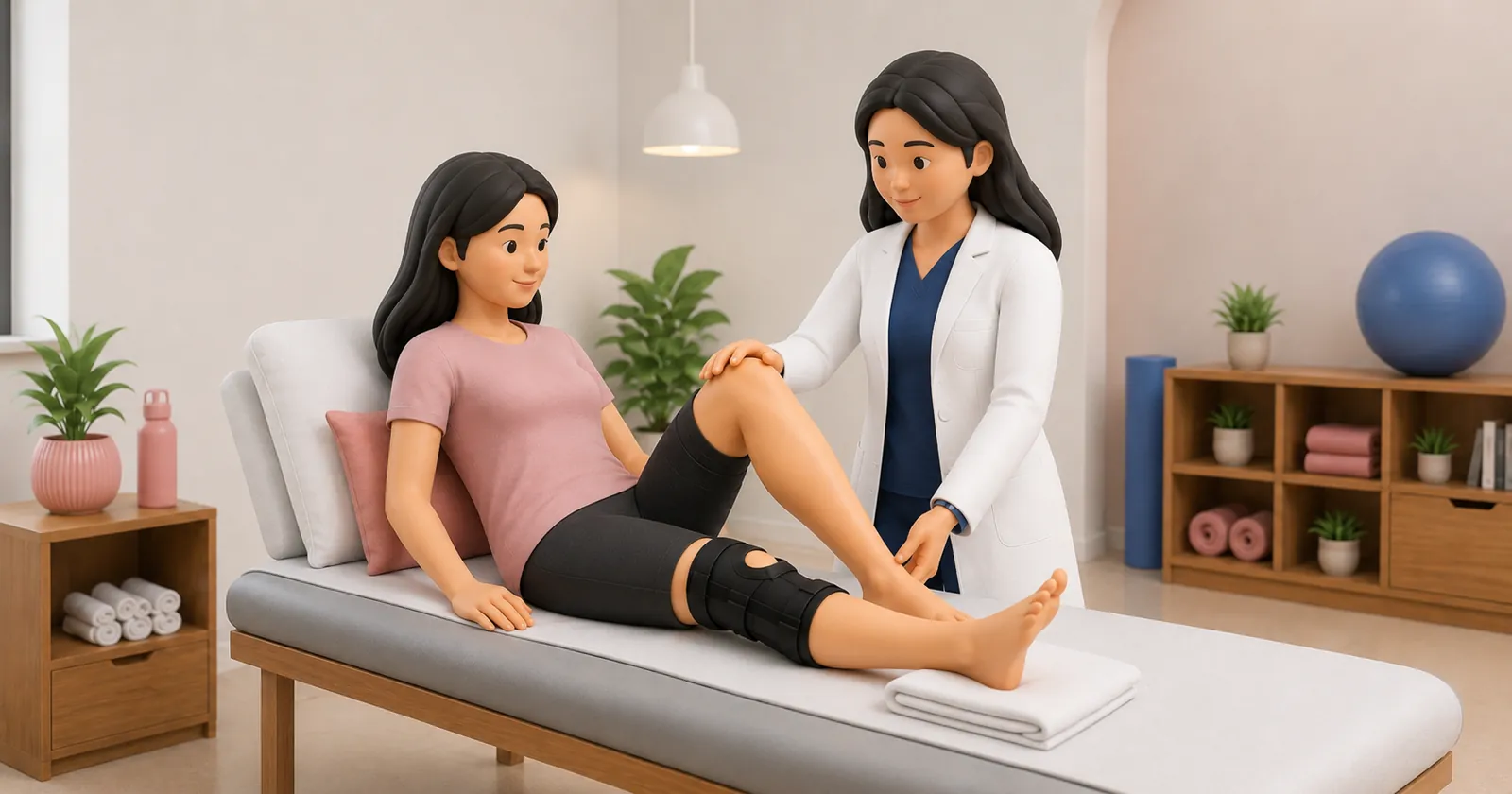
The Lachman test is an orthopaedic examination used by physiotherapists and orthopaedic doctors to evaluate the integrity of the anterior cruciate ligament (ACL). It assesses whether the tibia slides forward excessively relative to the femur when the knee is held at 20 to 30 degrees of flexion.
Clinical diagnostic accuracy: Systematic reviews in the Journal of Bone and Joint Surgery and Cochrane clinical assessments report the Lachman test has an estimated sensitivity of 85% to 87% and specificity of 94% to 96%, outperforming the anterior drawer test in acute knee injuries.
Step-by-step examination protocol
To execute the Lachman test accurately, follow these steps to minimise hamstring muscle guarding:
- 1. Patient positioning: Place the patient supine on an examination couch, completely relaxed.
- 2. Knee flexion angle: Flex the involved knee to 20 to 30 degrees. Ensure the quadriceps and hamstring muscles remain fully relaxed.
- 3. Femur stabilization: Grasp the anterior aspect of the lower femur just above the patella with your superior hand to anchor it firmly against the table.
- 4. Tibial translation: Grasp the posterior-medial aspect of the proximal tibia with your inferior hand, placing your thumb along the anterior joint line.
- 5. Anterior translation force: Apply a quick, firm anterior pull on the proximal tibia while maintaining femoral stability, feeling for displacement and the endpoint.
Interpreting end-feel and grading laxity
The quality of the end-point is more informative than millimeters of displacement alone. An intact ACL produces a crisp, sudden stop (firm end-feel). A complete ACL rupture produces a soft, mushy, or absent end-feel.
| Anterior Translation (mm) | Endpoint Quality | Clinical Interpretation | |
|---|---|---|---|
| Grade 1 (Mild) | 3 to 5 mm | Firm endpoint | Partial micro-tear or mild ligament sprain |
| Grade 2 (Moderate) | 6 to 10 mm | Soft or delayed endpoint | Significant partial rupture with compromised stability |
| Grade 3 (Severe) | Greater than 10 mm | Absent or empty endpoint | Complete ACL rupture |
Lachman test vs anterior drawer test vs pivot shift
Different knee tests evaluate different planes of instability and vary in diagnostic sensitivity across acute and chronic phases:
| Test Position | Sensitivity (Acute) | Specificity | Key Limitation | |
|---|---|---|---|---|
| Lachman Test | 20 to 30 deg flexion | 85% to 87% | 94% to 96% | Requires large examiner hands for large thighs |
| Anterior Drawer Test | 90 deg flexion | 55% to 62% | 91% to 92% | Hemarthrosis and hamstring spasm block translation at 90 deg |
| Pivot Shift Test | Extension to 30 deg flexion with valgus force | 24% to 28% (awake) | 98% | High patient discomfort and involuntary guarding |
Common diagnostic pitfalls and false findings
- Hamstring muscle guarding: In acute knee trauma, pain causes involuntary protective contraction of the hamstrings, which holds the tibia back and produces a false negative result.
- PCL tear pseudolaxity: A torn posterior cruciate ligament (PCL) causes the resting tibia to sag backward. When pulled forward to neutral, the examiner may mistake the movement for excessive anterior translation. Always assess posterior sag before performing the Lachman test.
What does a positive Lachman test mean?
A positive Lachman test indicates increased anterior tibial translation with a soft or absent endpoint, strongly suggesting a partial or complete tear of the anterior cruciate ligament.
Can a patient have a normal Lachman test with a torn ACL?
Yes. In acute injuries, joint swelling (hemarthrosis) and involuntary hamstring spasm can hold the tibia in place, masking the tear. Clinicians repeat the test after acute swelling subsides or verify with magnetic resonance imaging (MRI).
What should you do if your Lachman test is positive?
Consult a registered physiotherapist or orthopaedic specialist. Initial management focuses on controlling effusion, restoring knee extension, and strengthening the quadriceps and hamstrings through targeted rehabilitation.
- Journal of Bone and Joint Surgery: Diagnostic accuracy of physical tests for ACL injuries: https://jbjs.org
- Cochrane Database of Systematic Reviews: Physical examination tests for diagnosing ACL tears: https://cochranelibrary.com
- National Commission for Allied and Healthcare Professions Act, 2021: https://egazette.gov.in
Related condition guides


Related recovery guides & articles
BookPhysio.in Editorial Team
The BookPhysio.in editorial team writes and maintains this content, checking it against reliable clinical sources. Content follows our medical review policy: general information only, and no page claims a clinical review until a named registered physiotherapist has signed it off.
Read our medical review policy