
Why Longitudinal Digital Health Records Matter in Physiotherapy (and How DPDP Act Protects You)
In short
Losing physical prescription slips or handwritten exercise charts leads to repeated tests and fragmented rehabilitation. Discover how digital physiotherapy treatment records protect continuity of care and how the DPDP Act safeguards your clinical data.
In this guide (4 sections)
Musculoskeletal injuries and physical rehabilitation are rarely resolved in a single day. Chronic lower back pain, rotator cuff tears, post-surgical knee rehab, and stroke recovery unfold over weeks or months, often with recurring episodes years later. Yet in India, over eighty percent of physiotherapy patients still receive loose prescription slips or hand-drawn stick figures on paper pads. When those slips get misplaced, the clinical narrative vanishes.
The clinical danger of fragmented paper records
When physical therapy records are trapped on paper slips or casual chat threads, patients suffer several predictable clinical setbacks:
- Repeated baseline assessments and wasted time: When consulting an orthopaedic surgeon, neurologist, or new physiotherapist, patients must rely on vague memories of what movements hurt or what exercises were prescribed, leading to unnecessary re-evaluations.
- Loss of objective progress tracking: Subjective feelings of pain fluctuate daily. Without recorded measurements of joint range of motion (ROM), muscle strength grades, and functional balance scores, it is difficult to measure real clinical recovery.
- Insurance and reimbursement disputes: Third-party administrators (TPAs) and health insurers routinely reject outpatient claims that lack dated, itemized clinical session notes and practitioner registration credentials.
- Inconsistent exercise progressions: Handwritten notes frequently leave out crucial movement dosage, such as hold durations, contraction intensity, and repetition cadence, increasing the risk of re-injury.
How BookPhysio.in creates plain-language treatment summaries
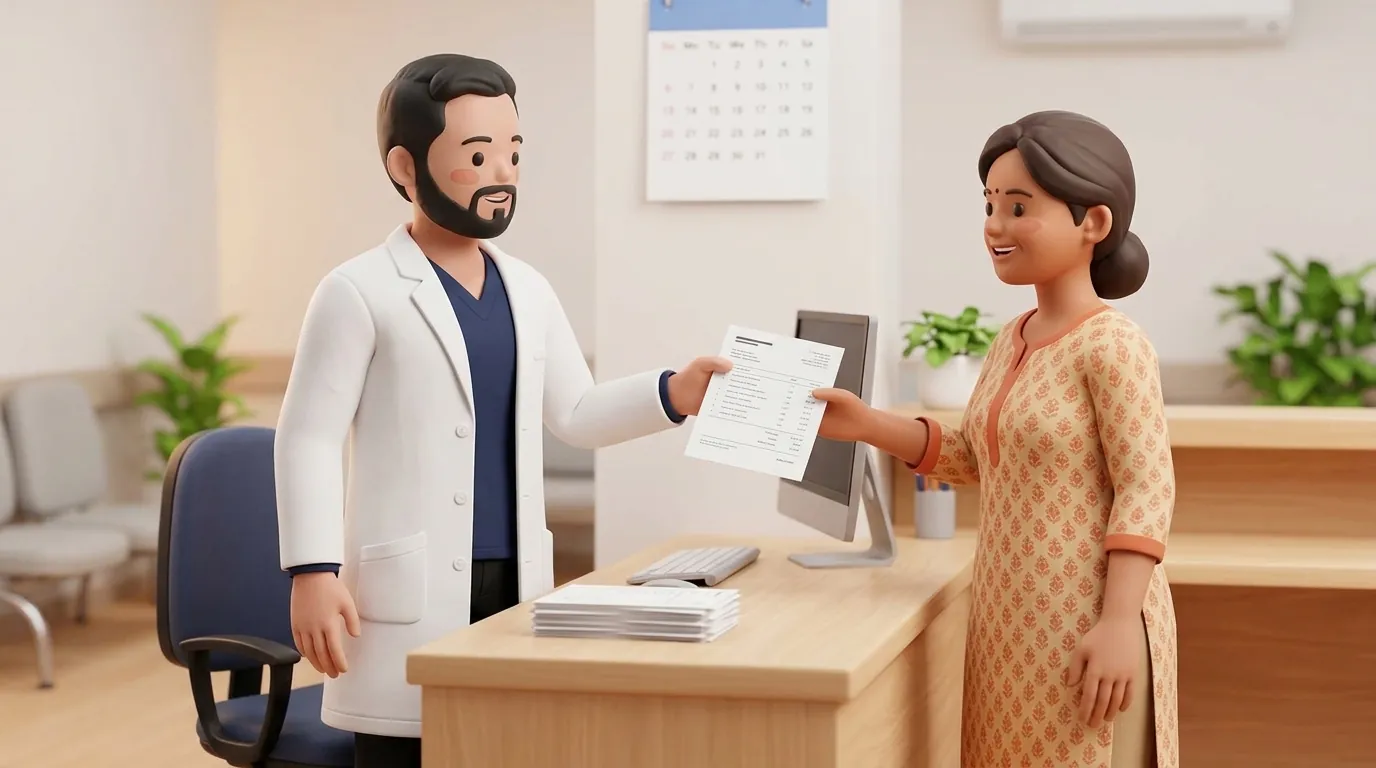
Inside the BookPhysio.in patient portal, clinical documentation is designed for patient clarity. Whenever your registered physiotherapist completes a clinical evaluation or progress note, a patient-facing summary is automatically generated in your secure dashboard.
| Documentation Dimension | Traditional Paper Slips & Chat Messages | BookPhysio.in Digital Records Portal |
|---|---|---|
| Storage & Access | Easily lost, damaged by moisture, or forgotten at home | Permanent, cloud-synchronized timeline accessible on any phone or computer |
| Jargon vs Clarity | Dense medical acronyms and illegible handwriting | Plain-language patient summaries translating clinical terms into clear recovery steps |
| Exercise Details | Crude stick figures without dosage or caution cues | Structured movement instructions with precise repetitions, sets, and hold times |
| Insurance Evidence | Generic cash memos often missing registrar numbers | Itemized receipts displaying statutory SAC 999312 and verified registration details |
| Privacy & Consent | Files stored in unsecured physical cabinets | Explicit consent verification meeting the standards of the DPDP Act 2023 |
Your privacy rights under the Digital Personal Data Protection Act
Health information is sensitive personal data. Under India's Digital Personal Data Protection Act (DPDP Act 2023), digital health platforms must observe strict governance standards. On BookPhysio.in, your data is protected by fundamental architectural safeguards:
- Mandatory practitioner consent attestation: A clinician cannot create or update a digital clinical chart on BookPhysio.in without explicit attestation that you provided informed consent for digital record keeping.
- Patient-isolated data partitions: Your clinical records, appointment dates, and exercise plans are strictly partitioned. One clinician cannot view another provider's patient records unless explicitly authorized.
- Zero commercial data exploitation: BookPhysio.in does not monetize patient records, sell diagnosis profiles to pharmaceutical distributors, or serve targeted medical advertisements based on your clinical conditions.
Supine Hooklying Pelvic Clock for Lumbopelvic Dissociation
Objective: Restore motor control of the deep stabilizing musculature (transversus abdominis and multifidus) while improving lumbosacral proprioception for chronic lower back stiffness.
- 1Lie on your back with your knees bent and feet flat on the floor, hips-width apart.
- 2Visualize a clock face resting flat on your lower abdomen, with 12 o'clock at your belly button and 6 o'clock at your pubic bone.
- 3Gently tilt your pelvis to flatten your lower back against the floor, moving toward 12 o'clock.
- 4Slowly rotate your pelvis toward 3 o'clock (right hip downward), then down toward 6 o'clock (arching lower back gently), and through 9 o'clock (left hip downward).
- 5Complete smooth, controlled circles without holding your breath or tensing your neck.
BookPhysio.in adheres to statutory Indian data protection standards. Your medical history, treatment plans, and contact details are stored securely and never shared with third-party advertisers.
Book an evaluation with a council-verified physiotherapist and receive clear, digital treatment summaries and exercise plans directly in your patient dashboard.
Find a Verified PhysiotherapistFrequently asked questions
Can I download my treatment records to share with my orthopaedic doctor?
Yes. All treatment summaries, visit dates, and clinician notes can be viewed or exported from your patient dashboard, providing a clear medical timeline for your doctor or surgeon.
What happens to my records if I switch physiotherapists on BookPhysio.in?
Your longitudinal history remains attached to your personal patient account. You retain full access to past session dates, treatment summaries, and exercise records.
Does BookPhysio.in charge patients to store digital health records?
No. Digital record storage, appointment booking, and treatment summaries are provided completely free for patients on BookPhysio.in.
Evidence reviewed 17 October 2026. Health information governance and clinical documentation guide for patients in India.
Related condition guides





Related recovery guides & articles
BookPhysio.in Editorial Team
The BookPhysio.in editorial team writes and maintains this content, checking it against reliable clinical sources. Content follows our medical review policy: general information only, and no page claims a clinical review until a named registered physiotherapist has signed it off.
Read our medical review policy