
Dual-task training in Parkinson's: cognitive-motor exercises to prevent falls during walking
In short
In Parkinson's disease, walking ceases to be an automatic subcortical process and requires conscious frontal lobe attention. Dual-task physiotherapy trains patients to combine walking with secondary cognitive or manual tasks, significantly reducing real-world fall risk.
In this guide (4 sections)
The neurobiology of dual-task interference in Parkinson's
In healthy individuals, walking is largely automated by basal ganglia circuitry, leaving the conscious frontal cortex free to talk, think, or check surroundings. In Parkinson's disease, loss of striatal dopamine impairs automated motor programmes. The patient must consciously think about every single step using the prefrontal cortex. When a secondary task is introduced (like answering a phone or carrying a cup), cognitive resources divide, causing step length to shrink, cadence to falter, and fall risk to multiply.
Clinical evidence: Studies in the journal Movement Disorders demonstrate that structured dual-task physiotherapy significantly improves gait velocity and reduces cognitive-motor interference without increasing falls when administered progressively.
Four-level dual-task rehabilitation hierarchy
Neurological physiotherapists structure dual-task training in progressive stages from controlled single-tasking to complex functional challenges:
| Level | Task Combination | Clinical Exercise Example | |
|---|---|---|---|
| Level 1 (Single Task) | Motor task alone with rhythmic sensory cues | Walking along a 10-metre line paced by a metronome (100 beats per minute) or following floor visual tape strips. | |
| Level 2 (Motor + Simple Cognitive) | Walking combined with structured verbal recitation | Stepping in cadence while reciting days of the week backwards, naming months in reverse, or counting by 2s. | |
| Level 3 (Motor + Executive Cognitive) | Walking combined with working memory and decision-making | Walking while naming Indian cities starting with a specific letter, serial 7 subtractions (100, 93, 86), or word-association games. | |
| Level 4 (Motor + Motor / Manual Task) | Walking combined with secondary upper-limb motor execution | Walking while carrying a tray with a cup of water, bouncing a tennis ball, or fastening buttons on a shirt. |
Structured dual-task home exercise routines
Practice these safe exercises with a caregiver nearby:
Metronome Marching with Category Naming
Objective: Integrate rhythmic auditory pacing with executive working memory retrieval.
- 1Set an audio metronome app to a comfortable cadence (typically 90 to 105 beats per minute).
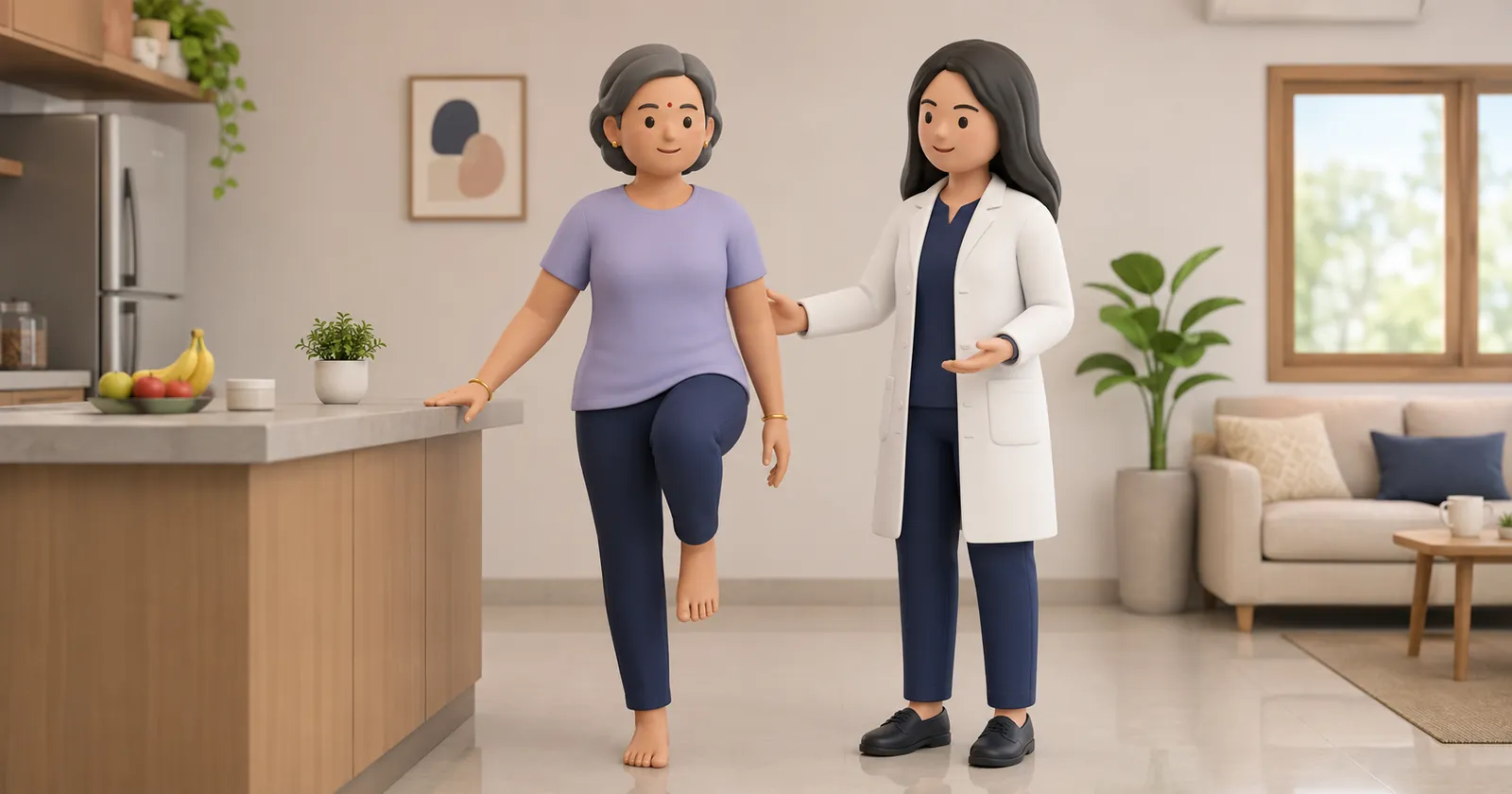
- 2March in place holding onto a sturdy kitchen counter, matching knee lifts to the beat.
- 3While maintaining the steady rhythm, name aloud one fruit, vegetable, or city on every fourth beat.
- 4Continue for 2 minutes, resting if gait rhythm breaks.
Line Walking with Object Transfer
Objective: Enhance dynamic balance and manual dexterity during forward progression.
- 1Walk forward along a clear hallway with deliberate, wide steps.
- 2Hold a small ball or soft object in your right hand.
- 3Every two steps, transfer the ball smoothly around your back into your left hand, then bring it forward.
- 4Maintain tall posture and gaze toward the end of the hallway rather than down at your feet.
When to practice 'Single-Task Priority'
While dual-task training is beneficial in controlled therapy sessions, patients must apply Single-Task Priority during high-risk real-world moments:
- Crossing roads or busy streets: Never talk on the phone, look through a handbag, or converse while crossing streets or negotiating crowds. Stop walking before engaging in another task.
- Navigating stairs and escalators: Focus 100% of conscious visual and physical attention on handrail grip and foot placement. Never carry objects in both hands on stairs.
- Entering elevators or narrow doors: Pause, plan the path, and focus solely on high stepping over the threshold.
Why does dual-tasking cause falls in Parkinson's disease?
Because Parkinson's damages automatic motor control, walking requires conscious attention. When forced to think, talk, or carry objects while walking, the brain cannot allocate enough cognitive capacity to both tasks, leading to shortened steps, freezing, and loss of balance.
Is dual-task training safe for Hoehn and Yahr Stage 3 and 4 patients?
Yes, provided it is conducted under the direct supervision of a physiotherapist or with a trained caregiver using a gait belt in a clear environment free from trip hazards.
What sensory cues work best during dual-task walking?
Auditory metronome beats and rhythmic music provide external pacing that bypasses the damaged basal ganglia, allowing patients to maintain stride length and cadence even while performing cognitive tasks.
- Movement Disorders Journal: Cognitive-Motor Dual-Task Training in Parkinson's Disease: https://movementdisorders.org
- Neurorehabilitation and Neural Repair: Dual-Tasking in Neurological Disorders: https://journals.sagepub.com/home/nnr
- Cochrane Database of Systematic Reviews: Motor and cognitive dual-task interventions in Parkinson's: https://cochranelibrary.com
Related condition guides


Related recovery guides & articles
BookPhysio.in Editorial Team
The BookPhysio.in editorial team writes and maintains this content, checking it against reliable clinical sources. Content follows our medical review policy: general information only, and no page claims a clinical review until a named registered physiotherapist has signed it off.
Read our medical review policy