
Post-ICU physiotherapy at home: rehabilitation for bedridden elderly patients
In short
Prolonged ICU stays and bed rest lead to rapid muscle wasting, joint stiffness, and respiratory weakness in elderly patients. Discover structured home physiotherapy steps to restore bed mobility, improve chest clearance, and prevent pressure ulcers.

In this guide (5 sections)
Returning home after an extended Intensive Care Unit (ICU) admission is a major milestone for elderly patients and their families. However, prolonged mechanical ventilation, heavy sedation, and complete bed rest trigger ICU-acquired weakness (ICUAW), causing seniors to lose substantial muscle mass. Structured home physiotherapy provides the gentle, progressive support needed to rebuild basic mobility safely.
Critical priorities during the first 72 hours at home
- Chest clearance and respiratory expansion: Gentle assisted deep breathing and supported coughing techniques help clear retained secretions and reduce the risk of secondary hypostatic pneumonia.
- Pressure ulcer prevention through regular repositioning: Rotating body positions every two hours using supportive pillows offloads bony prominences such as the sacrum, greater trochanters, and heels.
- Passive and active-assisted joint mobilization: Moving ankles, knees, hips, and shoulders through comfortable ranges prevents permanent joint contractures and preserves capsular flexibility.
- Monitoring vital signs before and during exercise: Tracking pulse rate, blood pressure, and oxygen saturation before initiating any movement ensures physiological safety.
Four-stage functional mobility progression
| Progression Stage | Target Milestone | Key Physiotherapy Exercises | Caregiver Role |
|---|---|---|---|
| Stage 1: In-bed activation | Independent rolling and pelvic bridging | Ankle pumps, quadriceps sets, assisted heel slides | Assisting side-turn positioning and pillow placement |
| Stage 2: Edge-of-bed balance | Supported sitting for 10 to 15 minutes | Trunk righting reactions, reaching drills, deep diaphragmatic breathing | Providing gentle side support and preventing dizziness |
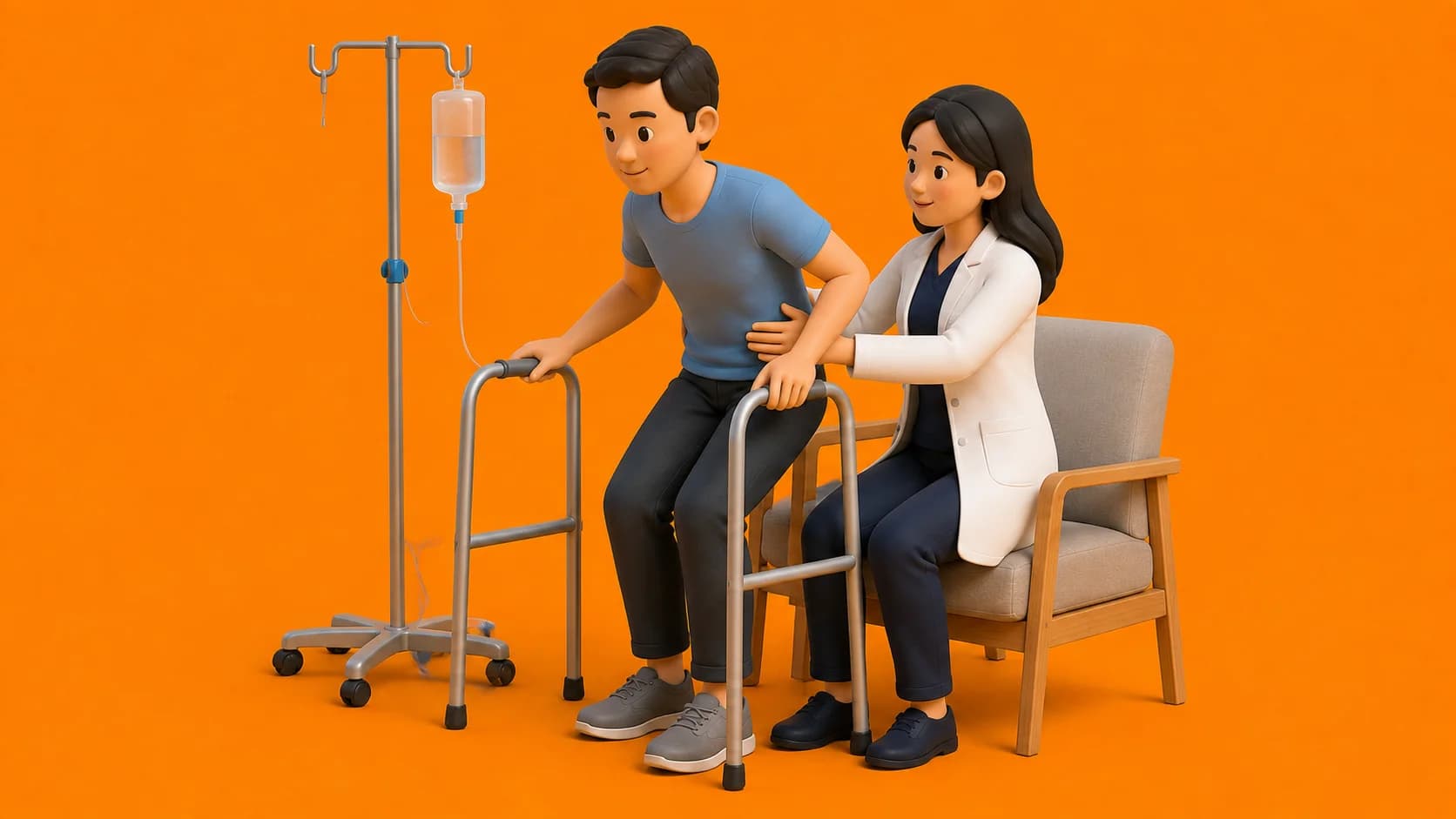
| Stage 3: Sit-to-stand transitions | Bearing weight evenly on both feet | Assisted chair rises, standing weight shifts, calf raises | Guarding behind the patient with hands on pelvic belt |
| Stage 4: Supervised ambulation | Short indoor walking using a walker | Reciprocal stepping, tandem balance, turning safety | Clearing floor obstacles and pacing walking distance |
Gentle bed exercises for early strength recovery
Assisted Ankle Pumps and Calf Activation
Objective: Stimulate venous calf muscle pump action to lower deep vein thrombosis risk.
- 1Position the patient comfortably on their back with legs extended flat.
- 2Instruct the patient to pull their toes upward toward their shins as far as possible.
- 3Next, push the toes downward as if pressing an accelerator pedal.
- 4Move slowly and smoothly through the full comfortable ankle range.
Supported Edge-of-Bed Trunk Control
Objective: Re-establish upright postural tone and vestibular orientation against gravity.
- 1Slowly assist the patient into a seated position on the bed with feet flat on the floor or stool.
- 2Place hands lightly on the bed beside their hips for support.
- 3Encourage the patient to lengthen their spine and gaze forward.
- 4Practice holding the upright posture steadily while taking slow, deep diaphragmatic breaths.
Red flags requiring immediate medical attention
If the patient develops sudden shortness of breath, blood oxygen saturation below 90 percent, unilateral hot calf swelling, chest tightness, or acute confusion, pause all exercises and contact their attending physician immediately.
How soon should home physiotherapy start after ICU discharge?
Physiotherapy should ideally begin within 24 to 48 hours of returning home to prevent rapid muscle atrophy and chest complications.
What is the fee for home physiotherapy for bedridden seniors?
Home visits for geriatric post-ICU rehabilitation typically range between ₹600 and ₹1,800 per session in Indian cities, payable directly to the visiting clinician.
Evidence reviewed 25 September 2026. General information only.
Sources reviewed
European Society of Intensive Care Medicine (ESICM) Clinical Practice Guidelines on Early Rehabilitation; Indian Journal of Critical Care Medicine; World Physiotherapy Geriatric Care Guidelines.
Related condition guides


BookPhysio.in Editorial Team
The BookPhysio.in editorial team writes and maintains this content, checking it against reliable clinical sources. Content follows our medical review policy: general information only, and no page claims a clinical review until a named registered physiotherapist has signed it off.
Read our medical review policy