
Rotator cuff repair rehabilitation protocol: post-surgical phases, sling removal, and range of motion guidelines
In short
Tendon-to-bone healing after arthroscopic rotator cuff repair takes up to 12 weeks. Premature active lifting risks re-tearing the suture anchor interface. Learn the 4-phase physiotherapy progression for safe, complete shoulder recovery.
In this guide (6 sections)
Tendon-to-bone biology and structural healing phases
When a torn supraspinatus or infraspinatus tendon is re-anchored to the humeral greater tuberosity using suture anchors, mechanical fixation holds the tissue in place. However, biological integration requires the formation of a fibrocartilaginous Sharpey fiber transition zone, a slow process requiring 8 to 12 weeks.
Early physiotherapy balances two competing demands: protecting the suture anchor repair against mechanical tensile strain while gently moving the glenohumeral joint to prevent adhesive capsulitis (secondary frozen shoulder).
The 4-Phase post-operative rehabilitation protocol
| Phase & Timeline | Sling & Protection | Permitted Exercises | Strict Contraindications | |
|---|---|---|---|---|
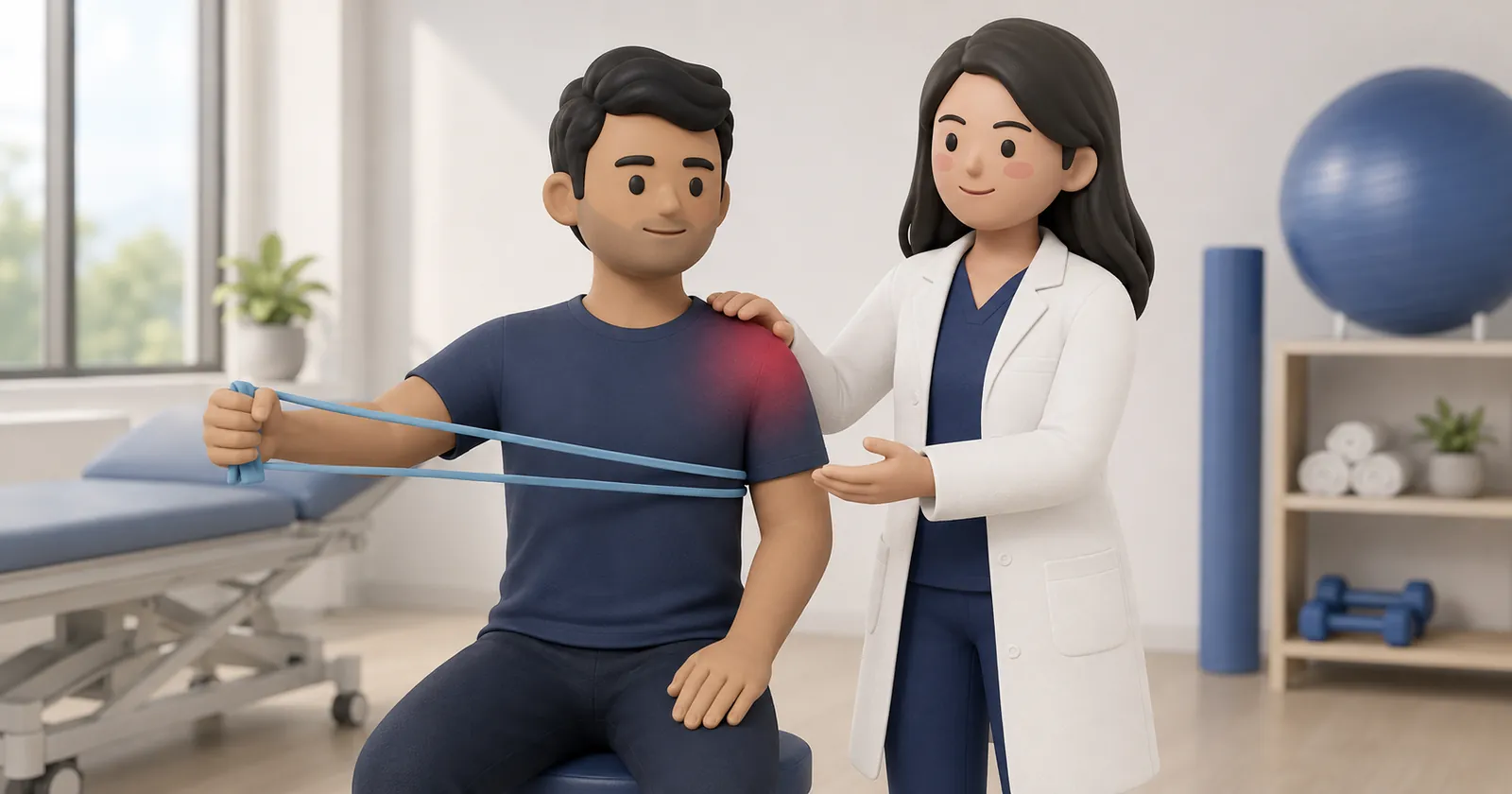
| Phase 1: Protection (Weeks 0 to 4-6) | Abduction sling worn 24/7 except for hygiene and prescribed home therapy. | Passive Range of Motion (PROM) only: pendular Codman exercises, supine passive forward elevation with therapist or pulley, active elbow, wrist, and hand exercises. | No active shoulder movement, no reaching behind back, no lifting objects over 200 grams, no weight bearing through arm. | |
| Phase 2: Active-Assisted (Weeks 6 to 10) | Sling discontinued based on orthopedic clearance. | Active-Assisted Range of Motion (AAROM) using a cane/wand, table slides, supine active elevation progressing to standing, isometric scapular retraction. | No sudden jerky movements, no heavy pushing or pulling, no aggressive internal rotation behind the back. | |
| Phase 3: Initial Strengthening (Weeks 10 to 14) | Full independent use for light activities of daily living. | Progressive isometric rotator cuff activation, light resistance band internal/external rotation, prone horizontal abduction, serratus anterior wall slides. | No overhead weight lifting, no throwing sports, no resisted bench press. | |
| Phase 4: Advanced Strengthening (Weeks 14 to 24) | None. | Eccentric rotator cuff strengthening, plyometric ball tosses, sports-specific and occupational movement drills. | Avoid uncontrolled impact loading until 6 months post-repair. |
During Phase 1, patients often attempt to assist movement using their own shoulder muscles. True passive forward flexion requires the shoulder muscles to remain completely silent while the physiotherapist or an external wand lifts the arm.
Sling management and sleep positioning
Sleeping supine is often painful after shoulder surgery because the humeral head drops posteriorly, creating traction on the repaired tendon. Clinicians recommend the following nighttime adjustments:
- Reclined Sleeping Position: Sleep in a semi-upright recliner chair or elevate the head of the bed with 3 pillows at a 30 to 45 degree angle for the first 3 to 4 weeks.
- Elbow Pillow Support: Place a small pillow under the elbow of the operated arm when resting supine. This holds the arm slightly anterior to the scapular plane, neutralizing rotator cuff tension.
- Abduction Wedge Maintenance: Keep the bolster pillow attached to the sling. The abduction wedge unloads the critical avascular zone of the supraspinatus tendon by preventing the arm from resting tightly against the torso.
Managing scapular dyskinesis during recovery
Prolonged sling immobilization deconditions the serratus anterior and lower trapezius, causing the shoulder blade to wing or shrug abnormally during attempted arm elevation. Incorporating gentle scapular setting (pinching shoulder blades down and back without activating the deltoid) restores proper scapulohumeral rhythm before active arm lifting commences.
Frequently asked clinical questions
When can I drive after rotator cuff repair surgery in India?
Driving is generally prohibited while wearing the abduction sling (the first 4 to 6 weeks) because emergency evasive steering is impossible. Most surgeons allow driving automatic cars once the sling is removed and active range of motion is restored, typically around weeks 7 to 8.
What are the signs of a rotator cuff repair failure or re-tear?
A sudden sharp pop followed by severe recurrent pain, loss of previously achieved passive elevation, and inability to maintain the arm in an elevated position (positive drop arm sign) warrant immediate re-examination with your treating orthopedic surgeon.
Evidence sources and clinical references
- American Journal of Sports Medicine: Rehabilitation protocols following arthroscopic rotator cuff repair: https://ajsm.sagepub.com
- Journal of Shoulder and Elbow Surgery: Systematic review of post-operative cuff therapy: https://jshoulderelbow.org
- Indian Association of Physiotherapists: Guidelines for Post-Surgical Upper Limb Rehabilitation: https://physiotherapyindia.org
Related condition guides

Related recovery guides & articles
BookPhysio.in Editorial Team
The BookPhysio.in editorial team writes and maintains this content, checking it against reliable clinical sources. Content follows our medical review policy: general information only, and no page claims a clinical review until a named registered physiotherapist has signed it off.
Read our medical review policy