
Total knee replacement physiotherapy at home: recovery milestones and exercises
In short
Recovering from total knee arthroplasty requires structured daily physiotherapy from the moment you return home. Discover realistic week-by-week knee bend milestones, safe home exercises, and how home-visit sessions restore independence.
In this guide (5 sections)
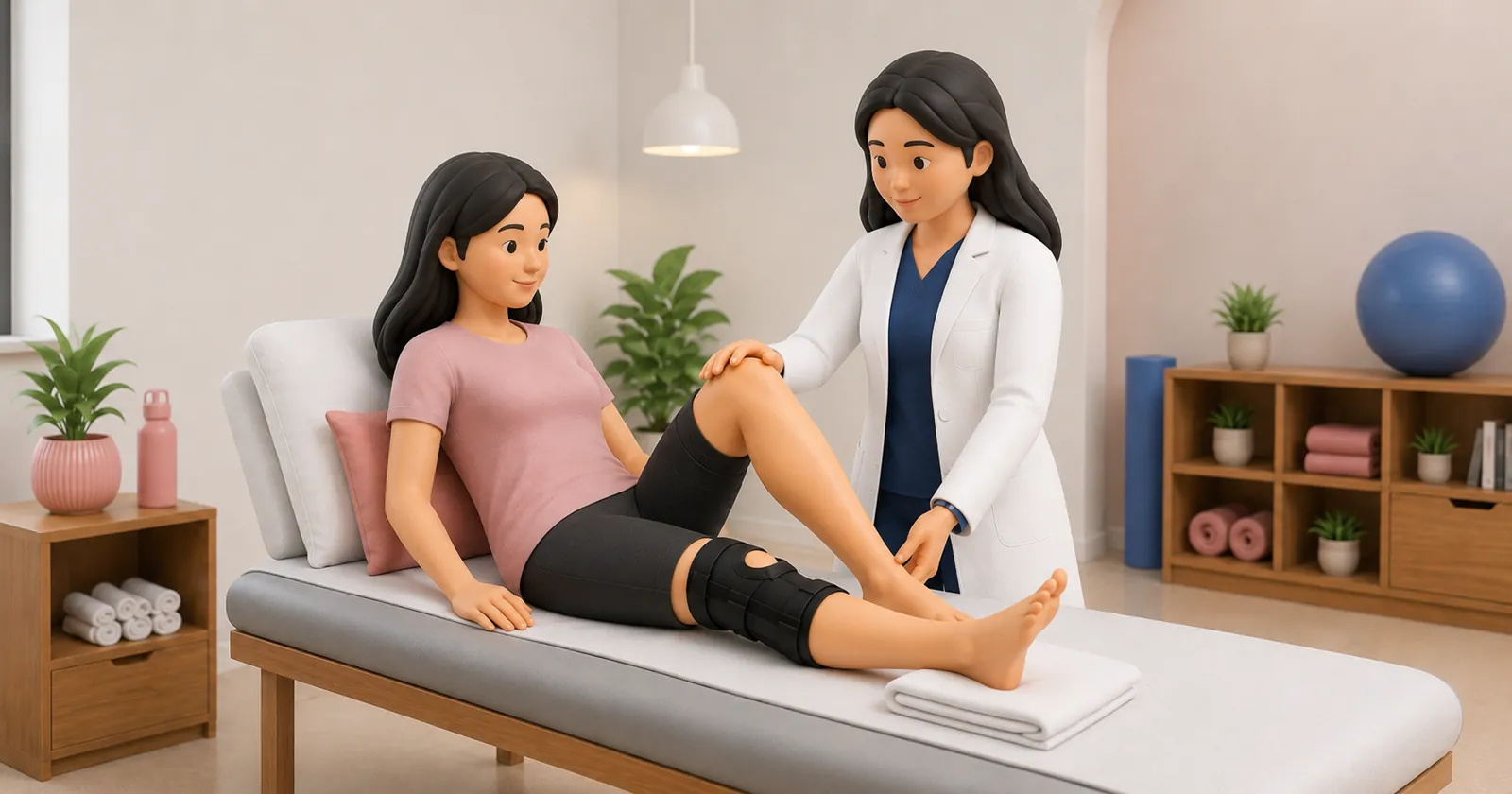
Total Knee Arthroplasty (TKA) successfully eliminates severe arthritic joint pain, but your eventual walking distance, stair mobility, and knee flexibility are determined by your post-surgical rehabilitation. Beginning guided home physiotherapy within 48 hours of hospital discharge protects surgical wound healing while restoring critical quadriceps activation and joint range of motion.
Week-by-week recovery milestones after knee replacement
| Recovery Stage | Target Range of Motion | Key Functional Milestone | Usual Assistive Device |
|---|---|---|---|
| Weeks 1 to 2 | 0 degrees extension, 80 to 90 degrees flexion | Independent bed transfers, safe bathroom visits | Standard rigid walking frame (walker) |
| Weeks 3 to 4 | 0 degrees extension, 100 to 110 degrees flexion | Active straight leg raise with zero lag, indoor walking | Transitioning to elbow crutches or quad cane |
| Weeks 5 to 6 | 0 degrees extension, 115 to 120 degrees flexion | Reciprocal stair climbing, outdoor garden walking | Single point walking stick or independent gait |
| Weeks 7 to 12 | Full comfortable flexion, normal gait symmetry | Returning to driving, community shopping, low-impact exercise | Independent walking without mobility aids |
Managing post-operative joint swelling effectively
Severe swelling is the primary physical block that prevents your knee from bending comfortably. Clinicians recommend applying a gel ice pack wrapped in a thin cotton cloth for 15 to 20 minutes every 3 to 4 hours, combined with elevating your lower leg above heart level while resting in bed. Controlling joint effusion allows faster quadriceps reactivation.
Foundational home rehabilitation exercises
Static Quadriceps Sets with Terminal Extension
Objective: Reactivate the vastus medialis and ensure full zero-degree knee straightening.
- 1Lie flat on your back on a firm bed with your operative leg extended straight.
- 2Place a small rolled washcloth under your ankle to allow your knee to hang straight.
- 3Tighten your front thigh muscles, pressing the back of your knee firmly down into the bed.
- 4Hold the firm contraction for 5 full seconds while breathing steadily.
- 5Release gently and rest for 3 seconds.
Active-Assisted Heel Slides for Knee Flexion
Objective: Gradually increase knee bend angle without putting strain on the surgical incision.
- 1Sit upright on your bed with legs extended forward.
- 2Loop a long towel or bedsheet around the sole of your foot on the operative side.
- 3Gently slide your heel backward toward your buttock, using the towel to provide smooth assistance.
- 4Stop when you feel a firm stretch across the front of the knee without sharp pain.
- 5Hold for 5 seconds, then slowly slide the foot back down straight.
Surgical wound care and deep vein thrombosis safety
Keep the surgical dressing dry until staples or sutures are removed by your surgeon. Check your calf daily for signs of deep vein thrombosis (DVT): redness, tenderness, warmth, or sudden asymmetrical swelling. Continue wearing compression stockings and performing regular ankle pumps as advised by your surgical team.
How many home physiotherapy sessions are needed after knee replacement?
Most patients benefit from 12 to 18 home sessions spanning 4 to 6 weeks, transitioning to outpatient clinic visits or independent home exercise once walking independently.
Is a CPM (Continuous Passive Motion) machine mandatory at home?
No. Major orthopedic trials demonstrate that active-assisted physiotherapy achieves equal or superior long-term range of motion compared to passive mechanical machines.
Evidence reviewed 25 September 2026. General information only.
Sources reviewed
American Association of Hip and Knee Surgeons (AAHKS) Postoperative Guidelines; British Association for Surgery of the Knee (BASK); Indian Orthopaedic Association Arthroplasty Consensus.
Related condition guides


BookPhysio.in Editorial Team
The BookPhysio.in editorial team writes and maintains this content, checking it against reliable clinical sources. Content follows our medical review policy: general information only, and no page claims a clinical review until a named registered physiotherapist has signed it off.
Read our medical review policy