
Working from Bed and Couch Posture: Relieving Thoracic Spine Stiffness and Interscapular Pain
In short
Working with a laptop propped on your lap in bed or sunk into a soft sofa locks the thoracic spine into persistent kyphosis. Learn how thoracic extension drills, foam rolling, and WFH support setups relieve mid-back burning.
In this guide (5 sections)
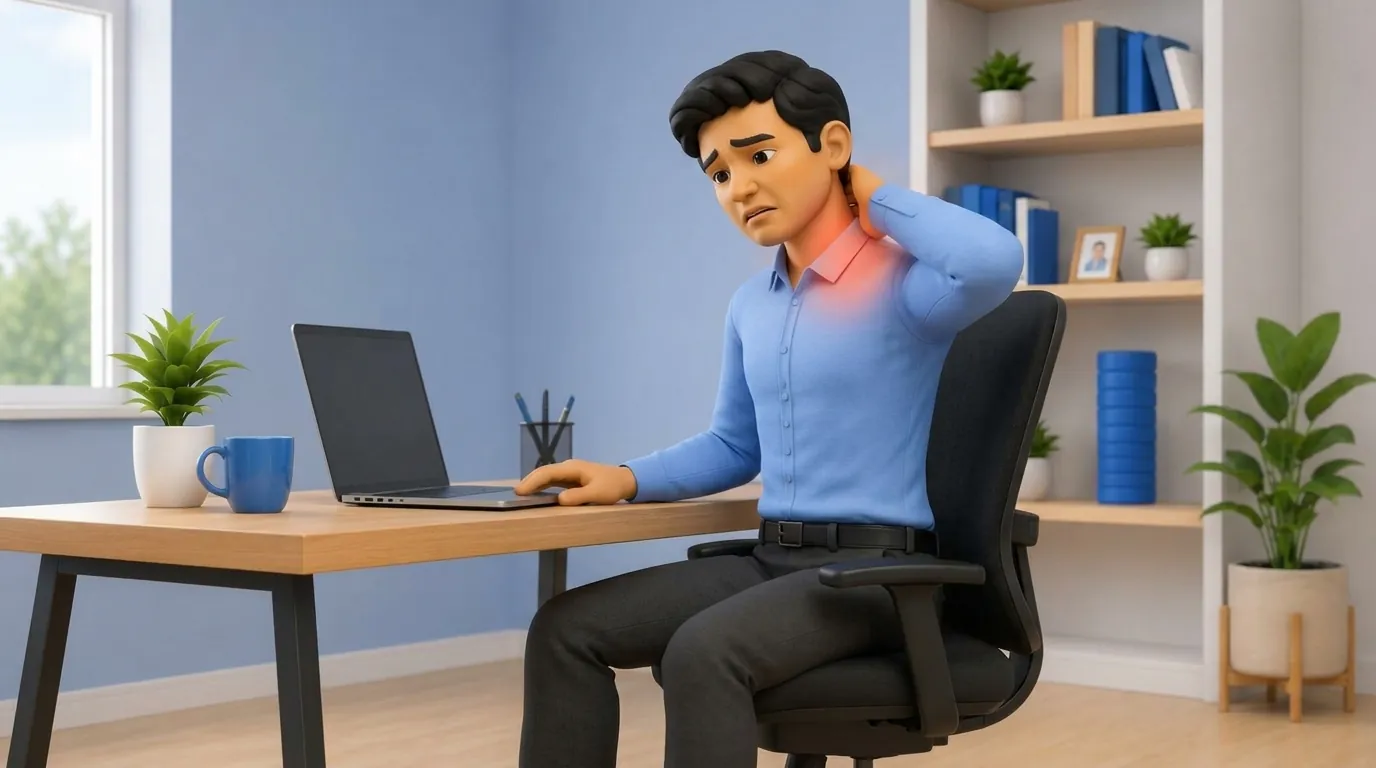
The permanent adoption of remote and hybrid work models across the Indian technology, consulting, and corporate sectors has introduced a pervasive ergonomic crisis: the informal bed-and-sofa workstation. Without dedicated home office furniture, millions of remote workers spend 6 to 10 hours daily hunched over laptops balanced on their knees, propped against soft bedroom pillows, or sunk deeply into cushioned living room couches. While initially comfortable, this soft, unsupportive environment is biomechanically catastrophic for the mid-back and rib cage.
The primary casualty of working from a bed or sofa is the thoracic spine: the 12 vertebrae (T1 to T12) that connect with the rib cage to protect vital cardiopulmonary organs. When you sit on a soft surface, your pelvis collapses into a posterior slump, forcing the thoracic spine into exaggerated, continuous C-shaped kyphosis. Over weeks of daily telecommuting, this leads to painful interscapular burning (pain between the shoulder blades), rib joint dysfunction (costovertebral subluxation), restricted breathing mechanics, and stubborn upper back stiffness.
1. Pathomechanics: Creep, Ligamentous Strain, and Respiratory Restriction
The thoracic spine is inherently less mobile than the cervical or lumbar spine due to the rigid bony cage formed by the ribs and sternum. However, it requires healthy extension and rotational mobility to support head posture and upper limb movement.
When sitting in bed with your back propped against soft pillows, the lumbar spine completely loses its natural lordosis. To keep your eyes focused on a low laptop screen, your thoracic spine bows outward into severe hyper-kyphosis. This posture exerts intense, unrelenting tensile strain on the posterior spinal ligaments: the supraspinous ligament, interspinous ligaments, and posterior longitudinal ligament. Under prolonged static load, these collagenous tissues undergo mechanical creep: they deform and lose their elasticity, leaving the spine feeling stiff, tight, and fatigued.
Concurrently, the interscapular muscles: the rhomboids, middle trapezius, and thoracic erector spinae, are held in an over-stretched, ischemic state, producing that familiar, agonizing burning ache between the shoulder blades at 4:00 PM. Furthermore, hyper-kyphosis compresses the anterior rib cage, restricting normal diaphragmatic excursion and reducing forced vital capacity (lung volume) by up to 15% to 20%. Workers frequently report shallow breathing, midday mental lethargy, and unexplained fatigue, completely unaware that their slumped sofa posture is restricting their oxygenation.
2. Bed vs Sofa vs Ergonomic Desk Biomechanical Comparison
Examining the mechanical forces across different home workstations clarifies why informal work surfaces cause persistent musculoskeletal breakdown:
| Biomechanical Parameter | Working from Bed (Propped on Pillows) | Working from Soft Living Room Couch | Dedicated Desk & Ergonomic Chair |
|---|---|---|---|
| Pelvic Orientation & Lumbar Support | Severe posterior pelvic tilt; legs extended straight forward on mattress tighten hamstrings | Pelvis sinks deep into soft cushions; knees sit higher than hips, accentuating lumbar flattening | Pelvis stabilized in neutral anterior tilt; hips at 90° to 100° with feet supported flat on the floor |
| Thoracic Kyphosis & Rib Cage Position | Exaggerated C-shaped kyphosis; severe compressive load across anterior vertebral bodies | Asymmetrical side-slumping against couch armrest; creates torsional rib cage shear | Natural gentle thoracic curve; ribs expand freely during three-dimensional diaphragmatic breath |
| Cervical Spine Compensatory Strain | Extreme forward head tilt (>45°) looking down at laptop resting on thighs or lap | Neck cocked forward and rotated to one side if working from a low coffee table | Head balanced in vertical alignment with eyes level with the top third of the monitor |
| Shoulder Girdle & Scapular Load | Arms reach forward unsupported; levator scapulae and upper trapezius bear full arm weight | Elbows elevated awkwardly on soft couch armrests or reaching down to coffee table | Forearms rest comfortably on height-adjustable armrests; shoulder girdle completely unloaded |
| Recommended Maximum Usage Window | Maximum 20 to 30 minutes for urgent evening emails; never for a full 8-hour workday | Maximum 30 to 45 minutes for phone meetings; highly destructive for continuous typing | Sustainable for full 8 to 10-hour workdays when combined with regular hourly micro-breaks |
3. Three-Phase Thoracic Spine De-Stiffening Protocol
To reverse the thoracic stiffness accumulated from remote working, you must actively restore extension and rotational mobility while building endurance in the neglected middle trapezius and rhomboids.
Three-Phase Thoracic Extension and Rotational Mobilization Protocol
Objective: Mobilize hypomobile thoracic vertebral segments, restore costovertebral gliding, and strengthen interscapular stabilizers.
- 1Phase 1 (Thoracic Extension on Foam Roller or Rolled Towel): Place a foam roller or firm rolled towel horizontally across your mid-back while lying supine with knees bent. Support your head with your hands. Gently arch your upper back over the roller, exhaling deeply. Hold for 5 seconds; roll to 3 distinct levels along the mid-back (avoid the lower back). Perform 5 extensions per level.
- 2Phase 2 (Side-Lying Open Book Rotations): Lie on your side with hips and knees bent to 90 degrees to lock the lumbar spine. Extend both arms straight in front of you. Slowly sweep your top arm up and across your body toward the opposite floor, rotating through your rib cage while keeping your knees glued together. Follow your hand with your eyes. Hold for 5 seconds; complete 10 repetitions per side.
- 3Phase 3 (Prone Scapular Y-T-W Retractions): Lie prone on the floor with your forehead resting on a small towel. Form a "Y" shape with your arms, thumbs pointing toward the ceiling. Lift arms 5 cm off the floor by squeezing your lower shoulder blades together. Repeat in a "T" position (middle trapezius) and a "W" position (rhomboids). Hold each for 5 seconds; complete 8 repetitions.
- 4Hourly Mid-Back Reset Drill: Every hour, stand tall, interlace your fingers behind your head, gently pull your elbows backward, and look up toward the ceiling while taking three slow, deep diaphragmatic breaths.
4. Temporary Ergonomic Hacks When Working from Bed or Sofa Is Unavoidable
If temporary living arrangements or travel require working without a formal desk, deploy these critical ergonomic modifications:
- Firm Back Wedge and Lumbar Roll: Never lean against soft squishy sleeping pillows. Use a firm triangular orthopaedic foam wedge cushion against the headboard, and place a rolled towel firmly behind your lower back to maintain lumbar lordosis.
- Lap Desk with Inclined Surface: Never place a hot laptop directly on your blanket or thighs. Deploy a sturdy lap desk with foldable legs and an inclined surface to raise the screen closer to eye height.
- Bend Your Knees with a Pillow Bolster: When sitting in bed, never keep your legs locked straight out in front of you; this severely tightens the hamstrings and forces pelvic slumping. Place a firm pillow or bolster under your knees to keep them comfortably bent at 45 degrees.
- External Peripherals Are Mandatory: Even when working from a couch, plug in an external compact keyboard and mouse. Place the laptop on a coffee table or stack of books at eye height, keeping the keyboard on your lap.
Frequently Asked Questions
Why do I feel sharp pain between my shoulder blades when taking a deep breath after WFH?
Sharp interscapular pain during deep inspiration is typically caused by Costovertebral Joint Dysfunction. Each of your 12 thoracic ribs connects to the spine at two tiny facet joints. When sustained thoracic slumping locks these joints in a rigid position, the rib cannot glide smoothly as your chest expands, triggering an acute, sharp pinching sensation during deep breathing.
Can working from bed cause permanent hunchback posture (kyphosis)?
In adults, working from bed rarely causes permanent structural bony deformity (such as Scheuermann disease). However, it causes severe functional postural kyphosis through ligamentous creep and muscular adaptation. The anterior chest muscles (pectoralis major and minor) shorten permanently, while the posterior thoracic extensors atrophy. Fortunately, this functional kyphosis is fully reversible with dedicated thoracic mobilization and postural strengthening.
What is the best mattress firmness for people who frequently work from bed in India?
If you work from bed, a medium-firm orthopaedic mattress (coir-foam hybrid or bonded foam) is far superior to an ultra-soft memory foam or plush spring mattress. Soft mattresses allow your hips to sink deep below your feet, exaggerating pelvic slump and spinal kyphosis. A medium-firm surface provides the necessary structural foundation to support your pelvis in neutral alignment.
How do I know if my upper back pain is musculoskeletal or related to my heart/lungs?
Musculoskeletal thoracic pain is mechanical: it changes intensity with specific body movements, spinal twisting, deep breathing, or direct pressure over the interscapular muscles. In contrast, cardiac or pulmonary pain is non-mechanical: it presents with crushing central chest pressure, shortness of breath, cold sweats, or pain radiating into the left jaw or arm. Any unexplained chest tightness warrants immediate medical emergency care.
How does BookPhysio.in support remote workers dealing with WFH spine pain?
BookPhysio.in connects remote workers across Indian tech hubs with licensed musculoskeletal physiotherapists who specialize in telecommuting ergonomics, manual thoracic mobilization, and home exercise rehabilitation. Book clinic consultations or home visits with transparent per-session fees (₹400 to ₹1,500 clinic, ₹600 to ₹2,000 home visits) and zero platform commission.
Related condition guides


BookPhysio.in Editorial Team
The BookPhysio.in editorial team writes and maintains this content, checking it against reliable clinical sources. Content follows our medical review policy: general information only, and no page claims a clinical review until a named registered physiotherapist has signed it off.
Read our medical review policy