
Scoliosis Physiotherapy and the Schroth Method: 3D Curve Correction and Postural Rehabilitation in India
In short
Scoliosis involves complex three-dimensional spinal curvature. Discover Cobb angle classification, rotational angular breathing, the Schroth Method, and specialized physio.
In this guide (5 sections)
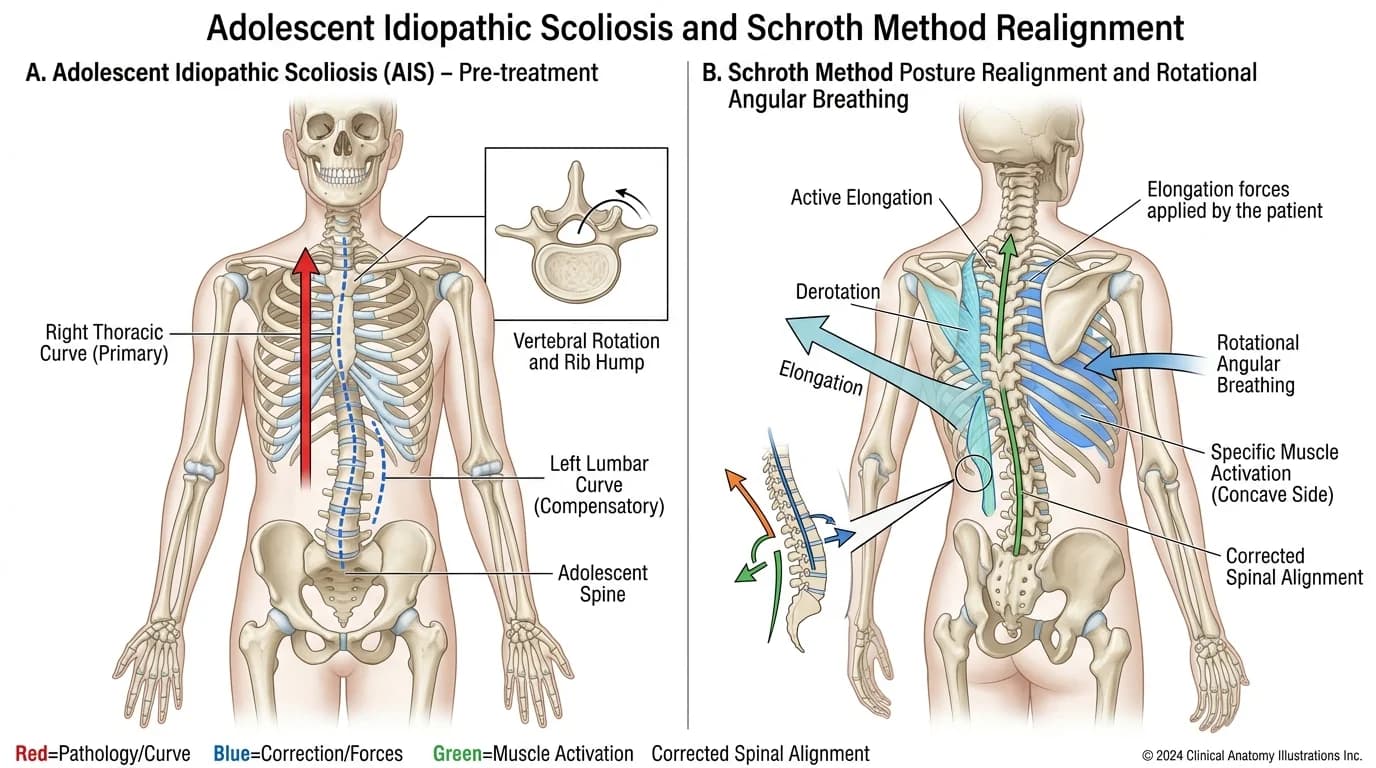
Scoliosis is frequently misunderstood as a simple two-dimensional lateral curvature of the spine. In reality, scoliosis is a complex, three-dimensional torsional deformity involving lateral deviation in the frontal plane, alteration of natural sagittal curves (often thoracic hypokyphosis or 'flat back'), and axial vertebral rotation in the transverse plane. As the vertebrae rotate, the ribs attached to them are pushed backward on the convex side, producing the characteristic visible 'rib hump'.
In India, adolescent idiopathic scoliosis (AIS) accounts for roughly 80 percent of all scoliosis cases, emerging during the rapid pubertal growth spurt between 10 and 15 years of age, with girls disproportionately affected by progressive curves. An outdated and dangerous historical approach was 'wait and see': waiting until a mild 15-degree curve progressed to a severe 40-degree surgical deformity. Today, the international Society on Scoliosis Orthopaedic and Rehabilitation Treatment (SOSORT) mandates early conservative intervention through Physiotherapeutic Scoliosis-Specific Exercises (PSSE), led by the gold-standard Schroth Method.
1. Cobb Angle Classification and SOSORT Clinical Guidelines
Scoliosis severity is quantified on full-spine standing radiographs using the Cobb angle: measured between the most tilted superior and inferior end-vertebrae of the curve. Skeletal maturity is simultaneously evaluated using the Risser sign (ossification of the iliac crest apophysis) or Sanders staging.
| Cobb Angle Range | Clinical Classification | Progression Risk During Growth | Gold-Standard Treatment Protocol |
|---|---|---|---|
| 10 to 19 Degrees | Mild Scoliosis | Moderate (higher if Risser 0 with significant remaining skeletal growth) | Physiotherapeutic Scoliosis-Specific Exercises (PSSE / Schroth); clinical monitoring every 6 months |
| 20 to 39 Degrees | Moderate Scoliosis | High risk of rapid progression during pubertal growth velocity peaks | Rigid 3D corrective bracing (e.g., Cheneau brace, 18-20 hrs/day) combined with intensive Schroth PSSE |
| 40 to 49 Degrees | Severe Scoliosis (Borderline) | Very high risk of ongoing adult progression (approx. 1 degree per year after maturity) | Full-time rigid bracing if skeletally immature; Schroth therapy; specialist orthopaedic surgical consultation |
| 50+ Degrees | Severe Surgical Scoliosis | Significant risk of cardiopulmonary compromise and chronic degenerative pain in adulthood | Surgical spinal fusion (posterior instrumented correction); pre- and post-operative functional physiotherapy |
2. Biomechanics of the Schroth Method: 3D Principles
Developed in Germany by Katharina Schroth and modernized into current clinical practice, the Schroth Method operates on three non-negotiable biomechanical principles: Auto-elongation, Deflection/Derotation, and Rotational Angular Breathing (RAB).
Traditional symmetrical gym exercises (like ordinary planks or pull-ups) can actually worsen scoliosis by strengthening already shortened, hypertonic muscles on the curve's concavity. In contrast, Schroth exercises are strictly curve-pattern specific. The patient uses visual feedback from mirrors, sensory proprioceptive cues, and specialized breathing mechanics to expand the collapsed, concave areas of the ribcage while isometrically stabilizing the overstretched convex musculature.
3. Three-Phase Schroth-Informed Exercise Protocol
These foundational corrective movements train the patient's brain to internalize corrected 3D spinal alignment during daily activities.
Phase 1: Active Axial Auto-Elongation (Unloading the Curve)
Objective: Decompress the intervertebral discs and elongate the collapsed curve using active cranial axial traction.
- 1Sit tall on a firm, flat stool in front of a mirror with feet planted shoulder-width apart.
- 2Ground your sit bones firmly into the stool.
- 3Actively imagine a string pulling the crown of your head straight upward toward the ceiling, lengthening your entire spine.
- 4Tuck your chin slightly while maintaining relaxed shoulders.
- 5Observe in the mirror how axial elongation naturally reduces the lateral deviation of your trunk.
- 6Maintain this lengthened posture for 30 seconds while breathing normally.
Phase 2: Rotational Angular Breathing (RAB) in Side-Lying
Objective: Use targeted intra-thoracic air pressure to derotate the vertebrae and expand the concave rib collapse.
- 1Lie on your side with the convex rib hump resting on a small, firm rice bag or rolled towel (to block further outward bulging).
- 2Place your top hand on the sunken, collapsed concave area of your ribcage.
- 3Take a slow, deep breath in, mentally directing the incoming air specifically into the concave area beneath your hand.
- 4Feel the collapsed ribs expand outward and upward against your hand, de-rotating the twisted spine from the inside.
- 5Exhale slowly while isometrically maintaining that expanded shape through deep abdominal core activation.
Phase 3: Prone Muscle Cylinder (Convexity Isometric Stabilization)
Objective: Isometrically strengthen the deep spinal stabilizers and trapezius on the concave side to prevent curve collapse.
- 1Lie prone on a firm mat with a small pillow under your abdomen to flatten excess lumbar lordosis.
- 2Extend your arm on the concave side forward and diagonally outward at a 45-degree angle.
- 3Perform auto-elongation through the crown of your head.
- 4Lift your extended concave-side arm 5 to 10 centimetres off the floor while maintaining thoracic derotation.
- 5Hold for 5 seconds, feeling the deep periscapular and paraspinal muscles fire, then lower smoothly.
While most adolescent scoliosis is idiopathic, rapid curve progression or atypical presentations warrant immediate neurological imaging (MRI of the whole spine). Red flags include: severe, persistent nocturnal spinal pain; left-sided thoracic curves (which have a higher association with underlying pathology); abnormal neurological reflexes; progressive muscle weakness in the lower limbs; or midline cutaneous markers such as hairy patches or dimples over the sacrum indicating occult spinal dysraphism.
4. Clinical Settings and Transparent Fee Standards in India
Because the Schroth Method requires specialized wall bars, physiological positioning blocks, corrective belts, and full-length mirrors, initial assessment and technique mastery are best conducted in a specialized outpatient physiotherapy clinic. Once the patient and parents master the curve-specific corrections, home-visit physiotherapy provides essential guidance in integrating 3D postural corrections into school study desk setups, backpack carrying, and daily habits.
In Indian metropolitan areas, specialized scoliosis physiotherapy sessions typically range from ₹500 to ₹1,800 per session. In-home physiotherapy sessions range from ₹700 to ₹2,000 depending on clinical expertise and travel distance. Transparent direct payments ensure clinical trust.
5. Frequently Asked Questions Regarding Scoliosis Physiotherapy
Can physiotherapy completely straighten a scoliotic spine?
Physiotherapy cannot magically make a structural scoliotic curve completely zero degrees. However, in mild to moderate adolescent scoliosis (curves under 30 degrees), evidence-based Schroth PSSE can halt curve progression, prevent the need for surgical fusion, achieve significant Cobb angle reductions of 5 to 15 degrees, and dramatically improve cosmetic trunk symmetry and breathing capacity. In adults, therapy eliminates chronic postural pain and prevents degenerative progression.
At what age should an adolescent be evaluated for scoliosis in India?
Adolescents should be screened during routine annual wellness checks between the ages of 10 and 14, which corresponds to the peak pubertal growth spurt. Parents can perform the simple Adam's Forward Bend Test at home: have the child bend forward at the waist with knees straight and palms hanging together. If you observe any unevenness, one shoulder blade sticking out higher than the other, or a noticeable rib hump on one side, consult a physiotherapist or orthopaedic specialist immediately.
Is yoga safe for someone with scoliosis?
Standard, unguided yoga can be problematic for structural scoliosis. Symmetrical forward bending, deep spinal twists, or forceful backbends (like wheel pose) can inadvertently worsen spinal rotation by driving movement into the already hypermobile, convex curves. Modified, curve-specific therapeutic yoga guided by a qualified scoliosis practitioner: emphasizing spinal elongation and core stability: can be beneficial, but general group yoga classes should be approached with caution.
How many hours a day should my child wear a scoliosis brace?
If a rigid corrective brace (such as a Cheneau or Boston brace) is prescribed for a moderate curve (20 to 40 degrees) in a growing child, it must typically be worn between 18 and 23 hours per day to be effective. The brace must only be removed for bathing and performing prescribed Schroth physiotherapy exercises. Wearing a brace without performing specific exercises often leads to spinal muscle weakness and rapid curve relapse when the brace is eventually weaned off.
Can school backpacks cause structural scoliosis?
No. Carrying a heavy school backpack does not cause structural scoliosis: scoliosis is a complex genetic and neuro-osseous developmental disorder. However, carrying an excessively heavy backpack (exceeding 10 to 15 percent of body weight) or slinging a bag over one shoulder can cause significant postural fatigue, compensatory muscle strain, and accentuate spinal asymmetry. Children should always wear backpacks with both shoulder straps adjusted snugly against the upper back.
Related condition guides


BookPhysio.in Editorial Team
The BookPhysio.in editorial team writes and maintains this content, checking it against reliable clinical sources. Content follows our medical review policy: general information only, and no page claims a clinical review until a named registered physiotherapist has signed it off.
Read our medical review policy