
Heavy School Bag Syndrome in Indian Children: Forward Head Posture, Spinal Strain, and Physio Solutions
In short
Overloaded school bags weighing over 8 kg force children into dangerous forward head stooping. Discover pediatric ergonomic backpack rules and posture exercises.
In this guide (5 sections)
Every morning across Indian cities, a distressing spectacle unfolds on street corners, school bus stops, and metro stations. Young school children: aged barely 8 to 14 years: trudge forward heavily weighed down by immense backpacks bulging with thick textbooks, multiple subject notebooks, full water bottles, lunch tiffins, and heavy art supplies. In many urban schools, bag weights routinely measure between 7 and 12 kilograms: often exceeding 20 to 30 percent of the child's total body weight.
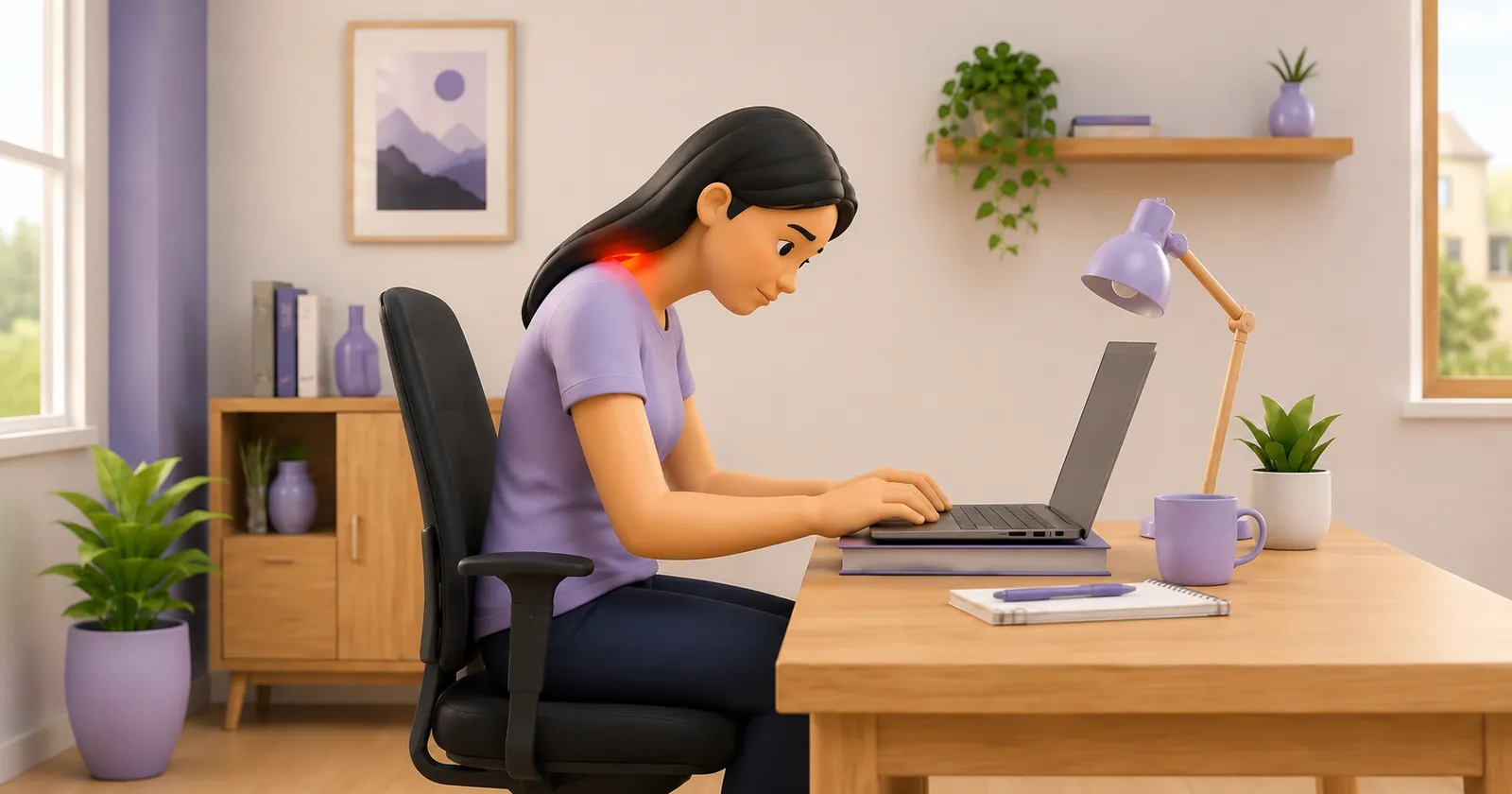
This severe overloading directly violates the Indian Ministry of Education's official guidelines, which mandate that school bags must never exceed 10 percent of a student's body weight. To counteract the immense backward gravitational pull of an overloaded bag, the child involuntarily throws their head forward, hunches their shoulders, and rounds their spine into a severe stoop. Over years of daily school commutes, this produces Heavy School Bag Syndrome: triggering early chronic neck pain, cervicogenic headaches, irreversible postural distortions, and structural spinal remodelling. Clinical paediatric physiotherapy provides the ergonomic rules and postural corrective exercises necessary to safeguard growing spines.
1. Biomechanics: Center of Mass Shift, Craniovertebral Angle, and Thoracic Kyphosis
In human posture, the spine functions as an upright mechanical pillar designed to maintain the body's Center of Mass (CoM) directly over the base of support. In an erect child, the head weighs approximately 4 to 5 kilograms, balanced effortlessly over the cervical spine. However, when a heavy backpack is slung across the shoulders, the external load shifts the entire body's Center of Mass backward toward the heels.
To avoid toppling backward, the developing nervous system adopts immediate compensatory kinematic shifts: 1. Forward Head Posture (FHP): the child thrusts the cervical spine forward and tilts the chin upward, sharply reducing the Craniovertebral Angle (CVA). Biomechanical research demonstrates that for every single inch the head shifts forward, the effective gravitational load on the posterior cervical musculature doubles! A 3-inch forward shift turns a 4.5-kilogram head into an agonizing 18-kilogram load on fragile upper trapezius and levator scapulae muscles.
2. Increased Thoracic Kyphosis: the mid-back hunches into an exaggerated round curve, compressing anterior vertebral growth plates (Scheuermann-like adaptations). 3. Brachial Plexus Compression: tight, narrow shoulder straps dig directly into the clavicular notch, compressing the neurovascular bundle: causing tingling, numbness, and cold fingers during the school commute.
| Bag Weight Percentage | Kinematic Postural Deviation | Spinal Biomechanical Strain | Clinical Paediatric Risk Level |
|---|---|---|---|
| <10% Child's Body Weight (Safe Limit) | Normal upright alignment; neutral craniovertebral angle | Symmetrical spinal loading; natural spinal shock absorption | Optimal; compliant with Ministry of Education guidelines |
| 11% to 15% Body Weight (Borderline) | Noticeable forward head tilt; slight rounded shoulders | Early cervical muscle spasm; mild upper back fatigue | Moderate; requires bag decluttering and strap adjustment |
| >20% Body Weight (Hazardous Overload) | Severe forward head stoop (>30°); pelvic anterior tilt; knee hyperextension | Extreme disc compression; risk of brachial plexus neuropraxia | Severe hazard; causes chronic cervicogenic headaches and postural deformity |
2. Indian School Realities: Heavy Textbooks, Lockers Absence, and Auto-Rickshaw Shakes
In the Indian schooling system, structural factors compound backpack burdens. Most Indian private and government schools do not provide individual student lockers, forcing children to carry their entire semester curriculum, multiple copies of reference guides, and separate homework notebooks back and forth every single day.
Furthermore, the daily school commute in shared auto-rickshaws, crowded private vans, or standing in public buses subjects heavily laden children to continuous jarring vibrations and sudden braking shocks. Children frequently sling their heavy bag over a single shoulder to squeeze into tight seats: introducing asymmetric lateral spinal shearing that encourages functional scoliotic listing.
Ergonomic reform begins with proactive parental audits: enforcing dual-strap wear, utilizing chest clips, packing the heaviest books closest to the spine, and liaising with school administrations to share textbook loads.
3. Three-Phase Postural Restoration and Back Strengthening Protocol
Three-Phase School Child Posture Reset and Spinal Extensor Protocol
Objective: Reverse forward head posture, strengthen mid-back scapular retractors, and master ergonomic backpack loading.
- 1Phase 1 (The Ergonomic Backpack Audit and Packing Formula - Daily): 1. The 10% Weight Rule: weigh your child on a bathroom scale, then weigh their packed school bag; if the bag exceeds 10% of their weight (e.g., more than 3.5 kg for a 35 kg child), remove non-essential books, stationery boxes, and pack an empty water bottle to fill at school. 2. Packing Physics: place the heaviest books (dictionaries, hardcovers) vertically against the BACK panel closest to the child's spine; pack light items (lunchbox, pencil pouch) in outer compartments. 3. Dual Padded Straps + Chest Clip: always wear BOTH shoulder straps adjusted snugly so the bag sits at mid-back level (2 inches above the waist); never let the bag sag down to the buttocks.
- 2Phase 2 (The Chin Tuck and Cervical Retraction Drill - Daily After School): 1. Double Chin Tucks: sit tall in a chair; look straight ahead; without tilting the head up or down, gently slide the chin straight backward like closing a drawer, creating a "double chin"; hold for 5 seconds; repeat 10 times; this fires the deep neck flexors to counteract forward head slouch. 2. Doorway Chest Stretch: stand in a doorway with forearms on the frame; step one foot forward gently until a comfortable stretch is felt across the chest pecs; hold for 20 seconds; repeat 3 times.
- 3Phase 3 (Prone Scapular "Y-T-W" Extensor Strengthening - 4 Days Weekly): 1. Prone "T" Lifts: lie face down on a mat with arms straight out to the sides at 90 degrees, thumbs pointing up toward the ceiling; squeeze shoulder blades together and lift arms 2 inches off the floor; hold 3 seconds; perform 2 sets of 10 repetitions. 2. Prone "Y" Lifts: move arms up into a "Y" shape (at 45 degrees); lift thumbs toward the ceiling; hold 3 seconds; 2 sets of 10 reps to strengthen the lower trapezius.
- 4Single Shoulder Rule: Never permit your child to carry their bag slung casually over one shoulder. Single-strap carrying produces immediate lateral spinal tilt and uneven shoulder heights.
4. Critical Red Flags: Recognizing Structural Scoliosis, Neuropathy, and Spondylolysis
While postural fatigue is common, certain symptoms indicate serious spinal pathology requiring immediate paediatric orthopaedic consultation. Seek specialist medical evaluation if you notice persistent numbness, pins-and-needles, or electric tingling shooting down your child's arms into their fingers (indicating severe Brachial Plexus traction neuropraxia or cervical nerve root impingement), visible structural asymmetry where one shoulder blade protrudes prominently like a wing or the ribcage twists unevenly when the child bends forward (warranting an Adams forward bend test to rule out Adolescent Idiopathic Scoliosis), constant night pain that awakens the child from sound sleep, or sharp, stabbing lower back pain aggravated by backward bending (suggestive of lumbar spondylolysis or pars fracture).
Frequently Asked Questions
Are rolling trolley bags better for school children than backpacks?
Trolley bags eliminate shoulder strain on flat airport-like floors, but they present significant hazards on Indian school campuses. Pulling a heavy trolley bag up flights of school stairs, across broken pavements, or hoisting it into high school buses forces the child to twist their spine asymmetrically, creating severe unilateral shoulder and back strain.
What is the maximum safe weight for a school bag according to Indian guidelines?
The Indian Ministry of Education and paediatric orthopaedic societies strictly recommend that a child's school bag must not exceed 10 percent of their total body weight. For instance, a child weighing 30 kilograms should never carry a bag exceeding 3 kilograms.
How does carrying a heavy bag cause frequent morning headaches in school children?
When a child stoops forward under a heavy bag, the suboccipital muscles at the base of the skull undergo continuous ischemic spasm to keep the eyes looking forward. These tense muscles compress the greater occipital nerve, triggering radiating tension headaches (cervicogenic headaches) behind the eyes and forehead.
How low should a school backpack hang on a child's back?
A backpack should never hang down around the child's buttocks or thighs. The bottom of the backpack should rest comfortably at the child's waistline, approximately 2 inches above the hip bones. Tighten the shoulder straps until the pack sits flush against the upper and mid-back.
How do I book a paediatric postural assessment through BookPhysio.in?
BookPhysio.in connects parents across major Indian cities with verified paediatric and musculoskeletal physiotherapists specializing in adolescent posture correction, scoliosis screening, and ergonomic back care. In-clinic sessions range from ₹400 to ₹1,500 and home visits range from ₹600 to ₹2,000, with direct per-visit payment and zero platform commission.
Related condition guides


BookPhysio.in Editorial Team
The BookPhysio.in editorial team writes and maintains this content, checking it against reliable clinical sources. Content follows our medical review policy: general information only, and no page claims a clinical review until a named registered physiotherapist has signed it off.
Read our medical review policy