
Text Neck Syndrome and Forward Head Posture in Tech Workers: Evidence-Based Clinical Exercises
In short
Prolonged forward head flexion while viewing smartphones or laptop monitors dramatically multiplies gravitational load on the cervical spine. Learn how structured deep cervical flexor endurance training, thoracic extension, and workstation adjustments relieve neck tension.
In this guide (5 sections)
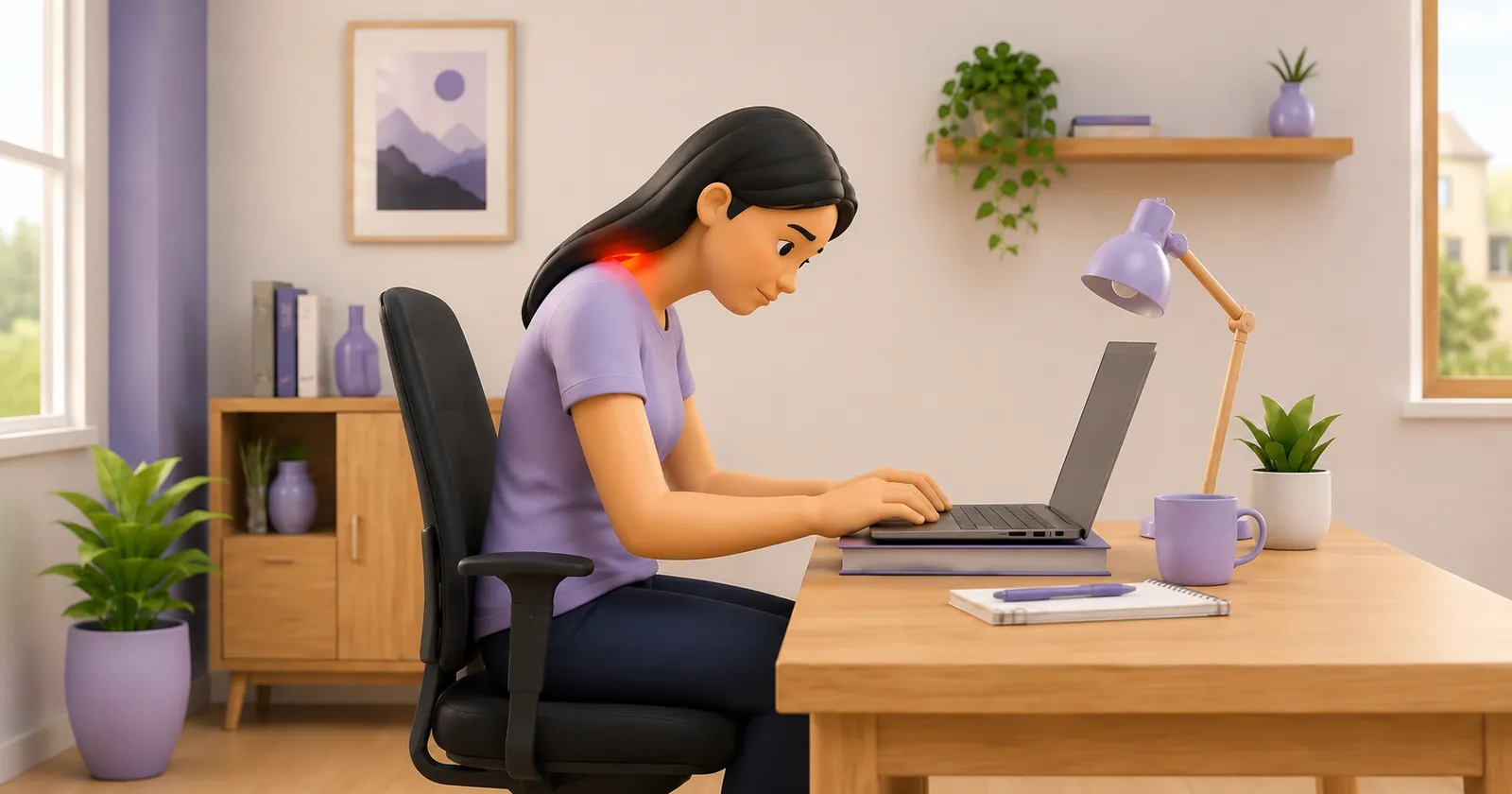
In an adult, the human head weighs approximately 4.5 to 5.5 kilograms when balanced in neutral vertical alignment over the cervical spine. However, as the head tilts forward, gravitational physics dramatically multiplies the effective mechanical torque exerted across the cervical vertebrae and surrounding posterior musculature. At a modest 15-degree forward angle, the effective load across the neck increases to approximately 12 kilograms. At a 45-degree angle, typical of typing on an unraised laptop, the load reaches 22 kilograms. At a 60-degree forward flexion angle, which is the standard posture when looking down at a smartphone resting in your lap, the gravitational load escalates to an astounding 27 kilograms. For Indian technology professionals in hubs like Bengaluru, Hyderabad, Pune, and Gurgaon who log 10 to 12 hours daily across multiple screens, this chronic mechanical overload causes severe cervical dysfunction.
This sustained postural distortion, universally recognized as Text Neck Syndrome, is not a simple cosmetic habit. It is an established neuromuscular pathology that leads to chronic suboccipital tension, premature cervical disc desiccation, facet joint arthropathy, and cervicogenic tension headaches. The human spine is marvelously engineered for dynamic movement, but prolonged static flexion places the cervical spine in a constant state of creep (plastic elongation of supporting ligaments) combined with chronic muscle ischemia.
1. Pathomechanics: Janda Upper Crossed Syndrome and Cervical Shear
From a biomechanical standpoint, text neck syndrome is the classic clinical manifestation of Vladimir Janda Upper Crossed Syndrome. In this predictable pattern of muscular imbalance, specific muscle groups become chronically hypertonic and shortened, while their reciprocal antagonists become lengthened, neurologically inhibited, and weak.
Specifically, the suboccipital muscle group (rectus capitis posterior and obliquus capitis), upper trapezius, levator scapulae, and sternocleidomastoid (SCM) remain in constant isometric contraction to prevent the head from collapsing further forward under gravity. Over time, these muscles develop painful myofascial trigger points that refer pain over the occiput and behind the eyes. Conversely, the deep cervical flexor muscles (the longus colli and longus capitis), which are responsible for stabilizing the anterior cervical curve and flattening the lower neck, become reciprocally inhibited and severely atrophied. Simultaneously, the middle and lower trapezius and rhomboids weaken, allowing the scapulae to protract and rotate downward.
This muscular failure shifts mechanical weight-bearing away from dynamic muscular shock absorbers directly onto the passive spinal structures. The lower cervical vertebrae (C5-C6 and C6-C7) experience severe anterior shear forces, accelerating degenerative disc thinning, osteophyte formation, and neuroforaminal narrowing.
2. Cervicogenic Headaches and the Trigeminocervical Complex
A major secondary complication of text neck syndrome among desk workers is recurrent cervicogenic headache, often mistaken for migraine or eye strain. The suboccipital nerves and upper cervical spinal nerves (C1, C2, and C3) converge anatomically with the spinal tract of the trigeminal nerve within the brainstem (the trigeminocervical nucleus). When hypertonic suboccipital muscles compress the greater occipital nerve, nociceptive signals are referred forward around the ear, across the temple, and directly behind the eye socket. Recognizing this mechanical origin is essential: analgesics provide temporary relief, but lasting resolution requires targeted cervical mobilization and deep flexor reactivation.
| Cervical Tilt Angle | Effective Head Weight | Typical Tech Activity | Primary Musculoskeletal Symptoms | Corrective Ergonomic Action |
|---|---|---|---|---|
| 0° (Neutral) | 4.5 to 5.5 kg | Standing with eyes level with horizon | Normal muscular tone; minimal disc pressure | Maintain natural lordotic curve with earlobes aligned over clavicles |
| 15° Forward | 12.2 kg | Desktop monitor placed slightly below eye level | Mild suboccipital tension, early upper trapezius tightness | Raise monitor stand by 5 to 8 cm; install external riser |
| 30° Forward | 18.1 kg | Typing on laptop screen placed flat on work desk | Interscapular burning, chronic levator scapulae tenderness | Deploy separate laptop riser and external ergonomic keyboard and mouse |
| 45° Forward | 22.2 kg | Reading tablet or mobile phone held at chest height | Cervicogenic headaches, reduced cervical rotation, mid-back aching | Hold mobile devices at chin height; support elbows on desk armrests |
| 60° Forward | 27.2 kg | Looking down at mobile phone held in lap or bed | Severe disc shear, nerve root irritation, C5-C6 tingling in fingers | Absolute elimination of lap texting; implement 20-20-20 postural reset breaks |
3. Three-Phase Clinical Rehabilitation Protocol
Reversing text neck requires a systematic, phased rehabilitation approach. Stretching tight muscles alone fails because inhibited deep stabilizers cannot sustain proper posture without specific motor control re-education.
Three-Phase Deep Cervical Flexor and Scapular Rehabilitation Protocol
Objective: Inhibit hypertonic suboccipital muscles, reactivate longus colli endurance, and rebuild postural scapular stability.
- 1Phase 1 (Week 1-2, Suboccipital De-toning and Supine Cranio-Cervical Nodding): Lie supine without a pillow. Keeping your head in contact with the mat, gently nod your chin down as if saying a subtle "yes" without engaging the superficial sternocleidomastoid muscles. Hold for 5 seconds; complete 3 sets of 10 repetitions twice daily.
- 2Phase 2 (Weeks 3-4, Seated Resisted Retraction and Wall Angels): Sit upright. Perform an active horizontal chin tuck, creating a subtle double chin. Place your palm against your forehead and apply gentle 30% isometric resistance without moving your head for 10 seconds. Pair with standing Wall Angels (elbows and wrists sliding against the wall to activate lower trapezius).
- 3Phase 3 (Weeks 5-6, Prone Cobra and Dynamic Scapulothoracic Integration): Lie prone with arms at your sides. Squeeze your shoulder blades together, rotate thumbs outward toward the ceiling, and lift your chest 5 cm off the floor while keeping your chin tucked. Hold for 15 seconds; perform 5 repetitions.
- 4Postural Reset Rule (The 20-20-20 Drill): Every 20 minutes of continuous screen time, look at an object 20 feet away for 20 seconds, roll your shoulders backward 3 times, and perform 3 slow cervical retractions.
4. Workstation Ergonomics for Indian IT and Remote Workspaces
Exercise rehabilitation is rapidly neutralized if your daily 10-hour workstation reinforces poor biomechanics. Implement these non-negotiable workstation adjustments:
- Screen Height Alignment: The top third of your primary computer monitor must sit directly level with your horizontal eye gaze when sitting tall. If using a laptop, an elevated laptop stand is mandatory.
- Peripheral Separation: Never type directly on an elevated laptop keyboard. Use an external USB or Bluetooth keyboard and separate mouse positioned so that your elbows rest naturally at a 90 to 100-degree angle with relaxed shoulders.
- Chair Lumbar Support and Armrest Contact: Adjust your ergonomic chair so your lumbar spine is supported. Keep armrests high enough to lightly support the forearms, offloading the weight of your shoulder girdle from the levator scapulae and upper trapezius.
- Smartphone Viewing Habits: When browsing or texting on mobile devices, raise the phone to eye level rather than dropping your chin. Rest your elbows on your rib cage or desk to support device weight comfortably.
Frequently Asked Questions
How long does it take to reverse text neck syndrome and forward head posture?
With consistent deep cervical flexor activation and workstation modifications, acute muscular neck ache and cervicogenic headaches typically improve within 2 to 3 weeks. However, true structural remodeling of postural motor patterns and connective tissue elongation generally requires 6 to 10 weeks of structured exercise. Chronic cases with established cervical spondylosis require long-term ergonomic maintenance to prevent symptom recurrence.
Do soft cervical collars help relieve text neck pain for software engineers?
We strongly advise against using soft cervical collars for postural neck strain during office work. While a collar may offer short-term psychological support, it promotes disuse atrophy of the deep cervical flexor and extensor muscles, worsening muscle weakness. Instead of passive immobilization, active rehabilitation focusing on chin tucks, scapular strengthening, and workstation adjustments provides lasting, evidence-based recovery.
What type of pillow is best for patients with text neck syndrome?
An orthopaedic contoured cervical pillow made of medium-density memory foam or natural latex is generally optimal. The pillow should provide a supportive contour that fills the hollow of the cervical lordosis while keeping the head in a neutral horizontal plane aligned with the thoracic spine. Avoid excessively thick, fluffy pillows that force the neck into sustained forward flexion when sleeping on your back.
When does neck pain from computer use indicate a serious cervical disc herniation?
If your neck pain is accompanied by sharp electrical shooting pain radiating past your elbow into the forearm, hand, or fingers, accompanied by numbness, tingling, or weakness in your grip or pinch strength, you may have cervical radiculopathy caused by nerve root compression. Any progressive hand weakness or loss of coordination warrants immediate evaluation by a qualified physiotherapist or spine specialist.
How does BookPhysio.in assist tech professionals suffering from neck pain?
BookPhysio.in connects IT professionals across Bengaluru, Hyderabad, Pune, Mumbai, Delhi NCR, and Chennai with verified musculoskeletal physiotherapists specializing in ergonomic and postural rehabilitation. You can book clinic consultations or convenient home visits with transparent per-session fees (₹400 to ₹1,500 in clinic, ₹600 to ₹2,000 for home visits) and zero platform commission, ensuring personalized, unhurried one-on-one clinical care.
Related condition guides

BookPhysio.in Editorial Team
The BookPhysio.in editorial team writes and maintains this content, checking it against reliable clinical sources. Content follows our medical review policy: general information only, and no page claims a clinical review until a named registered physiotherapist has signed it off.
Read our medical review policy