
Cervicogenic Headaches: How Neck Physiotherapy Relieves Chronic One-Sided Head Pain
In short
Chronic one-sided headaches radiating from the base of the skull into the temple and eye frequently originate in the upper cervical spine. Learn how C1-C2 joint mobilization and deep neck flexor exercises relieve cervicogenic headaches.
In this guide (5 sections)
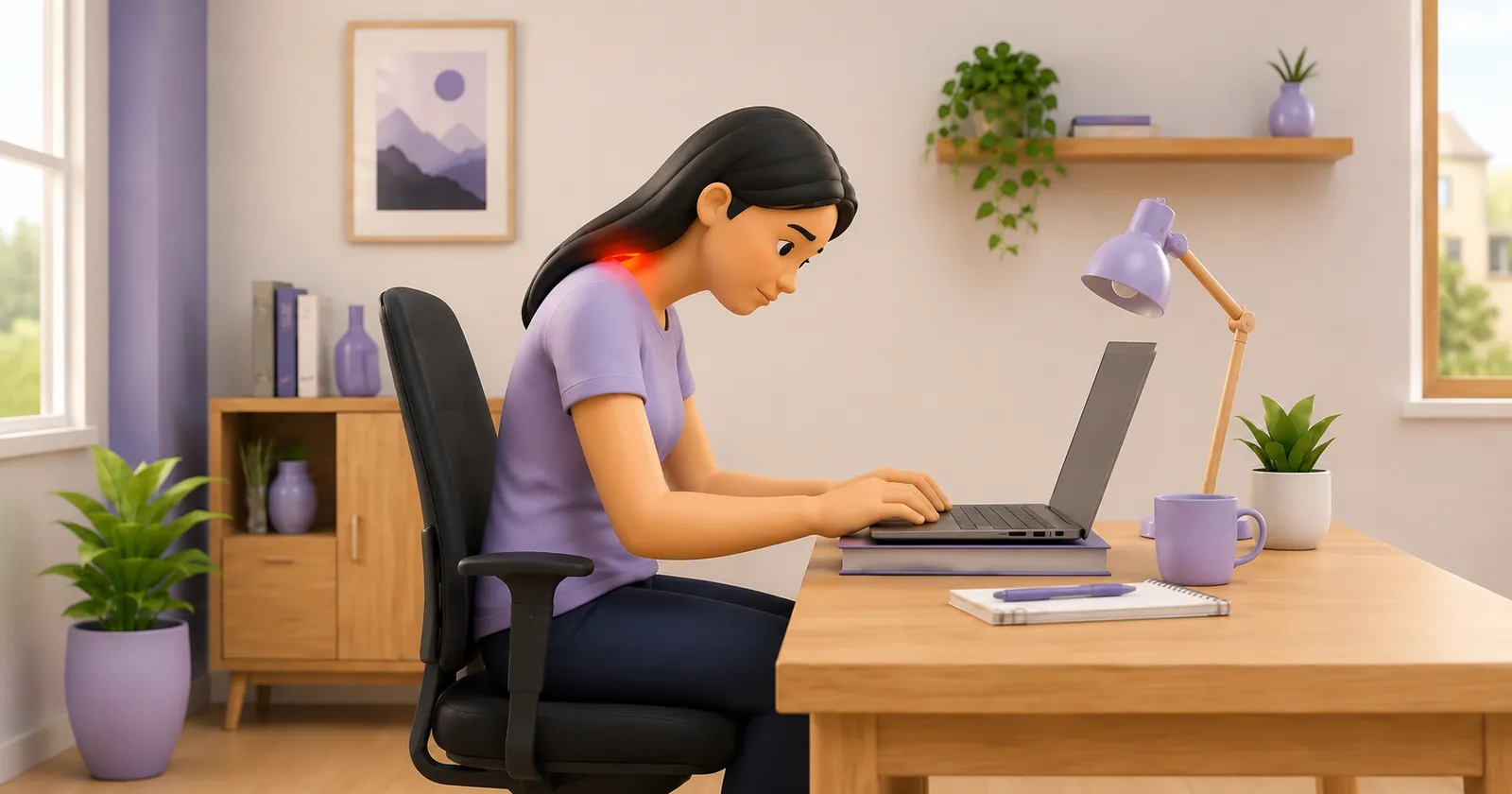
Chronic, recurrent headaches represent one of the most widespread and debilitating pain complaints in urban India. Millions of corporate professionals, software engineers, and homemakers spend years visiting neurologists, taking heavy preventative migraine medications, and undergoing repeated brain MRI scans, only to find that their headaches persist relentlessly. In a vast proportion of these cases, the pain does not originate inside the brain at all: it is a Cervicogenic Headache (CGH), a secondary headache originating from mechanical dysfunction in the upper cervical spine.
A cervicogenic headache is characterized by a unilateral (strictly one-sided) headache that originates at the base of the skull (suboccipital region) and spreads forward across the temple, ear, and directly behind the eye socket. It is consistently triggered or worsened by specific sustained neck postures: such as peering down at laptop monitors, driving in stop-and-go traffic, or awkward sleeping positions. Clinical research demonstrates that targeted manual cervical mobilization combined with deep cervical flexor retraining completely resolves cervicogenic headaches in over 85% of cases without long-term medication.
1. Pathophysiology: The Trigeminocervical Nucleus Complex
To understand how an irritated joint in the upper neck causes pain behind the eye, one must examine the neuroanatomy of the Trigeminocervical Nucleus. The Trigeminocervical Complex is an anatomical convergence zone located within the upper cervical spinal cord (C1-C3) where sensory nerve fibers from the upper three cervical spinal nerves physically merge with the descending spinal tract of the Trigeminal Nerve (Cranial Nerve V).
The trigeminal nerve is responsible for sensory innervation of the entire face, forehead, temples, and retro-orbital tissues (behind the eyes). When the C1-C2 (atlantoaxial) joint, C2-C3 zygapophyseal facet joint, or hypertonic suboccipital muscles (rectus capitis posterior and obliquus capitis) become compressed and inflamed, they send continuous nociceptive pain signals into the dorsal horn of C1-C3.
Because cervical and trigeminal sensory fibers synapse on the exact same secondary neurons in the brainstem, the brain cannot accurately distinguish the anatomical source. The cerebral cortex misinterprets the cervical pain signals as originating from the ophthalmic division of the trigeminal nerve, projecting a sharp, aching headache directly behind the eye and temple: a classic example of referred pain.
2. Differential Diagnosis: Cervicogenic Headache vs Migraine vs Tension Headache
Accurately differentiating cervicogenic headaches from primary headache disorders is critical to prescribing the correct treatment:
| Clinical Diagnostic Feature | Cervicogenic Headache (CGH) | Migraine Without Aura | Tension-Type Headache (TTH) |
|---|---|---|---|
| Pain Distribution & Laterality | Strictly unilateral (one-sided); does not shift sides; radiates from occiput forward to eye | Unilateral or bilateral; frequently alternates sides between attacks; pulsatile or throbbing | Diffuse bilateral "tight band" around the entire head; dull, non-pulsatile ache |
| Postural and Movement Triggers | Directly precipitated by sustained neck postures, awkward sleep, or pressure over C1-C3 facets | Triggered by stress, hormonal shifts, skipping meals, sensory bright lights, strong scents | Related to general emotional stress, anxiety, and fatigue; not triggered by neck motion |
| Associated Autonomic Symptoms | Mild ipsilateral eye watering or neck stiffness; absence of severe vomiting | Severe nausea, vomiting, intense photophobia (light sensitivity) and phonophobia (sound) | Absence of nausea or vomiting; mild sensitivity to light or sound, but never both |
| Key Physical Examination Signs | Positive Flexion-Rotation Test (<32°); exquisite local tenderness over C1-C2 joint | Normal cervical joint mobility; absence of focal segmental cervical restriction | Mild generalized pericranial tenderness; normal cervical segmental mobility |
3. Clinical Diagnostic Testing: The Flexion-Rotation Test (FRT)
The gold-standard physical examination test for cervicogenic headache is the Flexion-Rotation Test (FRT), which specifically isolates mobility at the C1-C2 (atlantoaxial) segment. With the patient lying supine, the physiotherapist fully flexes the cervical spine to lock out all mid-to-lower cervical joints (C3-C7), and then rotates the head gently to the left and right.
In healthy individuals, normal C1-C2 rotation is approximately 44 degrees in each direction. A positive test is defined as a range of motion restricted by more than 10 degrees (less than 32 degrees total rotation) combined with familiar headache reproduction. Restoring C1-C2 rotation is the primary clinical objective of therapy.
4. Three-Phase Cervical Mobilization and Deep Flexor Protocol
Treating cervicogenic headache requires combining manual joint mobilization with deep cervical flexor motor retraining.
Three-Phase Cervicogenic Headache Mobilization and Deep Flexor Protocol
Objective: Restore C1-C2 segmental rotation, eliminate trigeminocervical convergence, and build deep neck postural endurance.
- 1Phase 1 (Mulligan C1-C2 Self-SNAG with Towel): Sit upright. Loop an ordinary thin bath towel around the base of your skull directly over the C1-C2 level. Hold the right strap across your chest with your left hand to anchor it. Use your right hand to gently pull the right strap forward and across your eye-line while slowly turning your head to the right. The towel glides the C1 facet forward, painlessly restoring rotation. Complete 6 gentle repetitions, twice daily.
- 2Phase 2 (Suboccipital Release and Cranio-Cervical Nodding): Lie supine without a pillow. Place two tennis balls taped together directly under the base of your skull (suboccipital notch). Breathe deeply and let your head weight sink into the balls for 3 minutes to inhibit hypertonic suboccipital spasm. Follow with 10 gentle chin nods (cranio-cervical flexion) with 5-second holds.
- 3Phase 3 (Deep Cervical Flexor Endurance against Gravity): While sitting upright, maintain an active chin tuck (subtle double chin). Place an elastic resistance band behind the crown of your head and press gently backward into the band for 10 seconds, building endurance in the longus colli and thoracic stabilizers. Complete 3 sets of 8 repetitions.
- 4Ergonomic Screen Adjustment: Ensure the top third of your computer monitor is directly at eye level, completely eliminating the upward chin poke that compresses the C1-C3 suboccipital space.
Frequently Asked Questions
Can cervicogenic headaches cause throbbing pain behind only one eye in India?
Yes. Retro-orbital (behind-the-eye) and temporal headache pain is the classic referral pattern of cervicogenic headaches. Because the C1, C2, and C3 spinal nerves merge with the trigeminal nerve in the trigeminocervical nucleus, the brain misinterprets upper neck joint irritation as pain originating behind the eye on that same side. Restoring upper cervical mobility relieves the eye pain completely.
How do you know if a neck headache indicates a serious brain or arterial condition?
Seek emergency medical evaluation immediately if a headache begins with sudden, explosive, maximal intensity within seconds (a "thunderclap headache", raising concern for subarachnoid hemorrhage), or if it is accompanied by systemic fever, neck stiffness with chin-to-chest rigidity, confusion, visual loss, slurred speech, or Horner syndrome (drooping eyelid with pupil constriction). Any headache preceded by severe neck trauma requires urgent imaging.
Do medications like triptans and NSAIDs cure cervicogenic headaches?
Non-steroidal anti-inflammatory drugs (NSAIDs) may provide mild, temporary symptomatic relief, but migraine-specific medications (such as triptans or ergotamines) are notoriously ineffective for cervicogenic headaches because the underlying pathology is mechanical joint and muscular dysfunction, not intracranial neurovascular vasodilation. True long-term resolution requires physical joint mobilization and postural re-education.
What type of sleeping pillow is best for patients with cervicogenic headaches?
A contoured orthopaedic cervical memory foam pillow with a cylindrical neck roll is optimal. The pillow must fill the hollow space beneath your neck while keeping your head perfectly aligned with your mid-back in a horizontal neutral plane. Avoid sleeping on your stomach, as stomach sleeping forces the head into maximal cervical rotation for hours, severely compressing the C1-C2 joint.
How does BookPhysio.in assist patients suffering from chronic neck headaches?
BookPhysio.in connects headache sufferers across India with certified musculoskeletal and spine physiotherapists specializing in the Flexion-Rotation test, Mulligan SNAG mobilizations, and postural biomechanics. Patients book clinic consultations or convenient home visits with transparent per-session pricing (₹400 to ₹1,500 clinic, ₹600 to ₹2,000 home visits) and zero platform commission.
Related condition guides

BookPhysio.in Editorial Team
The BookPhysio.in editorial team writes and maintains this content, checking it against reliable clinical sources. Content follows our medical review policy: general information only, and no page claims a clinical review until a named registered physiotherapist has signed it off.
Read our medical review policy