
Cervical Spondylosis and Radiculopathy: How Physiotherapy Relieves Neck and Radiating Arm Pain
In short
Age-related wear in the neck vertebrae can irritate cervical nerve roots, sending sharp pain or tingling down the arm. Learn evidence-based physiotherapy exercises to decompress cervical nerves and restore neck mobility.
In this guide (9 sections)
Cervical spondylosis refers to age-related degeneration of the cervical spine discs, facet joints, and vertebral bones. When osteophytes (bone spurs) or disc bulges narrow the neural foramina and compress a cervical nerve root, it triggers cervical radiculopathy: electric shooting pain, numbness, or weakness traveling down the arm into the fingers. Over 85 percent of patients achieve complete resolution through targeted physiotherapy without surgery.
How cervical disc degeneration pinches nerve roots
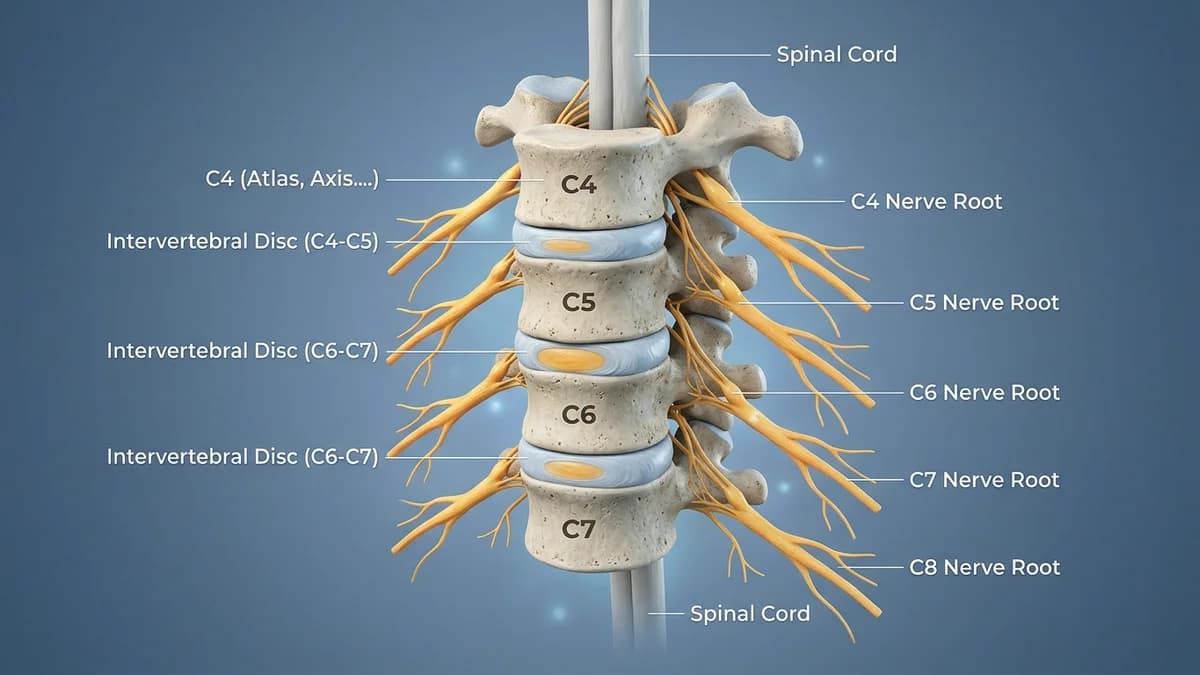
The cervical spine consists of seven vertebrae (C1 to C7) that support the head while allowing wide multi-directional rotation. Over decades, intervertebral discs gradually lose water content and height, bringing adjacent vertebrae closer together. In response, the body develops compensatory bone spurs (osteophytes) around the uncovertebral and facet joints.
The C5-C6 and C6-C7 levels are most commonly affected. Compression of the C6 nerve root typically sends pain and numbness down the biceps and into the thumb and index finger, while C7 root compression radiates down the triceps into the middle finger. Knowing the exact nerve root allows your physiotherapist to prescribe precise nerve sliders that restore nerve mobility.
| Nerve Root | Radiation Path & Sensory Deficit | Motor Weakness & Reflex Test |
|---|---|---|
| C5 Nerve Root | Lateral upper shoulder and deltoid area. | Deltoid shoulder abduction weakness; diminished biceps reflex. |
| C6 Nerve Root | Lateral forearm, thumb, and index finger. | Biceps and wrist extensor weakness; diminished brachioradialis reflex. |
| C7 Nerve Root | Posterior arm, forearm, and middle finger. | Triceps extension and wrist flexor weakness; diminished triceps reflex. |
| C8 Nerve Root | Medial forearm, ring finger, and little finger. | Finger flexion and hand grip weakness; normal reflexes. |
Targeted exercises to decompress cervical nerves
Perform these exercises gently within a pain-free range twice daily.
Craniocervical Flexion (Gentle Chin Tuck)
Objective: Activate deep cervical flexors (longus capitis and colli) to restore cervical lordosis.
- 1Sit tall with your back supported against a firm chair, looking straight ahead.
- 2Gently glide your chin backward like making a subtle double chin, as if sliding your head straight back on a level shelf.
- 3Do not tilt your head down toward your chest. Keep your eye line horizontal.
- 4Hold the gentle retracted position for 5 seconds, feeling a gentle stretch at the base of your skull.
- 5Release smoothly back to neutral.
Median Nerve Gliding Slider
Objective: Mobilize the irritated cervical nerve along its path without provoking acute inflammation.
- 1Stand tall with your affected arm at your side.
- 2Bring your arm out to the side at shoulder height with your palm facing forward and fingers relaxed.
- 3As you extend your wrist backward (pulling fingers back), gently tilt your head toward the same shoulder to keep nerve tension neutral.
- 4As you bend your wrist forward, gently tilt your head toward the opposite shoulder.
- 5Perform in a smooth, rhythmic sliding motion without holding end-range tension.
Thoracic Extension over Chair Back
Objective: Relieve compensatory cervical shear by restoring upper back mobility.
- 1Sit on a sturdy chair with the backrest ending just below your shoulder blades.
- 2Interlace your fingers behind your neck to support your cervical spine.
- 3Gently lean backward over the top of the backrest, allowing your upper back to extend.
- 4Take a slow, deep breath in at the top of the extension, then return to upright.
Why prolonged soft neck collars delay recovery
In India, patients experiencing neck pain are frequently prescribed soft foam cervical collars. While a collar may offer short-term comfort for 24 to 48 hours during an acute flare, wearing a collar for weeks leads to rapid atrophy of the deep cervical stabilizing muscles, increases joint stiffness, and fosters psychological dependence. Modern clinical guidelines strongly advise weaning off cervical collars quickly in favour of active deep neck flexor stabilization and gentle movement.
Critical red flags: Cervical myelopathy
Seek immediate emergency medical evaluation if neck pain is accompanied by loss of hand dexterity (difficulty buttoning shirts or dropping cups), unsteady balance and clumsiness when walking, numbness across both legs, or loss of bowel and bladder control. These signs suggest cervical myelopathy (compression of the spinal cord itself), which requires urgent surgical consultation.
In-clinic vs home visit physiotherapy
In an outpatient clinic, clinicians utilize manual cervical traction and graded thoracic mobilization to widen the neural foramina. For patients experiencing severe radiating arm pain where traveling through bumpy traffic worsens nerve irritation, home visit physiotherapy allows a specialist to provide gentle manual decompression and correct pillow and mattress ergonomics directly in your home.
On BookPhysio.in, cervical spondylosis physiotherapy sessions typically range from ₹400 to ₹1,400 for clinic visits and ₹500 to ₹1,800 for home visits across Indian cities. All fees are paid directly to your practitioner with zero middleman fees.
Indian two-wheeler commutes, potholes, and text-neck posture
Cervical spondylosis and cervical radiculopathy are exceptionally common among urban Indian commuters who travel 20 to 40 kilometers daily on motorcycles and scooters. Repeated axial shocks from uneven roads and speed breakers transmit violent compressive forces up through the spinal column. Combined with wearing heavy, ill-fitting motorcycle helmets and spending 8 to 10 hours slouched over smartphones and laptops ("text neck"), the lower cervical discs (C5-C6 and C6-C7) undergo rapid degenerative narrowing.
As disc height collapses and uncovertebral joints develop osteophytes (bone spurs), the exit foramina narrow, pinching exiting cervical nerve roots. Patients experience radiating "electric shock" pain, numbness, and motor weakness traveling down the arm into the fingers. Physiotherapy relieves nerve compression through gentle mechanical traction and posture re-education.
Mechanical cervical traction and neural mobilization techniques
Evidence-based cervical physiotherapy utilizes intermittent mechanical cervical traction (applying gentle axial tension at a 15-to-24-degree flexion angle) to widen the intervertebral foramina by up to 1 to 2 millimeters, immediately reducing perineural venous congestion and mechanical nerve impingement. Paired with median and radial nerve gliding exercises (neurodynamics), traction allows irritated nerve roots to slide smoothly without tethering.
Frequently asked questions
Which pillow is best for cervical spondylosis?
Use an ergonomic contoured cervical memory foam or latex pillow that supports the natural curve of your neck while keeping your head neutral. When sleeping on your side, the pillow height should exactly match the distance between your neck and the edge of your shoulder.
Can yoga cure cervical spondylosis?
Gentle restorative yoga focusing on gentle posture alignment and breathing is beneficial. However, poses that place direct axial load or extreme hyperextension on the neck (such as Shirshasana / headstand and Sarvangasana / shoulder stand) should be strictly avoided as they can dangerously compress degenerated cervical discs.
Is surgery necessary for cervical radiculopathy?
Surgery (such as anterior cervical discectomy and fusion / ACDF) is necessary in fewer than 10 percent of cases, typically reserved for severe progressive muscle weakness (such as marked triceps or biceps paralysis) or myelopathy that does not respond to conservative physiotherapy.
Evidence reviewed 7 October 2026. General information only.
Sources reviewed
North American Spine Society (NASS) Evidence-Based Clinical Guidelines for Multidisciplinary Spine Care: Diagnosis and Treatment of Cervical Radiculopathy from Degenerative Disorders; Childress MA & Becker BA, Nonoperative Management of Cervical Radiculopathy (Am Fam Physician); Jull G et al., Clinical Assessment of the Deep Cervical Flexor Muscles: The Craniocervical Flexion Test (J Manipulative Physiol Ther); Cochrane Review on Mechanical Traction for Neck Pain with or without Radiculopathy.
Can cervical radiculopathy cause numbness in the fingers?
Yes. Depending on which cervical nerve root is pinched: C6 compression causes numbness in the thumb and radial forearm; C7 compression affects the middle finger; and C8 compression causes numbness in the ring and little fingers and weakness in hand grip.
How do I book an experienced cervical spine physiotherapist via BookPhysio.in?
BookPhysio.in connects patients across India with certified spine physiotherapists skilled in cervical traction, manual therapy, and ergonomic posture correction. Consultations range from ₹400 to ₹1,500 in clinic and ₹600 to ₹2,000 for home visits, with direct payment to your clinician and zero platform commission.
Related condition guides


BookPhysio.in Editorial Team
The BookPhysio.in editorial team writes and maintains this content, checking it against reliable clinical sources. Content follows our medical review policy: general information only, and no page claims a clinical review until a named registered physiotherapist has signed it off.
Read our medical review policy