
Gait Ataxia and Wide-Based Gait in Cervical Myelopathy: Balance Loss and Fall Risk Protocols
In short
Analyze the pathomechanics of myelopathic gait ataxia, wide-based walking, and proprioceptive loss, exploring proactive balance rehabilitation to prevent falls.
In this guide (4 sections)
Gait ataxia represents the most disabling and dangerous clinical feature of cervical spondylotic myelopathy, serving as the primary cause of catastrophic falls and loss of independent living among older adults. Patients describe an unsettling sensation of walking on cotton wool, feeling drunk without alcohol, or being unsure of where their feet are positioned in space. In response to this sensory uncertainty and descending corticospinal motor stiffness, the nervous system adopts a characteristic compensatory gait pattern: the feet are placed unusually far apart (wide-based gait), step length becomes irregular, walking speed drops dramatically, and the arms are held abducted away from the torso to act as stabilizing counterweights. Without timely clinical identification and targeted neuro-rehabilitation, progressive myelopathic ataxia inevitably leads to fear-driven immobility, muscle wasting, and debilitating fractures.
Navigating Wet Indian Bathrooms, Pavement Hazards, and Night Walking
Indian living spaces present immense environmental hurdles for patients with myelopathic gait unsteadiness. Domestic bathrooms, often constructed with smooth, wet ceramic tiles and lacking wall-mounted grab bars, represent the most hazardous domestic zone. Stepping out of a bathing bucket area or rising from a low toilet seat frequently induces severe equilibrium loss. At night, waking up in a darkened room to visit the toilet becomes exceptionally dangerous; because these patients rely heavily on visual cues to compensate for lost spinal cord proprioception, extinguishing the lights removes their primary sensory stabilizer, causing them to veer into doorframes or collapse onto the floor. Outside the home, navigating unpaved roads, broken concrete footpaths, crowded bazaars, and steep pedestrian footbridges over railway tracks demands rapid postural adjustments that an ataxic spinal cord simply cannot coordinate.
Spinocerebellar, Dorsal Column, and Corticospinal Disruption
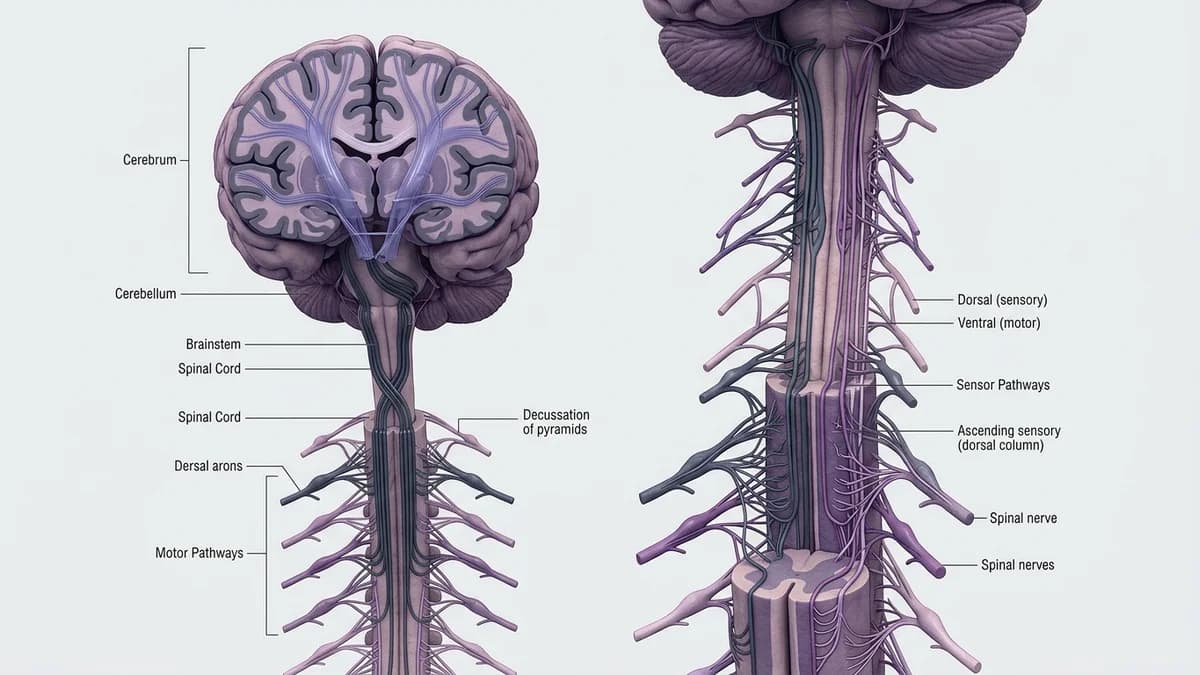
The complex pathomechanics of myelopathic gait ataxia stem from the simultaneous disruption of three distinct neural highways traversing the cervical spinal cord. First, compression of the dorsal columns (fasciculus gracilis) blocks conscious proprioceptive and kinesthetic feedback from lower limb mechanoreceptors, depriving the cerebral cortex of essential information regarding joint angles and ground contact forces. Second, compression of the dorsal and ventral spinocerebellar tracts interrupts unconscious proprioceptive signals destined for the cerebellum, preventing the cerebellar circuits from performing real-time error correction and smooth motor coordination. Third, compression of the lateral corticospinal tracts impairs voluntary motor drive to the lower extremity muscles, producing extensor spasticity in the quadriceps and gastrocnemius. The combination of sensory blindness and motor spasticity produces the classic stiff-legged, uncoordinated, wide-based myelopathic gait.
Multimodal Balance Training, Assistive Device Prescription, and Fall Prevention
Physiotherapy for myelopathic gait ataxia must balance rigorous neuromuscular training with absolute patient safety. Rehabilitation begins with objective balance testing, utilizing the Berg Balance Scale, Functional Gait Assessment, and Dynamic Gait Index. Exercise interventions focus on multisensory balance training: patients practice standing and walking with progressively narrowed bases of support, incorporating head turns, eye tracking, and compliant foam surfaces under close supervision. Parallel bar drills emphasize deliberate heel-to-toe foot placement to counteract foot scuffing. The physiotherapist evaluates and prescribes appropriate walking aids, such as a sturdy quad cane or a wheeled walker, to expand the patient base of support and provide tactile feedback. Fall prevention education includes installing bathroom grab bars, laying anti-skid rubber mats, and removing loose carpets throughout the domestic home.
Corner Stance Proprioceptive Balance Retraining with Visual Cues
Objective: Challenge lower extremity proprioception and postural alignment safely within a protective corner environment to eliminate fall risk
- 1Stand facing outward in the corner of a room, with your back facing the junction of the walls and a sturdy chair placed directly in front of you for fingertip touch.
- 2Position your feet slightly narrower than shoulder-width apart, ensuring your weight is distributed evenly between both heels and balls of the feet.
- 3Keep your hands hovering one inch above the chair back, ready to grasp it instantly if you feel unsteady.
- 4Fix your gaze on a clear visual target on the opposite wall at eye level, holding a steady, upright posture for thirty seconds.
- 5As your confidence improves over weeks under guidance, gently close your eyes for five to ten seconds, feeling your ankle muscles make rapid stabilizing micro-adjustments.
| Gait Severity Stage | Kinematic and Postural Changes | Functional Mobility Impact | Recommended Safety and Mobility Equipment |
|---|---|---|---|
| Mild Myelopathic Ataxia | Mild unsteadiness on tandem walking, subtle widening of base, occasional scuffing | Full domestic independence, feels uncertain in crowds, dark rooms, or uneven ground | Single-point walking stick for outdoor walking, bathroom anti-skid floor mats |
| Moderate Ataxia with Spasticity | Noticeable wide-based gait, stiff knee swing, positive Romberg sign, frequent stumbling | Unable to walk outdoors unassisted, requires wall touching indoors, struggles with stairs | Quad cane or bilateral walking sticks, bathroom grab rails, shower commode chair |
| Severe Ataxic Quadriparesis | Severe spastic-ataxic gait, scuffing toes, requires two-person support or cannot walk | Confined to bed or wheelchair, high domestic fall risk, severe loss of independence | Standard wheeled walker or wheelchair mobility, comprehensive caregiver assistance |
When a patient who was previously walking independently experiences an abrupt deterioration over days, becoming unable to cross a room without clutching walls or furniture, the spinal cord is under critical compressive compromise. This rapid progression necessitates immediate orthopaedic evaluation and emergency MRI assessment to prevent permanent paraparesis.
Frequently Asked Questions
Why do I feel like I am walking on cotton wool or a bouncy mattress?
This sensation is a classic symptom of spinal cord compression. Inside your cervical spine, the sensory nerve pathways (the dorsal columns) carry position signals from the soles of your feet to your brain. When bone spurs or disc bulges squeeze these pathways, the signals become fuzzy and delayed. Your brain cannot clearly feel the solid floor underneath you, creating the strange illusion that you are walking on soft sponges, pillows, or cotton wool.
Do I need a doctor referral for cervical myelopathy physiotherapy on BookPhysio.in?
BookPhysio.in does not require a doctor referral. Under the National Commission for Allied and Healthcare Professions (NCAHP) Act 2021, patients across India enjoy direct access to autonomous registered physiotherapists. Through BookPhysio.in, you connect directly with verified clinicians and pay per session with transparent fees, completely free from advance package commitments, commission markups, or platform subscription charges.
Related condition guides



Related recovery guides & articles
BookPhysio.in Editorial Team
The BookPhysio.in editorial team writes and maintains this content, checking it against reliable clinical sources. Content follows our medical review policy: general information only, and no page claims a clinical review until a named registered physiotherapist has signed it off.
Read our medical review policy