
Gluteal Amnesia Reversal and Pelvic Leveling Post-Total Hip Arthroplasty
In short
Discover clinical techniques to reverse gluteal amnesia and hamstring dominance, restoring symmetrical pelvic leveling following total hip arthroplasty.
In this guide (4 sections)
Years of severe end-stage hip osteoarthritis frequently cause profound neuromuscular dysfunction that persists long after successful total hip arthroplasty. To minimize arthritic joint pain prior to surgery, patients instinctively alter their movement patterns, leading to chronic reciprocal inhibition and neuromuscular shutdown of the gluteus maximus and gluteus medius, a phenomenon clinically referred to as gluteal amnesia. When the gluteal complex fails to fire during functional tasks, synergistic muscles, particularly the hamstrings, erector spinae, and tensor fasciae latae, become chronically overactive and dominant. Simply replacing the mechanical hip joint does not automatically restore normal motor neuron firing patterns. Reversing gluteal amnesia through targeted neuromuscular re-education is necessary to level the pelvis, normalize gait cadence, and protect adjacent spinal segments.
Addressing Postural Habits and Kitchen Leaning in Indian Homes
In Indian homes, daily domestic habits often reinforce gluteal weakness. Standing for hours in the kitchen preparing meals while leaning heavily against the counter allows the pelvis to drift into an exaggerated anterior pelvic tilt and lateral hip hang, completely shutting off active gluteal recruitment. Furthermore, sitting on soft sofas or low beds during leisure hours keeps the hip flexors in a chronically shortened, tight position that reciprocally inhibits the gluteus maximus behind it. Patients frequently complain of persistent lower back tightness and hamstring cramping during walking, unaware that their gluteal muscles are dormant. Physiotherapists educate patients on maintaining an active, neutral pelvis during cooking and domestic chores, transforming daily routines into functional strengthening opportunities.
Reciprocal Inhibition Neurophysiology, Hamstring Dominance, and Pelvic Tilt
The neurophysiological basis of gluteal amnesia involves Sherrington's law of reciprocal inhibition and altered motor unit recruitment hierarchies. Chronic pre-operative hip flexion contractures cause persistent shortening and hypertonicity of the iliopsoas and rectus femoris. The constant afferent discharge from muscle spindle fibers in these shortened anterior flexors sends inhibitory signals through spinal interneurons to the alpha motor neuron pool of the gluteus maximus. When hip extension is attempted during walking stance, the central nervous system substitutes the hamstrings and lumbar erector spinae to generate extension torque. Because the hamstrings insert distally on the tibia, they produce excessive anterior femoral translation forces rather than stabilizing the hip center, while the hyperactive lumbar paraspinals pull the pelvis into excessive anterior tilt, precipitating secondary facet joint impingement.
Isolated Neuromuscular Re-Education and Closed Kinetic Chain Progressions
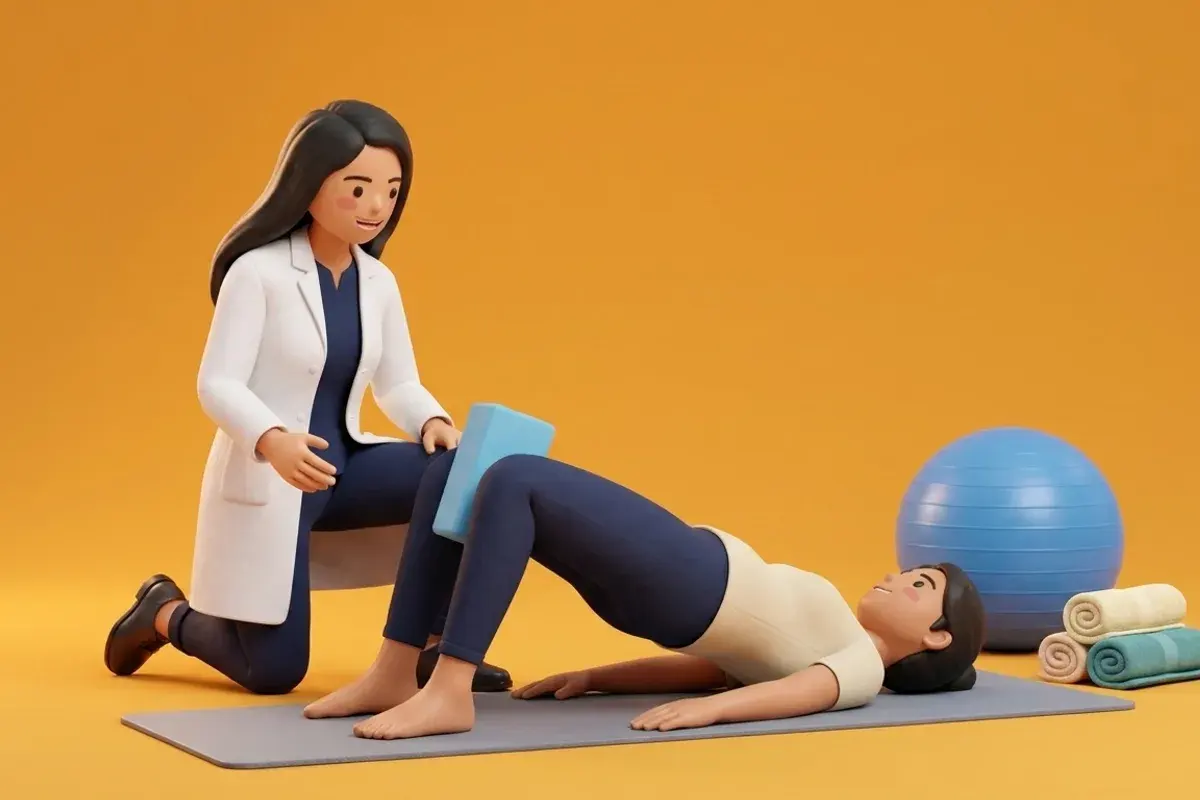
Reversing gluteal amnesia requires a systematic, phased progression that first breaks the compensatory dominance of the hamstrings. Testing begins in a prone or standing position, evaluating the firing sequence: normal recruitment initiates with the gluteus maximus, followed by contralateral erector spinae, ipsilateral hamstrings, and ipsilateral erector spinae. In amnesic patients, the hamstrings fire first with explosive force. To isolate the gluteus maximus, patients perform prone hip extension with the knee bent to ninety degrees, which mechanically slackens the hamstrings through active insufficiency. Tactile biofeedback, where the clinician or patient places a hand directly over the gluteus maximus belly during contraction, facilitates corticomotor re-mapping. Once isolated firing is achieved, training progresses to bridging drills and standing pelvic tucks.
Bent-Knee Prone Gluteal Squeeze and Lift Drill
Objective: Isolate gluteus maximus motor recruitment by placing the hamstrings into mechanical active insufficiency
- 1Lie flat on your stomach on a firm bed with a thin pillow placed beneath your abdomen to support your lower back.
- 2Bend your operative knee to ninety degrees so the sole of your foot faces directly toward the ceiling.
- 3Before initiating any upward movement, firmly squeeze your operative buttock muscle as hard as comfortably possible.
- 4Maintaining that firm buttock squeeze, lift your thigh one to two inches off the bed without arching your lower back.
- 5Hold the lift for three seconds, feeling pure gluteal contraction without hamstring cramping, then lower down gently.
| Assessment Domain | Normal Gluteal Activation Pattern | Synergistic Hamstring Dominance Pattern |
|---|---|---|
| Prone Hip Extension Firing Order | Gluteus maximus fires first, followed by contralateral paraspinals and hamstrings | Hamstrings or ipsilateral lumbar paraspinals fire first; gluteus remains soft |
| Pelvic Alignment in Stance | Neutral pelvis with balanced co-contraction of abdominals and gluteals | Excessive anterior pelvic tilt (>12 degrees) with hyperlordotic lumbar spine |
| Walking Stance Kinematics | Full terminal hip extension driven by powerful gluteal push-off | Shortened terminal stance; pelvis rotates forward to substitute for lost extension |
| Patient Symptom Presentation | Comfortable walking endurance; level pelvis; symmetrical stride cadence | Recurrent hamstring cramps, lower back muscle spasms, and fatigue aching over hip |
When performing prone hip extension exercises, patients who had a direct anterior approach must keep the lift small (no more than two inches of thigh elevation) and avoid excessive backward hyperextension during the first six to eight weeks. Excessive hyperextension can place unwanted tension across the healing anterior capsular repair.
Frequently Asked Questions
Why do my hamstrings cramp when I try to squeeze my buttock after hip surgery?
When you have had severe hip arthritis, your brain forgets how to turn on your buttock muscles and relies on your hamstring muscles behind your thigh instead. When you try to lift your leg, the overworked hamstring tries to do all the work and goes into spasm. Doing exercises with your knee bent turns off the hamstring and forces your buttock to wake up.
Do I need a doctor referral for post-hip replacement physiotherapy on BookPhysio.in?
BookPhysio.in does not require a doctor referral. Under the National Commission for Allied and Healthcare Professions (NCAHP) Act 2021, patients across India enjoy direct access to autonomous registered physiotherapists. Through BookPhysio.in, you connect directly with verified clinicians and pay per session with transparent fees, completely free from advance package commitments, commission markups, or platform subscription charges.
Related condition guides



Related recovery guides & articles
BookPhysio.in Editorial Team
The BookPhysio.in editorial team writes and maintains this content, checking it against reliable clinical sources. Content follows our medical review policy: general information only, and no page claims a clinical review until a named registered physiotherapist has signed it off.
Read our medical review policy