
Monitoring Neurological Recovery in Cervical Radiculopathy: Grip Strength and Sensory Mapping
In short
Learn how clinicians objectively track nerve root regeneration: master hand dynamometry, Semmes-Weinstein sensory mapping, and motor recovery milestones.
In this guide (4 sections)
Objective monitoring of neurological recovery is a foundational component of evidence-based clinical decision-making in cervical radiculopathy. When a cervical nerve root is compressed, the primary pathological consequences are conduction block (neurapraxia) and structural axonal interruption (axonotmesis). Because subjective pain levels can fluctuate unpredictably based on psychological stress, sleep deprivation, and analgesics, relying solely on self-reported pain scales can lead clinicians to miss progressive neurological deterioration or prematurely discharge a patient with persistent motor deficits. Systematic physical tracking of neurological status requires standardized evaluation of three objective domains: isometric hand grip dynamometry, quantitative sensory mapping using calibrated monofilaments and pinprick testing, and deep tendon reflex symmetry.
Opening Pickle Jars, Spilling Morning Chai, and Door Key Dexterity
In Indian households, the functional impact of subtle neurological recovery or decline is vividly reflected in daily manual tasks. A homemaker with resolving C6 or C7 radiculopathy notices early motor recovery when she can firmly twist open tight metal lids on glass pickle (achar) jars, wring out heavy wet cotton towels without her wrist giving way, or securely hold full stainless steel cups of hot morning chai without trembling and spilling. For working adults and elders, functional recovery is measured by their ability to firmly grip and turn brass keys in stiff deadbolt door locks, count small paper currency notes without dropping them, or securely operate the stiff hand brake and clutch levers on a commuter scooter. Tracking these authentic domestic tasks provides meaningful milestones that complement clinical dynamometer data.
Neurobiology of Axonal Regeneration and Quantitative Physical Testing
The biological timeline of neurological recovery depends on the severity of nerve injury. In neurapraxia (pure focal demyelinating conduction block), remyelination and functional conduction restore within several days to weeks once mechanical compression is relieved. In axonotmesis, where axonal continuity is severed, recovery requires axonal sprouting and regeneration down the endoneurial tube at the established biological rate of approximately one millimeter per day (one inch per month). To monitor this gradual reinnervation, clinicians utilize the Jamar hydraulic hand dynamometer across standard Handle Position 2, measuring the average of three maximal grip efforts in kilograms. Sensory testing is quantified using Semmes-Weinstein monofilaments (establishing light touch threshold) and neuro-tip pinprick testing across specific dermatomal landmarks, charting the gradual contraction of the sensory deficit map.
Objective Assessment Protocols and Graded Neuromuscular Loading
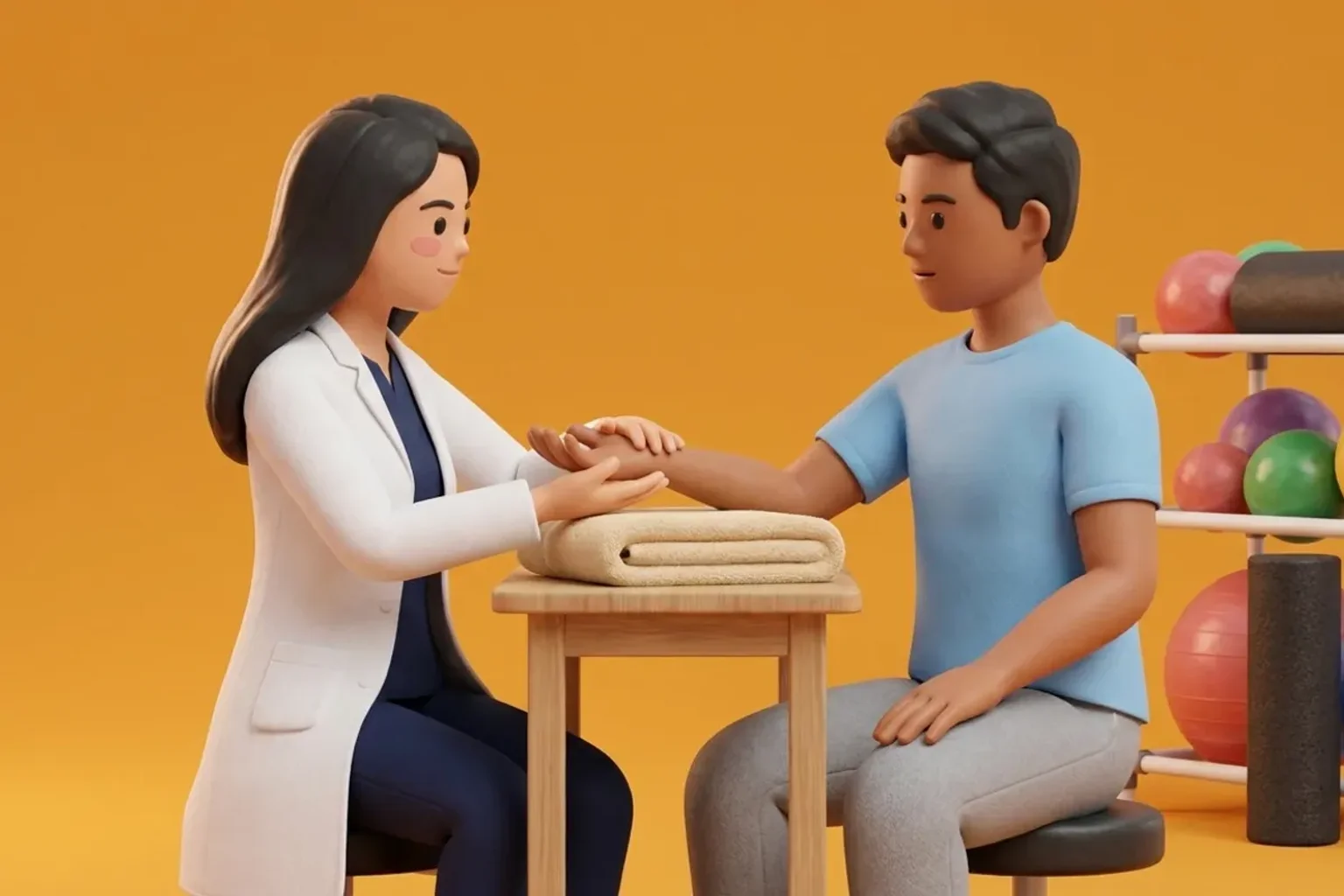
Standardized physiotherapy protocol requires baseline neurological documentation repeated at two-to-three-week intervals. A normal physiological grip strength discrepancy between the dominant and non-dominant hand is approximately ten percent (the 10% rule); a deficit exceeding twenty percent on the symptomatic side represents clinically significant myotomal weakness. When testing demonstrates that motor strength is plateauing or recovering, rehabilitation introduces graded neuromuscular re-education. Therapy incorporates progressive isometric grip holds using therapeutic silicone putty, resisted wrist extension with elastic bands to rebuild C6 motor units, and closed-kinetic-chain upper body weight-bearing drills, ensuring newly regenerating motor endplates are recruited into coordinated kinetic patterns.
Graded Isometric Grip and Finger Extension Retraining
Objective: Rebuild hand grip dynamometry and intrinsic fine motor control following cervical nerve root decompression
- 1Sit comfortably with your forearm supported on a table and your wrist resting in a neutral, slightly extended position.
- 2Take a soft therapeutic silicone ball or a tightly rolled hand towel, holding it securely in the palm of your symptomatic hand.
- 3Gently squeeze the ball with your fingers and thumb, building pressure up to a comfortable seventy percent effort.
- 4Hold the isometric squeeze steadily for six seconds while breathing normally, feeling your forearm muscles activate.
- 5Release the squeeze, then immediately place a wide rubber band around the outside of your fingers and open your hand against resistance.
| Neurological Examination Domain | Clinical Testing Instrument & Method | Normal Physiological Benchmark | Threshold Indicating Genuine Recovery |
|---|---|---|---|
| Isometric Grip Dynamometry | Jamar Hydraulic Dynamometer; Handle Position 2; mean of 3 trials | Symmetrical strength within 10% of contralateral healthy hand | Improvement of >5 kg (11 lbs) or closing side-to-side deficit to <10% |
| Sensory Light Touch Mapping | Semmes-Weinstein Monofilaments (Targeting 2.83 to 3.61 filaments) | Detection of 2.83 (0.07 g force) across all digital sensory receptive fields | Advancing from 4.31 (diminished protective sensation) to 3.61 (normal touch) |
| Myotomal Motor Power | Medical Research Council (MRC) 0 to 5 Scale against manual resistance | Grade 5/5 (Normal power against strong examiner resistance) | Progressing from Grade 3/5 (movement against gravity) to Grade 4+ or 5/5 |
| Deep Tendon Reflexes | Neurological reflex hammer testing (Biceps C5/6, Brachioradialis C6, Triceps C7) | Grade 2+ (Normal brisk symmetrical reflex bilaterally) | Restoration of depressed 1+ reflex to symmetrical 2+ brisk response |
While gradual improvement over weeks reflects normal axonal biology, an acute, rapid drop in grip dynamometry by greater than thirty percent over a one-to-two-week period represents an urgent clinical red flag. Rapid loss of motor power signifies acute structural axonal collapse, requiring immediate orthopaedic spine or neurosurgical re-evaluation for timely decompression before permanent muscle denervation and fibrosis occur.
Frequently Asked Questions
How long does it take for a pinched nerve in the neck to regrow its strength in the hand?
Nerve tissue regrows at a biologically fixed rate of approximately one millimeter per day, or about an inch every month. Because the distance from your lower neck to your fingertips is roughly sixty to seventy centimeters, recovering full strength and sensation after significant nerve root compression typically takes three to six months of consistent physiotherapy. As long as objective tests show steady monthly gains, your recovery is on track.
Do I need a doctor referral to treat cervical radiculopathy on BookPhysio.in?
BookPhysio.in does not require a doctor referral. Under the National Commission for Allied and Healthcare Professions (NCAHP) Act 2021, patients across India enjoy direct access to autonomous registered physiotherapists. Through BookPhysio.in, you connect directly with verified clinicians and pay per session with transparent fees, completely free from advance package commitments, commission markups, or platform subscription charges.
Related condition guides



Related recovery guides & articles
BookPhysio.in Editorial Team
The BookPhysio.in editorial team writes and maintains this content, checking it against reliable clinical sources. Content follows our medical review policy: general information only, and no page claims a clinical review until a named registered physiotherapist has signed it off.
Read our medical review policy