
Pain Neuroscience Education in Epicondylalgia: Failed Healing versus Acute Inflammation
In short
Chronic tennis elbow pain does not mean your tendon is tearing. Discover how pain neuroscience education reframes pain signals and deconstructs kinesiophobia.
In this guide (4 sections)
In the management of chronic lateral epicondylalgia lasting longer than three months, tissue pathology at the elbow joint is rarely the sole determinant of the patient's pain experience. Prolonged nociceptive input from a degenerated tendon origin frequently induces secondary neuroplastic changes within the central nervous system, known as central sensitization. Patients develop hyperalgesia, widespread pain, and intense kinesiophobia (fear of movement), operating under the mistaken belief that every twinge of discomfort represents ongoing tissue tearing. Integrating Pain Neuroscience Education (PNE) dismantles these unhelpful cognitive beliefs, reframing pain as an overprotective alarm system rather than an accurate barometer of structural harm.
Fear-Avoidance Beliefs in Indian Families and Workplaces
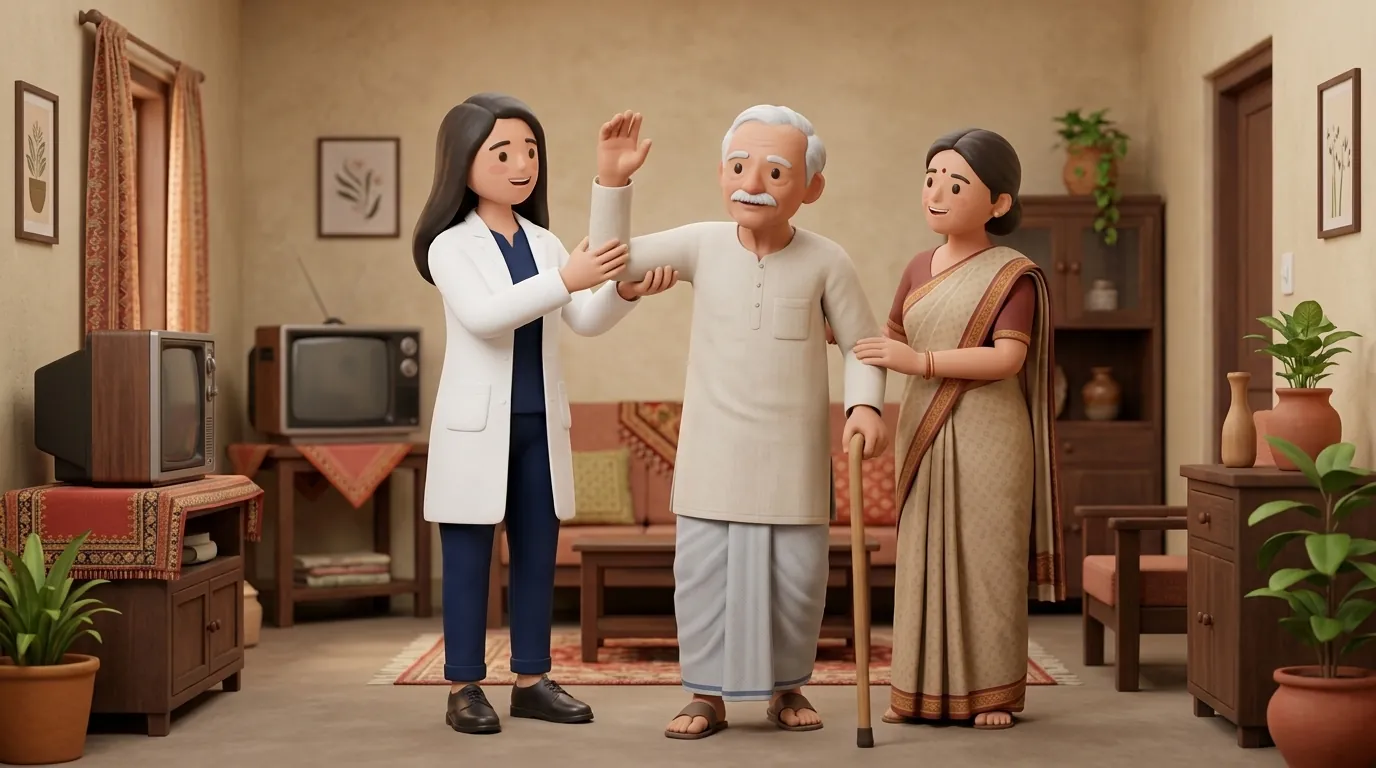
In Indian society, cultural narratives surrounding joint and tendon pain often emphasize complete rest and catastrophic fragility. Well-meaning family members frequently advise a patient with tennis elbow to stop using their arm entirely, avoid picking up their children, and cease cooking, warning that continued movement will snap the tendon. Over months of fearful resting, the patient develops profound disuse muscle atrophy, joint stiffness, and heightened nervous system sensitivity. Simple acts like picking up a smartphone or turning a light switch trigger alarm signals out of proportion to mechanical tissue threat.
Central Sensitization, Neurotag Priming, and Failed Healing Biology
The biological distinction between acute pain and chronic tendinopathy is fundamental. Acute pain functions as an accurate warning system indicating real or imminent tissue damage (such as an acute burn or bone fracture), driven by classic inflammatory mediators. In chronic epicondylalgia, however, the tendon is not inflamed; it has undergone non-inflammatory degenerative remodeling characterized by hypercellularity and failed collagen turnover. Over months of unremitting nociceptive signaling, dorsal horn neurons in the spinal cord and cortical pain networks become sensitized, lowering their firing thresholds. The brain's pain alarm becomes hyper-sensitive, ringing loudly in response to completely safe, non-threatening daily movements.
Cognitive Reframing, Graded Exposure, and The Hurt versus Harm Rule
Pain Neuroscience Education utilizes structured educational metaphors to re-educate the patient's nervous system. The clinician explains the difference between hurt (sensory perception modulated by an overprotective alarm) and harm (actual physical structural damage). Patients are taught that mild to moderate discomfort (up to 3 or 4 out of 10) during progressive tendon loading exercises is completely safe and physiologically necessary to stimulate cellular healing. Combining this cognitive reframing with graded movement exposure systematically turns down the volume of the sensitized central nervous system, restoring physical confidence.
Graded Mental Imagery and Desensitization Movement Drill
Objective: Recondition cortical motor representation and dampen kinesiophobia through non-threatening movement visualization
- 1Sit in a quiet, comfortable chair with your eyes closed and your arms resting relaxed in your lap.
- 2Take 5 slow, deep diaphragmatic breaths, allowing your shoulders, neck, and jaw to soften completely.
- 3Vividly visualize your affected arm picking up a filled water bottle smoothly, observing your wrist holding it with complete comfort.
- 4Open your eyes, take the actual water bottle in your hand, and lift it 5 cm off your lap while reminding yourself: "My tendon is strong and safe."
- 5Lower the bottle smoothly, breathe out calmly, and notice that mild sensation does not mean structural damage.
| Clinical Dimension | Outdated Biomedical / Inflammatory Model | Modern Pain Neuroscience Model (PNE) |
|---|---|---|
| Nature of Underlying Condition | Believed to be acute inflammatory "tendinitis" with active cellular swelling and destruction | Recognized as failed healing and degenerative tendinosis; zero inflammatory cells present |
| Meaning of Pain Sensation | Pain is viewed as a direct 1:1 indicator of ongoing tendon tearing and physical damage | Pain is an overprotective neurological alarm modulated by central sensitization and fear |
| Prescription for Recovery | Complete rest, immobilization splints, and anti-inflammatory pharmaceutical suppression | Graded mechanical loading, active movement exposure, and progressive capacity building |
| Long-Term Patient Outlook | Kinesiophobia, fragility mindset, and perpetual fear of domestic or athletic relapse | Empowerment, tissue resilience, and confident self-management across functional demands |
Pain neuroscience education applies to chronic, non-malignant musculoskeletal conditions. It should never be used to dismiss new, unexplained neurological deficits, acute mechanical locking, progressive night pain waking the patient from deep sleep, or signs of infectious joint inflammation.
Frequently Asked Questions
Does learning about pain neuroscience mean my elbow pain is all in my head?
Not at all. Your pain is 100 percent real and physical. Pain neuroscience simply explains that your brain and nervous system have become hyper-sensitive and overprotective, causing you to feel pain at much lower thresholds than normal even though your tendon is structurally safe to move.
Do I need a doctor referral to see a tennis elbow physiotherapist on BookPhysio.in?
BookPhysio.in does not require a physician prescription. Under the National Commission for Allied and Healthcare Professions (NCAHP) Act 2021, patients across India enjoy direct access to autonomous registered physiotherapists. Through BookPhysio.in, you connect directly with verified clinicians and pay per session with transparent fees, completely free from advance package commitments, commission markups, or platform subscription charges.
Related condition guides



Related recovery guides & articles
BookPhysio.in Editorial Team
The BookPhysio.in editorial team writes and maintains this content, checking it against reliable clinical sources. Content follows our medical review policy: general information only, and no page claims a clinical review until a named registered physiotherapist has signed it off.
Read our medical review policy