
Pregnancy and Relaxin Effects on Pre-Existing Spondylolisthesis
In short
Pregnancy hormones and biomechanical changes challenge spondylolisthesis. Learn how relaxin, postural shifts, and maternity supports guide safe pregnancy care.
In this guide (4 sections)
Pregnancy induces some of the most profound, rapid anatomical and physiological transformations the female musculoskeletal system can experience. For women entering pregnancy with pre-existing, often asymptomatic lumbar spondylolysis or low-grade spondylolisthesis, the gestational period presents significant biomechanical and hormonal challenges. As circulating concentrations of the peptide hormone relaxin surge during the first and third trimesters, systemic ligamentous laxity increases to prepare the birth canal for delivery. Concurrently, anterior uterine expansion shifts the maternal center of gravity forward, exaggerating lumbar lordosis and magnifying anterior translational shear across the L5-S1 motion segment. Structured prenatal physiotherapy is essential to support the spine, manage pain, and guide safe birthing mechanics.
Indian Maternal Care, Traditional Chores, and Postpartum Lifting
In traditional Indian households, pregnant women frequently navigate complex cultural expectations alongside demanding physical routines. Family structures often encourage women to remain active with domestic tasks, such as sweeping, cooking over floor stoves, and washing clothes, well into the third trimester. While light activity is healthy, deep bending and floor-level chores under a shifting center of gravity impose intense shear on vulnerable lumbar vertebrae. Following childbirth, traditional postpartum rituals (jaapa) often require mothers to sit cross-legged on the floor for hours nursing the newborn, followed by bathing infants in low plastic tubs. When combined with postpartum ligamentous laxity, these postures frequently precipitate acute spondylolisthesis flares.
Relaxin-Induced Collagen Remodeling, Anterior Center of Gravity Shift, and Shear
The pathophysiological mechanisms driving symptom flares during pregnancy involve a combination of biochemical tissue softening and altered load geometry. Secreted by the corpus luteum and placenta, relaxin upregulates collagenase and matrix metalloproteinases, degrading dense Type I collagen within the sacroiliac, iliolumbar, and anterior longitudinal ligaments. In an intact spine, muscular compensation easily counters this joint laxity. In pre-existing spondylolysis, where the bony pars is defective, passive ligamentous restraint was the primary barrier preventing vertebral translation. As the growing fetus adds ten to fifteen kilograms anterior to the spine, the maternal center of mass moves forward, steepening the sacral slope and increasing anterior shear forces by over thirty percent.
Maternity Support Orthoses, Pelvic Floor Integration, and Birthing Positions
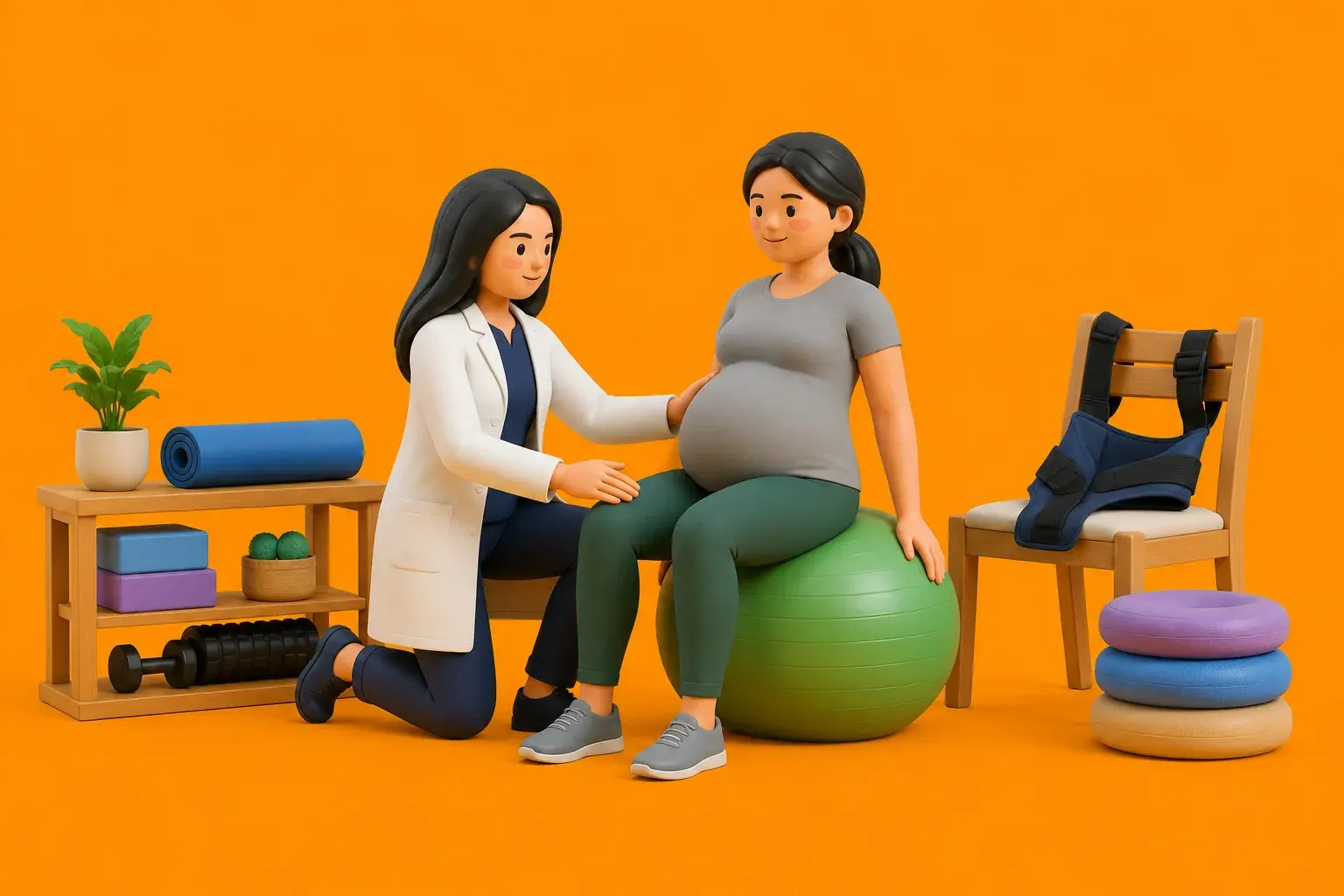
Prenatal physiotherapy emphasizes safe mechanical offloading, core canister conditioning, and ergonomic education. Prescription of a supportive, elastic maternity belt (trochanteric support band) cradles the lower abdomen and compresses the pelvic ring, reducing gravitational shear without compressing the growing fetus. Exercises prioritize gentle pelvic tilting, side-lying clam shells, and transverse abdominis setting coordinated with diaphragmatic respiration. Clinicians collaborate with obstetricians to plan birthing positions: prolonged labor in traditional semi-recumbent lithotomy with heavy spinal flexion should be avoided; side-lying (Sims position) or supported all-fours birthing positions are favored to eliminate lumbosacral shear during active labor.
Prenatal Side-Lying Clamshell with Neutral Spine Support
Objective: Strengthen gluteus medius and pelvic stabilizers without imparting compressive or shear load on the lumbar spine
- 1Lie comfortably on your left side on a supportive exercise mat, with a firm pillow beneath your head and a small pillow under your belly.
- 2Bend both knees to forty-five degrees, keeping your feet aligned with your hips and your spine in a relaxed neutral posture.
- 3Gently engage your lower abdominal wall, coordinating with your breath, keeping your pelvis perfectly vertical to the ceiling.
- 4Keeping your heels glued firmly together, slowly lift your top right knee upward like an opening clamshell.
- 5Lift only as high as you can without rolling your pelvis backward, hold for 2 seconds, and lower your knee smoothly back down.
| Gestational Period | Biomechanical & Hormonal Status | Physiotherapy Focus & Ergonomic Adjustments |
|---|---|---|
| First Trimester (Weeks 1-12) | Peak surge in circulating relaxin; early ligamentous softening; minimal weight gain | Baseline postural assessment; education on avoiding high-impact running and ballistic yoga stretches |
| Second Trimester (Weeks 13-27) | Rapid uterine growth; center of gravity shifts forward; early anterior pelvic tilt | Fit maternity support belt; initiate side-lying gluteal strengthening and pelvic tilt re-education |
| Third Trimester (Weeks 28-40) | Maximum anterior shear load; severe ligamentous laxity; waddling gait emerging | Water-supported aquatic exercise; birth position planning (side-lying/all-fours); avoid supine lying |
| Postpartum Phase (Months 0-6) | Prolonged relaxin clearance if breastfeeding; high lifting demands (baby, stroller, car seat) | Ergonomic nursing setups; gentle core canister reactivation; progressive return to upright lifting |
Pregnant women beyond twenty weeks gestation should never be positioned flat on their backs for physiotherapy exercises. Supine positioning compresses the inferior vena cava beneath the heavy gravid uterus, causing acute maternal hypotension, dizziness, and fetal hypoxia. Furthermore, sudden onset of progressive leg weakness or urinary retention during pregnancy requires immediate emergency obstetric and spine specialist review.
Frequently Asked Questions
Will having spondylolisthesis prevent me from having a normal vaginal delivery?
Having spondylolisthesis does not mean you must have a Caesarean section. The vast majority of women with stable Grade I or II spondylolisthesis safely deliver vaginally. However, you should discuss your condition with your obstetrician and physiotherapist in advance. During labor, you should avoid the standard flat-on-your-back lithotomy position with your knees pulled to your ears, as this forces your spine into extreme shear. Birthing positions such as side-lying or on all-fours keep your pelvis open and relaxed, protecting your slipped vertebra throughout delivery.
Do I need a doctor referral to consult a spondylolisthesis physiotherapist on BookPhysio.in?
BookPhysio.in does not require a doctor referral. Under the National Commission for Allied and Healthcare Professions (NCAHP) Act 2021, patients across India enjoy direct access to autonomous registered physiotherapists. Through BookPhysio.in, you connect directly with verified clinicians and pay per session with transparent fees, completely free from advance package commitments, commission markups, or platform subscription charges.
Related condition guides



Related recovery guides & articles
BookPhysio.in Editorial Team
The BookPhysio.in editorial team writes and maintains this content, checking it against reliable clinical sources. Content follows our medical review policy: general information only, and no page claims a clinical review until a named registered physiotherapist has signed it off.
Read our medical review policy