
Preventing Contralateral Facial Muscle Overuse and Contracture: Symmetrical Neuromuscular Balance
In short
When one side of the face is paralyzed, the healthy side works twice as hard, developing severe hyperkinesis and pulling the facial midline off-center. Discover how to balance bilateral facial mechanics.

In this guide (4 sections)
A universal, frequently overlooked biomechanical consequence of unilateral peripheral facial palsy is the rapid development of compensatory hyperactivity and secondary contracture in the contralateral, healthy hemiface. Because the brain perceives a loss of total facial excursion, it instinctively increases central motor drive to both sides. The unaffected facial muscles, retaining 100 percent of their motor units, contract with exaggerated force, pulling the nasal philtrum, modiolus, and brow across the midline and deepening contralateral facial asymmetry.
Domestic Realities and Environmental Safeguards in India
In Indian social environments, patients desperately want to communicate clearly during conversations with family members, employers, or shopkeepers. To make up for the weak side, patients often speak with dramatic, exaggerated mouth movements on the normal side, clenching their normal cheek and raising their normal eyebrow sky-high. Over months, this habit deepens the wrinkles and nasolabial fold on the healthy side, while creating severe muscular aching and jaw tension. Family members often comment that the healthy side looks "crooked or strained." Symmetrical motor retraining restores balanced facial mechanics.
Central Motor Overflow and Modiolar Lateral Shift Biomechanics
Cortical motor representations in the primary motor cortex (M1) interact through transcallosal inhibitory pathways. Following unilateral axotomy, loss of afferent sensory feedback disinhibits cortical motor outputs to both the injured and uninjured facial subnuclei. Biomechanically, the facial tissues are continuous across the midline: the orbicularis oris fibers interlace across the philtrum, while frontalis and procerus fibers meet at the glabella. When the hyperactive normal muscles contract without the balanced counter-traction of the paretic side, the entire facial midline shifts laterally toward the healthy side.
Contralateral Down-Training and Manual Anchoring Protocols
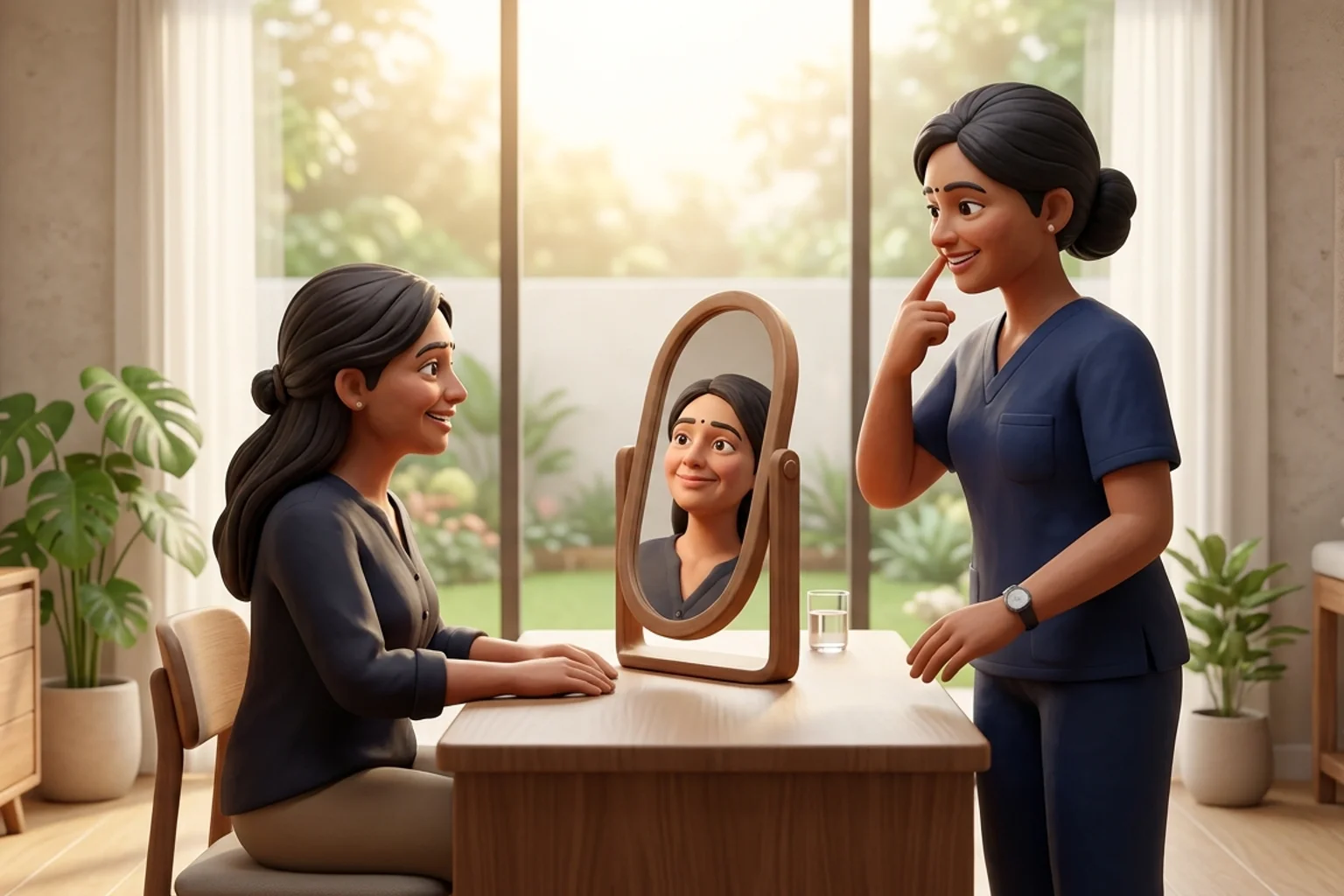
Rehabilitation requires down-training the hyperactive healthy side while facilitating the recovering side. Clinicians instruct patients in manual contralateral anchoring during all expressive movements: the patient places their flat hand or fingertips across the normal cheek or brow, physically preventing it from over-contracting. In front of a mirror, the patient practices subtle, submaximal expressions, matching the excursion of the healthy side to the limited movement of the recovering side, rather than forcing the weak side to match the healthy side.
Contralateral Manual Anchoring and Midline Centering Drill
Objective: Down-train hyperactive normal facial muscles while encouraging symmetrical midface excursion
- 1Sit upright before a mirror, checking that your resting philtrum and chin are aligned vertically.
- 2Place the palm of your hand on your healthy, normal side flat against your cheek and temple.
- 3Apply light, firm pressure to anchor the healthy facial skin, preventing it from pulling across the midline.
- 4Slowly initiate a very subtle 20 percent smile, feeling both sides elevate by only 2 millimeters.
- 5Hold the gentle, centered smile for 3 seconds, observing in the mirror that the philtrum stays vertical, then release.
| Anatomical Region | Contralateral Overuse Presentation | Targeted Physiotherapy Countermeasure |
|---|---|---|
| Healthy Forehead / Brow | Deep, exaggerated horizontal furrows; brow elevates excessively during ordinary gaze. | Contralateral manual forehead block; conscious down-training; bilateral gaze leveling drills. |
| Healthy Midface / Smile | Mouth corner pulls aggressively upward and outward; deepens normal nasolabial crease. | Palmar cheek anchoring; submaximal smile pacing; mirror biofeedback to keep lips centered. |
| Healthy Platysma / Neck | Tense, hyperactive neck cords during speech; pulling mouth corner downward. | Gentle myofascial neck elongation; diaphragmatic breathing; conscious shoulder relaxation. |
| Oral Philtrum & Modiolus | Marked lateral shift of the midline toward the healthy side by 5 to 10 millimeters. | Bilateral symmetry retraining; active-assisted guidance on paretic side to balance traction. |
Never practice exaggerated facial gymnastics on your healthy side. Over-exercising the normal side accelerates muscular hypertrophy, deepens facial asymmetry, and cements chronic midfacial contractures that resist long-term correction.
Frequently Asked Questions
Will botulinum toxin ever be injected into the normal, healthy side of the face?
Yes. In cases of severe contralateral hyperkinesis where the normal brow or forehead over-elevates dramatically, physicians occasionally inject micro-doses of botulinum toxin into the healthy side. This temporarily dampens its excessive movement, creating immediate resting and dynamic symmetry while the recovering side heals.
How do BookPhysio.in physiotherapists retrain bilateral facial symmetry?
Under the NCAHP Act 2021, registered physiotherapists utilize mirror biofeedback and contralateral inhibition techniques to restore balanced facial biomechanics. On BookPhysio.in, you book directly with verified clinicians, paying transparently per session with zero subscription commitments.
Related condition guides

Related recovery guides & articles
BookPhysio.in Editorial Team
The BookPhysio.in editorial team writes and maintains this content, checking it against reliable clinical sources. Content follows our medical review policy: general information only, and no page claims a clinical review until a named registered physiotherapist has signed it off.
Read our medical review policy