
Autogenic Drainage for Cystic Fibrosis and Severe Secretion Retention: The Three Lung Volume Phases
In short
Autogenic Drainage uses controlled airflow at varying lung volumes to clear secretions without violent coughing. Learn the 3 phases, breathing depths, and clinical execution.
In this guide (5 sections)
Understanding the Principles of Autogenic Drainage
Developed in Belgium by Jean Chevalier in the 1960s, Autogenic Drainage (AD) is a sophisticated, self-administered airway clearance technique widely recognized as the gold standard for individuals with Cystic Fibrosis (CF) and severe non-CF bronchiectasis.
Unlike traditional postural drainage and percussion which require an assistant, AD empowers the patient to use their own breathing control to maximize shearing airflow along bronchial walls.
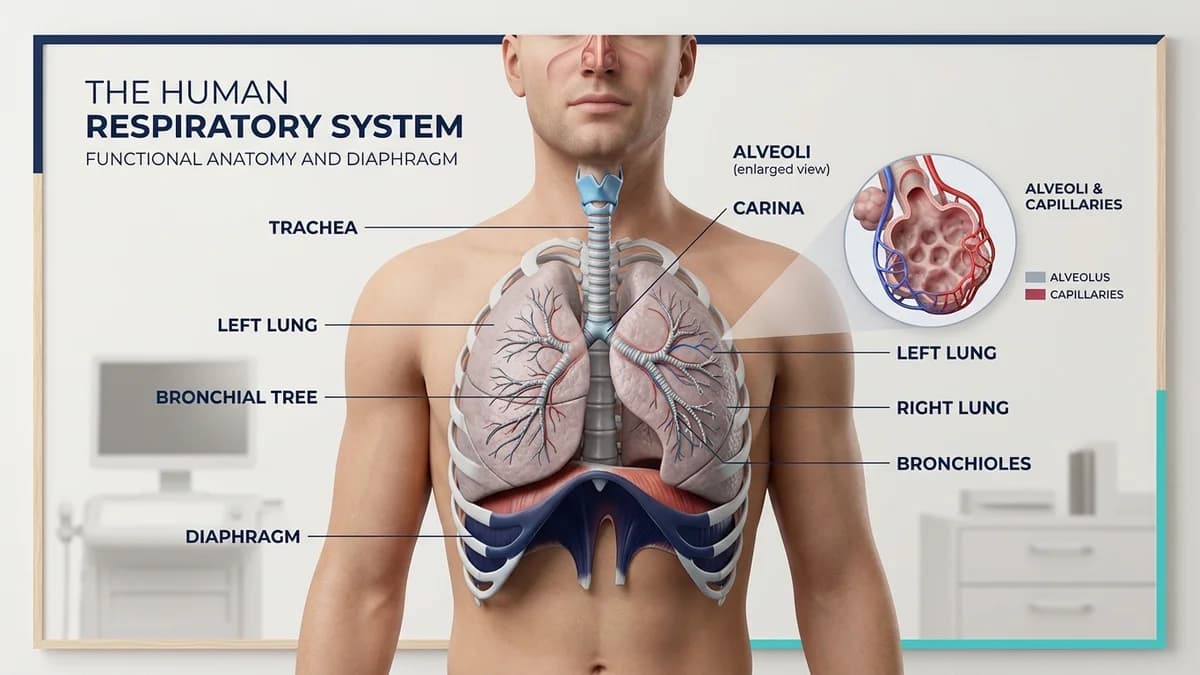
The technique utilizes the highest possible expiratory airflow without causing dynamic airway compression, shearing thick mucus from peripheral bronchioles into the central trachea using controlled tidal volumes across three distinct lung levels.
The Three Phases of Autogenic Drainage
Autogenic drainage progresses systematically from peripheral detachment to central evacuation, matching the anatomical location of mucus.
| Phase Name | Target Lung Volume Level | Physiological Objective | Acoustic / Tactile Feedback | |
|---|---|---|---|---|
| 1. Unsticking Phase | Low lung volume (near Residual Volume, RV) | Loosens secretions adhering to small peripheral airways | High-pitched crackles heard or felt in lower chest. | |
| 2. Collecting Phase | Mid lung volume (around Functional Residual Capacity) | Accumulates loosened secretions into medium-sized bronchi | Medium-pitched rattles felt in mid-thoracic region. | |
| 3. Evacuating Phase | High lung volume (near Total Lung Capacity, TLC) | Propels pooled mucus from central trachea into pharynx | Low-pitched coarse vibrations in upper chest and throat. |
Step-by-Step Execution of the AD Breathing Cycle
The patient sits upright with an open glottis, breathing in slowly through the nose to warm and filter the air, holding for 2 to 3 seconds, and exhaling smoothly through the mouth.
- Step 1: The Initial Exhalation: Exhale completely down toward Residual Volume, emptying the lungs as much as comfortably possible without straining.
- Step 2: Low-Volume Unsticking Breaths: Inhale a small breath, hold for 2 to 3 seconds, and exhale smoothly down to low volume. Repeat for 3 to 5 breaths until peripheral crackles change pitch.
- Step 3: Mid-Volume Collecting Breaths: Gradually increase inspiratory depth to normal tidal volume, holding at peak, and exhaling to mid-lung level to roll secretions together.
- Step 4: High-Volume Evacuation and Huff: Inhale deeply toward TLC and perform a gentle, high-volume huff to evacuate secretions into the mouth for clean expectoration without violent coughing.
Clinical Advantages and Patient Selection
The greatest advantage of AD is that it produces zero gastroesophageal reflux (GERD) and minimal intracranial pressure spikes, making it far safer than head-down postural drainage in patients prone to reflux or hemoptysis.
However, mastering AD requires cognitive maturity, body awareness, and patient patience. It is generally introduced to children from age 8 to 10 onward.
Frequently Asked Questions
Why is autogenic drainage preferred over coughing in cystic fibrosis?
Repetitive violent coughing collapses unstable, bronchiectatic airways, creating dynamic airway obstruction and causing severe fatigue. AD shears mucus smoothly without airway collapse, saving energy and preserving lung function.
How long does a complete autogenic drainage session take?
A thorough AD session typically takes 20 to 30 minutes, performed once or twice daily during stable periods, and increased to 3 to 4 times daily during acute pulmonary exacerbations.
Can nebulized bronchodilators or mucolytics be taken before AD?
Yes. Inhaling prescribed bronchodilators, hypertonic saline (3% or 7%), or dornase alfa 15 to 30 minutes prior to AD hydrates secretions, significantly accelerating clearance.
Related condition guides


Related recovery guides & articles
BookPhysio.in Editorial Team
The BookPhysio.in editorial team writes and maintains this content, checking it against reliable clinical sources. Content follows our medical review policy: general information only, and no page claims a clinical review until a named registered physiotherapist has signed it off.
Read our medical review policy