
Preventing Falls in Elderly Parents: Balance Drills, Bathroom Safety, and Walking Aids
In short
Falls among elderly parents lead to devastating fractures and loss of independence. Discover proven balance exercises and practical Indian home safety modifications.
In this guide (5 sections)
Falls among older adults are the single leading cause of fatal and non-fatal accidental injuries globally, with studies in India indicating that more than 30 percent of community-dwelling individuals over the age of 60 experience at least one fall each year. In the elderly, a fall is rarely a simple stumble: it frequently results in catastrophic femoral neck hip fractures, traumatic subdural hematomas, prolonged bed rest, and permanent loss of independent living. Furthermore, the psychological "fear of falling" triggers a devastating cycle of voluntary activity restriction, rapid muscle wasting, and worsening frailty.
Falls are neither an inevitable nor a normal part of ageing. They result from an identifiable combination of intrinsic biological vulnerabilities (sarcopenia, sensory decline, polypharmacy, postural hypotension) and extrinsic environmental hazards (slippery marble tiles, dark corridors, loose throw rugs). Specialized geriatric physiotherapy, utilizing evidence-based balance programmes like the Otago Exercise Programme, reduces fall risk by up to 40 to 50 percent while restoring senior confidence and dignity.
1. Pathophysiology: Age-Related Sensory and Motor Balance Decline
Upright human balance relies on the seamless integration of three distinct sensory afferent systems: the visual system, the vestibular system of the inner ear, and proprioceptive mechanoreceptors located in plantar foot skin, ankles, and spinal joints. With advancing age, peripheral nerve conduction velocities slow, plantar mechanoreceptors decrease in density, and vestibular hair cells atrophy: a triad known as presbyastasis.
Simultaneously, age-related sarcopenia preferentially atrophies type II (fast-twitch) skeletal muscle fibers in the quadriceps, gastrocnemius, and gluteus medius. When an elderly person stumbles over an obstacle, their brain perceives the displacement milliseconds too late, and their weakened fast-twitch muscle fibers fail to generate the rapid reactive stepping reaction required to catch their balance.
| Risk Dimension | Key Clinical Factors | Diagnostic Screening Tool | Physiotherapy Intervention Priority |
|---|---|---|---|
| Musculoskeletal (Sarcopenia) | Quadriceps weakness, weak ankle dorsiflexors, gluteal atrophy | 30-Second Chair Stand Test (< 10 reps indicates high risk) | Progressive resistance training, sit-to-stand chair power drills |
| Neuromuscular Balance | Presbyastasis, impaired reactive stepping, widened base of support | Timed Up and Go (TUG) Test (> 12 seconds indicates high fall risk) | Otago balance protocol, tandem stance, dynamic obstacle navigation |
| Sensory & Medication | Diabetic neuropathy, cataracts, polypharmacy (> 4 medications) | Monofilament test, orthostatic blood pressure check | Sensory reweighting, lighting improvements, physician medication review |
| Environmental Hazards | Polished vitrified tiles, loose cotton dhurries, dark night corridors | CDC STEADI Home Safety Environmental Checklist | Installation of bathroom grab rails, non-slip footwear, rug elimination |
2. The Indian Household Safety Audit: Bathrooms, Dhurries, and Lighting
The architecture and flooring of traditional and modern Indian homes present unique fall risks that must be systematically addressed. Over 60 percent of indoor falls occur in bathrooms or during night-time navigation between the bedroom and bathroom. Wet, smooth vitrified tiles, water puddles from bucket baths, and low wooden bath stools without back support create treacherous slip hazards.
A comprehensive home safety audit requires immediate physical modifications: remove all loose cotton dhurries, decorative rugs, and slippery doormats (or affix them firmly with heavy-duty double-sided rug tape); install wall-mounted stainless steel grab rails beside the commode and inside the shower area; place battery-operated motion-sensor nightlights along the hallway; and replace slippery smooth-soled slippers with supportive footwear featuring non-skid rubber grip soles.
3. Three-Phase Otago Balance and Strength Protocol
The Otago Exercise Programme is an internationally validated, evidence-based fall prevention system specifically engineered for seniors.
Three-Phase Otago Balance and Lower Limb Strength Protocol
Objective: Progressively narrow the base of support, improve reactive stepping speed, and strengthen anti-gravity leg musculature.
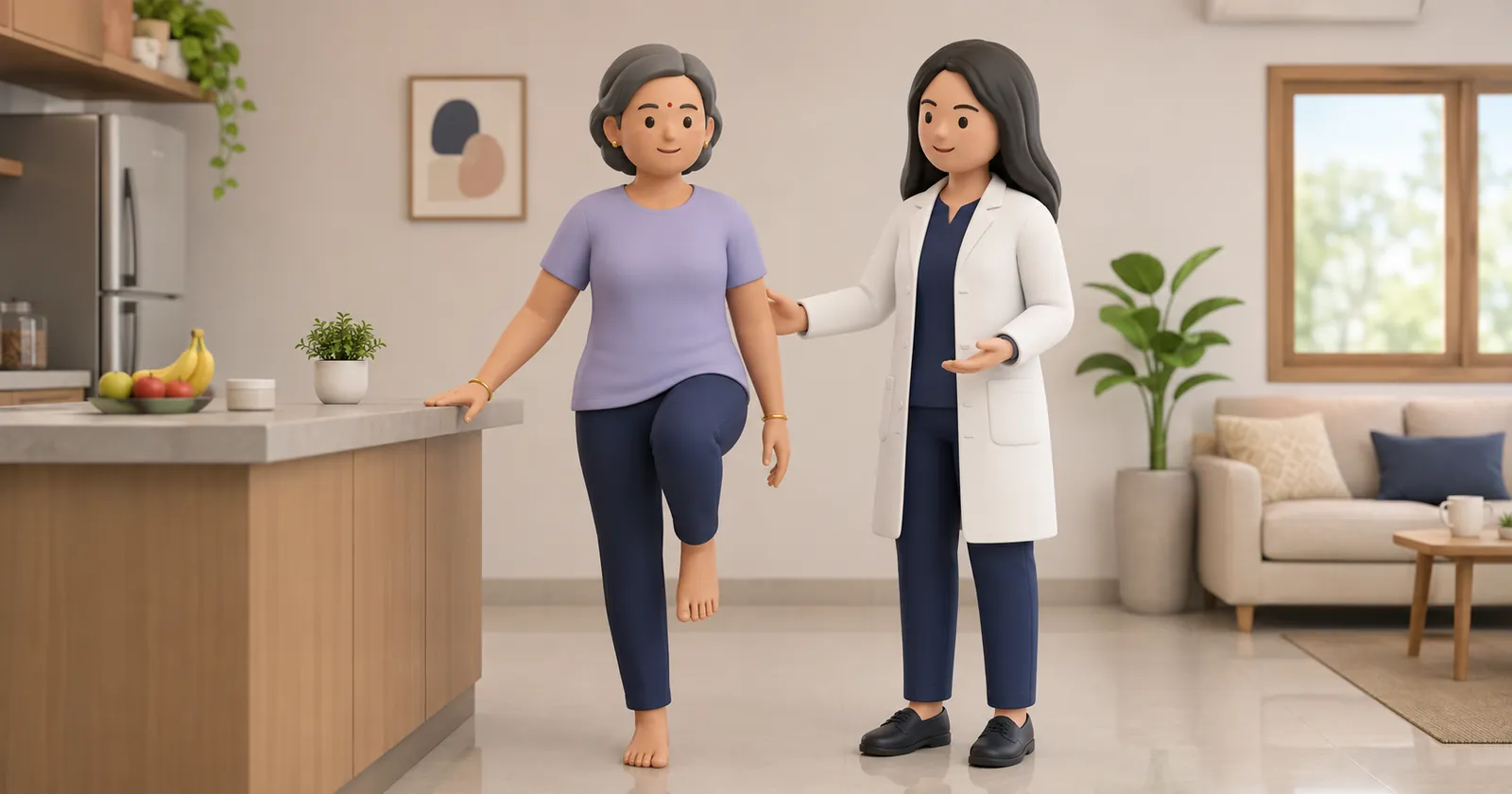
- 1Phase 1 (Progressive Base-of-Support Narrowing): Stand beside a sturdy dining table or kitchen counter where you can hold with two hands if needed. Practice four sequential balance stances: (1) Feet together (feet touching); (2) Semi-tandem (heel of one foot touching the instep of the other); (3) Full tandem (one foot directly in front of the other like walking a tightrope); and (4) Single-leg stance (standing on one leg). Aim to hold each position for 10 to 20 seconds. Progress from two hands holding, to one fingertip, to hands hovering above the counter.
- 2Phase 2 (Dynamic Locomotion and Tandem Walking): Walk 10 steps along a clear hallway placing your heel directly against the toes of your other foot (tandem walking). Next, practice backward walking: take 10 deliberate steps backward holding a wall or railing for security. Backward walking specifically stimulates hip extensors and vestibular righting reflexes that deteriorate with age.
- 3Phase 3 (Sit-to-Stand Functional Power Training): Sit upright in a sturdy armchair with feet flat on the floor. Cross your arms across your chest. Lean your upper torso forward from the hips ("nose over toes") and push firmly through your heels to stand completely upright without using your hands. Lower back down with slow, controlled pacing over 3 seconds. Perform 10 repetitions, 2 sets daily.
- 4Safety Rule: Never perform balance drills alone without sturdy furniture or a caregiver nearby. If dizziness occurs, immediately sit down in a firm chair.
4. Red Flags and Post-Fall Emergency Management
If an elderly parent experiences a fall, careful assessment is mandatory before attempting to lift them. If the senior hit their head (especially if taking blood-thinning medications like aspirin, clopidogrel, or apixaban), seek emergency hospital evaluation for a non-contrast head CT scan to exclude intracranial hemorrhage. If they complain of severe groin, hip, or back pain, or if one leg appears visibly shortened and turned outwards, suspect a femoral neck hip fracture: do not attempt to stand them up; immobilize the leg and call emergency medical services immediately.
Frequently Asked Questions
How do I convince an elderly parent who refuses to use a walking stick?
Many seniors resist walking aids because they associate them with frailty and loss of independence. Frame the walking stick as a tool of freedom and security that allows them to continue going to temples, community parks, and family weddings safely without fear. Work with a physiotherapist to properly measure and fit the cane: a properly fitted, modern lightweight cane feels empowering rather than cumbersome.
Why do elderly people tend to fall when getting out of bed quickly at night?
Sudden rising triggers orthostatic (postural) hypotension: a sudden drop in blood pressure when transitioning from lying to standing, caused by sluggish autonomic baroreceptor reflexes and blood pressure medications. This temporary cerebral hypoperfusion causes brief dizziness and blackout. Seniors should sit on the edge of the bed for 60 seconds, pump their ankles, and take several deep breaths before standing.
Can balance exercises still help someone in their late 70s or 80s?
Yes, remarkably so. Clinical trials consistently prove that neuromuscular plasticity and muscle hypertrophy occur well into the 80s and 90s. Seniors who engage in structured balance and strength training experience substantial reductions in fall frequency and regain the ability to climb stairs and walk outdoors independently.
What is the correct height for a walking stick or cane?
Stand upright wearing normal walking footwear with arms hanging naturally at the sides. The top handle of the walking stick should align exactly with the crease of the wrist (level with the greater trochanter of the femur). When holding the handle, the elbow should bend naturally at a comfortable 15 to 20-degree angle.
How does BookPhysio.in assist families seeking fall prevention care across India?
BookPhysio.in connects families with certified geriatric physiotherapists who conduct comprehensive fall risk assessments and Otago balance training in the safety of the senior's home (₹600 to ₹2,000) or in clinics (₹400 to ₹1,500). Clinicians audit home hazards and train caregivers with transparent per-visit pricing and zero platform commission.
Related condition guides


BookPhysio.in Editorial Team
The BookPhysio.in editorial team writes and maintains this content, checking it against reliable clinical sources. Content follows our medical review policy: general information only, and no page claims a clinical review until a named registered physiotherapist has signed it off.
Read our medical review policy