
Fear of Falling (Ptophobia) in Indian Elders: Breaking the Deconditioning Cycle at Home
In short
Fear of falling traps Indian elders in sedentary isolation, paradoxically doubling their fall risk. Discover clinical balance confidence protocols and home physio.
In this guide (5 sections)
Among elderly Indian citizens, one of the most pervasive yet poorly recognized geriatric syndromes is Ptophobia: the clinical Fear of Falling (FOF). Following a minor slip on a wet bathroom tile, a stumble over an uneven pavement slab during a morning walk, or simply witnessing a peer suffer a fatal hip fracture, an elder develops an overwhelming, paralyzing terror of losing their balance.
Out of deep love and anxiety, their adult children often amplify this fear: "Papa, don't go out for walks anymore," "Mummy, don't step into the kitchen, the maid will do everything." Confined to their armchair or bed, the senior's world shrinks to four walls. However, modern geriatric medicine reveals a cruel biological paradox: sheltering an elder through forced immobility dramatically accelerates muscular atrophy, degrades vestibular balance reflexes, and paradoxically doubles their risk of suffering a catastrophic fall. Clinical geriatric balance physiotherapy breaks this vicious cycle, restoring physical stability and mental self-efficacy.
1. Pathophysiology: The Avoidance-Deconditioning Vicious Loop and Stiffening Strategy
Fear of falling triggers a destructive neuro-biomechanical cascade known as the Geriatric Avoidance-Deconditioning Loop. When an individual perceives high fall risk, their sympathetic nervous system activates, prompting an involuntary motor reaction known as the "postural stiffening strategy."
Instead of allowing natural, fluid, compliant micro-adjustments at the ankles and hips to absorb perturbations, the fearful senior co-contracts opposing muscle groups simultaneously: locking their knees, freezing their ankles, shortening their stride, and stooping forward with a wide, rigid base of support. This rigid posture severely impairs the body's natural balance strategies: 1. The Ankle Strategy (subtle gastrocnemius-tibialis anterior sways for small balance disturbances). 2. The Hip Strategy (rapid pelvic flexion-extension for medium perturbations). 3. The Stepping Strategy (rapid reactive stepping when the center of mass moves outside the base of support).
Because walking feels terrifyingly rigid and exhausting, the elder restricts physical activity. Within weeks, disuse triggers rapid Type II (fast-twitch) muscle fiber atrophy in the quadriceps and gluteals, declines proprioceptive joint receptors, and dulls vestibular semicircular canal sensitivity. When a minor, unavoidable trip occurs (such as catching a toe on a rug), their weakened, slow-firing muscles cannot execute a rapid reactive recovery step, resulting in an unprotected fall.
| Deconditioning Phase | Neuromuscular & Biomechanical State | Psychological & Social Impact | Clinical Physiotherapy Intervention |
|---|---|---|---|
| Phase 1: Initial Stumble / Minor Slip | Intact musculature; transient fright reflex | Acute anxiety; loss of perceived invulnerability | Immediate clinical gait screening; reassurance; early balance audit |
| Phase 2: Motor Stiffening & Activity Avoidance | Co-contraction of ankles/knees; shuffling gait; slowed cadence | Avoids outdoor walks, pooja visits, and family social events | Dual-task balance drills; pelvic fluidity; ankle strategy restoration |
| Phase 3: Severe Sarcopenia & Frailty | Loss of Type II fast-twitch muscle fibers; severe quad weakness | Depression, complete domestic dependence, fear of standing alone | Progressive resistance training; reactive step recovery; home modifications |
2. Indian Domestic Environment: Kitchen High Shelves, Clutter, and Slippery Tiles
Indian domestic settings are filled with high-risk balance traps that terrify unstable elders. In traditional Indian kitchens, heavy stainless-steel spice jars (dabbas) and cookware are frequently stored on high shelves requiring seniors to stand on tiptoes or climb unstable wooden stools. Furthermore, kitchen floors routinely have slick spots from water splatters, spilled cooking oil, or dal.
Living areas feature loose floor mats, scattered toys in joint families, low electrical extension cords, and dark corridors during nighttime bathroom trips. An elder attempting to navigate this obstacle course with impaired eyesight and stiff joints experiences continuous sensory terror.
Breaking ptophobia requires restructuring the physical environment: reorganizing kitchen items to waist level, clearing floor pathways, improving ambient lighting, and systematically retraining balance confidence.
3. Three-Phase Balance Confidence and Reactive Stepping Protocol
Three-Phase Balance Confidence and Fall-Recovery Retraining Protocol
Objective: Dismantle the postural stiffening strategy, retrain reactive recovery steps, and rebuild confidence in daily activities.
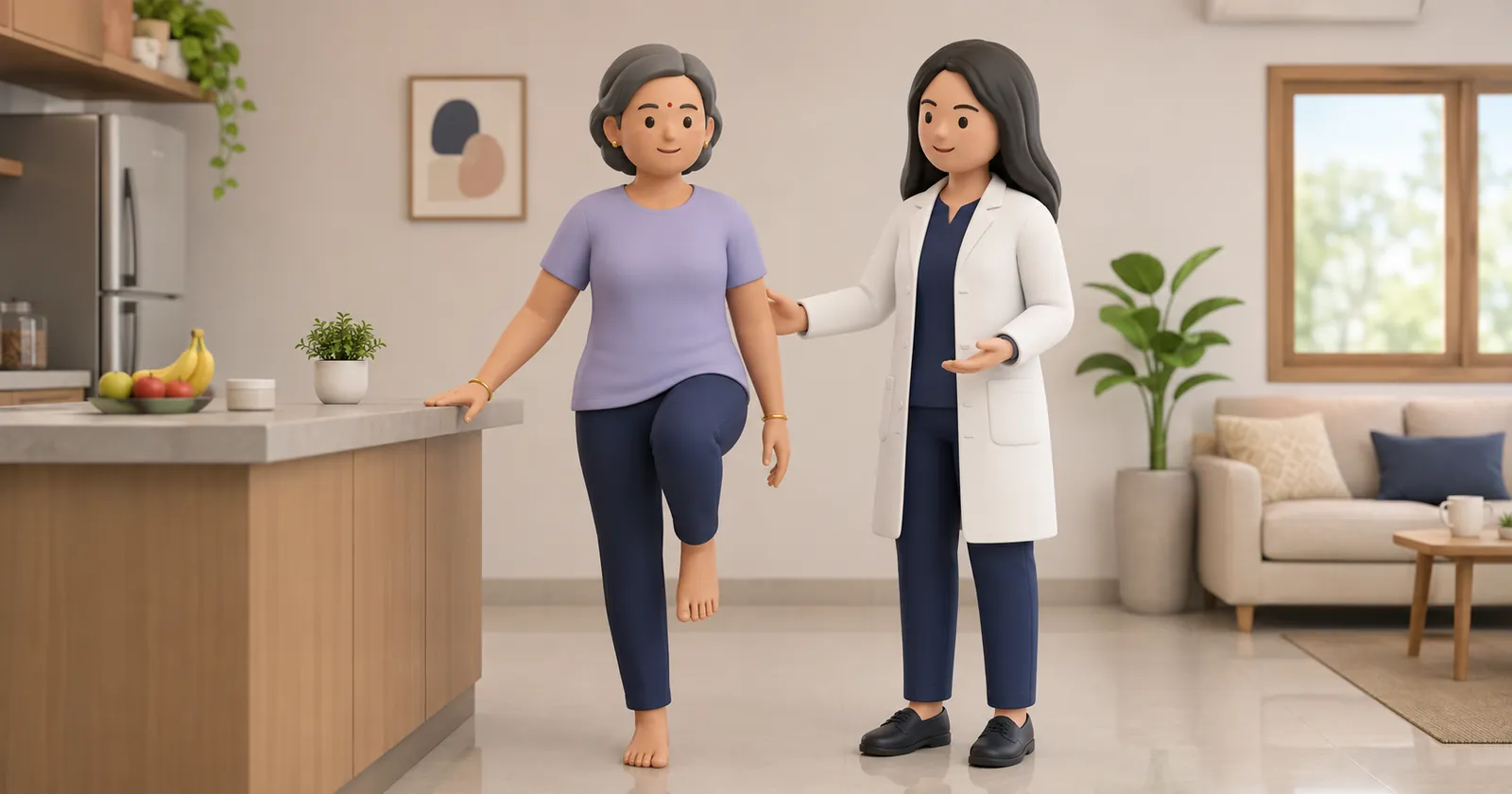
- 1Phase 1 (Static Postural Sensory Retraining - Daily): Perform beside a sturdy dining table or kitchen counter for safety: 1. Feet-Together Stance: stand with feet touching side-by-side, holding the counter lightly with one hand; look straight ahead at eye level; hold for 30 seconds; gradually reduce hand support to fingertip touch. 2. Semi-Tandem and Full Tandem Stance: place one foot directly in front of the other (heel touching toe); balance for 20 seconds per side; this challenges the vestibular and proprioceptive systems without fall risk.
- 2Phase 2 (Dynamic Weight Shifting and Ankle Strategy - 4 Days Weekly): 1. Ankle Rockers: stand tall with feet hip-width apart; gently sway forward onto the balls of your feet, then sway backward onto your heels without bending at the waist; feel the ankle muscles catching your balance; repeat 15 sways. 2. Kitchen Counter Side-Steps: take 10 slow, deliberate sideways steps along the counter to the right, then 10 steps to the left, firing the crucial hip stabilizer: the gluteus medius.
- 3Phase 3 (Reactive Stepping and Dual-Task Challenge - 3 Days Weekly): Most falls occur when attention is divided: 1. Controlled Reactive Stepping: stand with feet together; have a caregiver call out "Step Right!" or "Step Left!"; immediately take a rapid, wide recovery step in that direction and push back to center; repeat 10 times. 2. Dual-Task Walking: walk across the living room while naming items out loud (e.g., naming Indian states, counting backward from 50 by twos); this trains the brain to automate balance while conversing.
- 4The Overprotective Family Rule: Family members must stop doing everything for the senior. Encourage them to walk to the dining table, brew their own tea, and perform light daily tasks with supervision.
4. Critical Red Flags: Distinguishing Psychological Fear from Neurological Pathology
While fear of falling is predominantly psychological and deconditioning-related, new or worsening unsteadiness may signal an underlying neurological or cardiac disorder. Seek immediate specialist medical evaluation if you notice sudden, progressive difficulty walking accompanied by urinary incontinence and cognitive memory decline over a few months (the classic triad of Normal Pressure Hydrocephalus / NPH, which is surgically treatable with a shunt), sudden onset of lightheadedness, dizziness, or blacking out immediately upon standing up (indicating severe Orthostatic Hypotension or cardiac dysrhythmia), persistent "room-spinning" vertigo with nausea and nystagmus (suggestive of acute vestibular neuritis or BPPV), or asymmetrical limb weakness or facial drooping.
Frequently Asked Questions
Why does keeping an elderly parent in bed or in a chair make their fall risk worse?
When an elder stops walking, their muscles lose strength and power rapidly (up to 1 to 2 percent of muscle mass per day of bed rest), their joints stiffen, and their brain's balance centers become dull and slow. When they eventually must stand, their legs are too weak to support them, doubling their fall risk.
What is the "postural stiffening strategy" and why does it cause people to fall?
When someone is terrified of falling, they involuntarily tense all their leg and trunk muscles, locking their knees and ankles. While this feels safe, a rigid body cannot absorb small bumps or surface irregularities. The moment their foot catches, the stiff body topples over like a falling tree.
How do you convince an anxious, fearful senior to start walking again?
Start very small with zero-risk exercises right beside a sturdy kitchen counter or heavy dining table. Celebrate every tiny success. Having a professional home physiotherapist guide them through safe, gradual balance challenges builds confidence much faster than well-meaning family coaxing.
Are walking sticks or walkers helpful or do they make an elder dependent?
When properly measured and prescribed by a physiotherapist, a walking stick or four-wheeled walker expands the base of support and provides invaluable sensory feedback, dramatically reducing anxiety. However, using an improperly sized or wobbly stick can actually cause trips and falls.
How do I book a home balance and fall-prevention physiotherapist on BookPhysio.in?
BookPhysio.in connects families across major Indian cities with certified geriatric physiotherapists who specialize in balance confidence retraining, reactive stepping drills, and home hazard audits. In-home sessions range from ₹600 to ₹2,000 with direct per-visit payment and zero platform commission.
Related condition guides


BookPhysio.in Editorial Team
The BookPhysio.in editorial team writes and maintains this content, checking it against reliable clinical sources. Content follows our medical review policy: general information only, and no page claims a clinical review until a named registered physiotherapist has signed it off.
Read our medical review policy