
Neck Disability Index (NDI): Scoring, Interpretation and MCID in Cervical Spine Care
In short
The Neck Disability Index (NDI) is the primary outcome measure for cervical radiculopathy, whiplash and tech-neck posture pain. Here is how clinicians score, interpret and apply NDI findings.
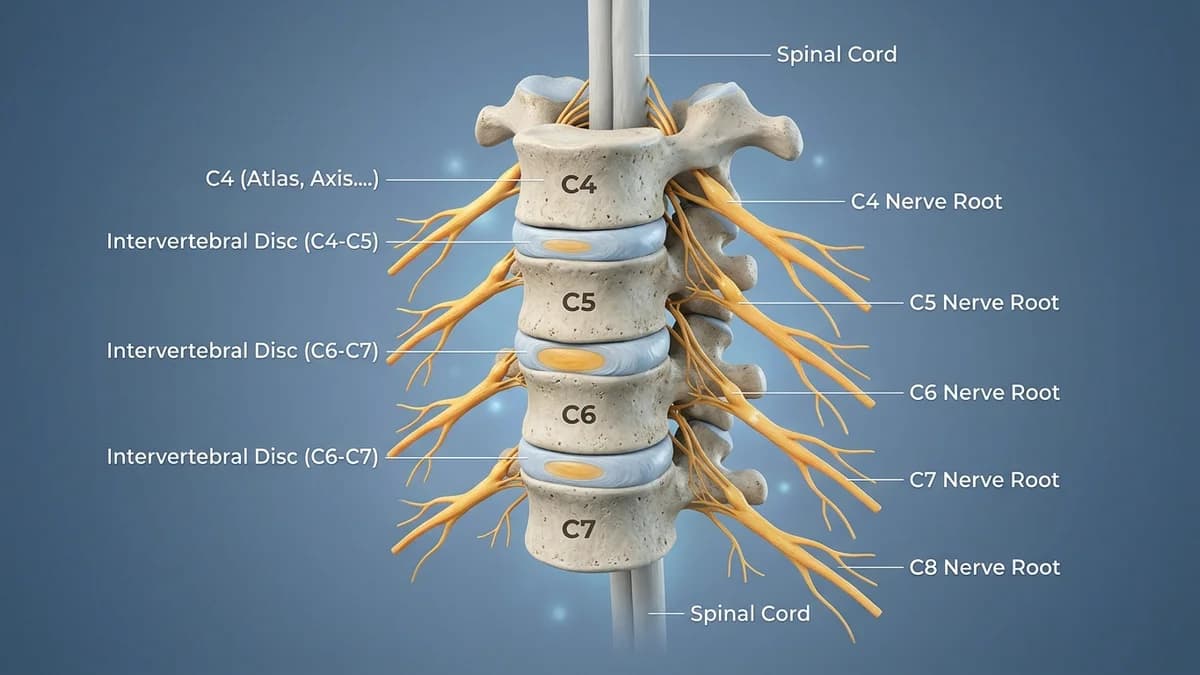
In this guide (5 sections)
What Is the Neck Disability Index (NDI)?
The Neck Disability Index (NDI) was developed by Howard Vernon and Silvano Mior in 1991 as an adaptation of the Oswestry questionnaire specifically tailored to the cervical spine.
It consists of 10 items assessing neck-related functional limitations: pain intensity, personal care, lifting, reading, headaches, concentration, work, driving/commuting, sleeping and recreation.
Scoring Formula and Classification Levels
Each item is scored from 0 (no limitation) to 5 (complete limitation). The raw score ranges from 0 to 50.
Clinicians frequently convert the raw score to a percentage by multiplying by 2: Percentage (%) = Raw Score * 2. If one item is unanswered (such as driving for non-drivers), divide by the actual maximum possible points: (Raw Score / 45) * 100.
| Score (out of 50) | Percentage (%) | Severity Category | Typical Clinical Presentation | |
|---|---|---|---|---|
| 0 to 4 | 0% to 8% | No Disability | Mild intermittent stiffness; no functional impairment during computer work or sleep. | |
| 5 to 14 | 10% to 28% | Mild Disability | Can perform work and self-care but experiences soreness after sustained screen time, reading or driving. | |
| 15 to 24 | 30% to 48% | Moderate Disability | Difficulty with concentration, prolonged desk postures, lifting bags and restful sleep. Requires frequent rest breaks. | |
| 25 to 34 | 50% to 68% | Severe Disability | Significant restriction across reading, driving and work. Arm radiation or cervicogenic headaches frequently present. | |
| 35 to 50 | 70% to 100% | Complete Disability | Patient is unable to perform basic self-care, work or drive due to severe cervical pain or radiculopathy. |
Minimal Clinically Important Difference (MCID)
Research by Young et al. and Pool et al. establishes an MCID of 5 points (or 10 percentage points) for cervical radiculopathy and non-specific mechanical neck pain.
For acute whiplash injuries (WAD), a change of 7 points is considered the threshold for true clinical improvement exceeding standard error.
- Desk-bound IT professionals: A reduction from 18 points (36%) to 8 points (16%) correlates with improved screen tolerance and fewer tension headaches.
- Cervical radiculopathy: A drop of 7 or more points indicates successful nerve root decompression and neural mobilization.
- Follow-up intervals: Re-test at week 3, week 6 and week 12 of conservative care.
Ergonomic and Commuting Context in India
In major Indian metro cities, two wheeler commuting (motorcycles and scooters over uneven road surfaces) and laptop use without external monitors place severe axial loading on the cervical facet joints and disc spaces.
Clinicians should note whether driving scores reflect two-wheeler vs four-wheeler operation, as motorcycle riding with a heavy helmet imposes substantially higher cervical fatigue.
Frequently Asked Questions
Can the NDI be used for tension-type or cervicogenic headaches?
Yes. Section 5 of the NDI specifically rates headache intensity and frequency related to neck stiffness, making it very helpful for evaluating cervicogenic headaches.
How do you score NDI if a person does not drive?
Omit the driving section and divide the total score by 45: (Raw Score / 45) * 100. This avoids artificially skewing the disability percentage.
What is the correlation between NDI and visual analog scale (VAS)?
NDI and VAS correlate moderately (r = 0.55 to 0.70). While VAS measures subjective pain intensity, NDI measures functional disability and emotional limitation.
Related condition guides

Related recovery guides & articles
BookPhysio.in Editorial Team
The BookPhysio.in editorial team writes and maintains this content, checking it against reliable clinical sources. Content follows our medical review policy: general information only, and no page claims a clinical review until a named registered physiotherapist has signed it off.
Read our medical review policy