
Spurling's Test and Cervical Distraction Test: Cervical Radiculopathy Assessment Guide
In short
Spurling test and the cervical distraction test form the clinical backbone of Wainner cervical radiculopathy diagnostic cluster. Learn the hand placement, biomechanical mechanisms, sensitivity, specificity, and red flags for cervical spine examination.
In this guide (5 sections)
Clinical Objective of Spurling Test
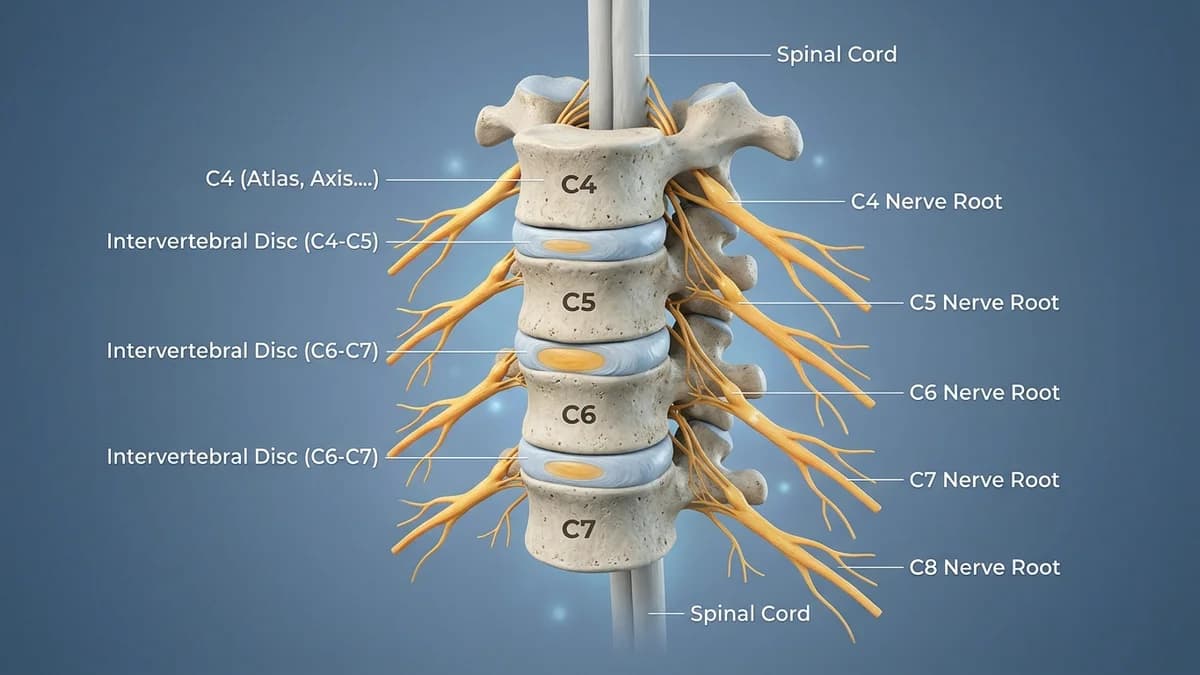
Spurling test, also known as the neck compression test, is a provocative physical examination maneuver designed to reproduce cervical radiculopathy symptoms by narrowing the neural foramina.
When cervical disc herniation, uncovertebral osteophytes, or facet joint hypertrophy encroaches upon an exiting cervical nerve root (most commonly C6 or C7), axial loading combined with lateral flexion concentrates compressive stress on that nerve root.
How to Perform Spurling Test (Wainner Modification)
The modified Spurling test A (Wainner protocol) emphasizes patient safety by avoiding excessive hyperextension:
- Patient Positioning: The patient sits upright comfortably on an examination plinth with feet flat on the floor.
- Lateral Flexion Maneuver: The patient actively side-bends their head toward the symptomatic side.
- Controlled Axial Loading: The clinician places both hands interlocked on the patient crown and applies a gentle, controlled vertical axial downward force of approximately 7 kg.
- Positive Finding: Reproduction of sharp radicular pain radiating down the ipsilateral arm in a distinct dermatomal distribution. Localized neck pain alone does NOT constitute a positive test.
The Cervical Distraction Test: Relieving Neural Tension
The cervical distraction test is the mechanical counterpart to Spurling test: rather than compressing the neural foramen, it widens the space.
The patient lies supine. The clinician securely grasps the occiput with one hand and the chin or forehead with the other, smoothly applying an axial traction force of 10 to 15 kg. A positive finding occurs when the patient resting arm pain or tingling decreases or resolves completely.
Diagnostic Accuracy and The Wainner Cluster
No single provocative test provides 100 percent certainty. Mark Wainner and colleagues demonstrated that combining four physical tests yields a 99 percent post-test probability of cervical radiculopathy.
| Clinical Test | Sensitivity | Specificity | Diagnostic Role | |
|---|---|---|---|---|
| Spurling Test A | 50 percent (Low) | 92 percent (High) | Rules IN radiculopathy when positive | |
| Cervical Distraction Test | 44 percent (Low) | 90 percent (High) | Confirms mechanical decompression effect | |
| Upper Limb Neurodynamic Test 1 (ULTT1 / Median) | 97 percent (Very High) | 22 percent (Low) | Rules OUT radiculopathy when negative | |
| Ipsilateral Cervical Rotation < 60° | 89 percent (High) | 49 percent (Moderate) | Detects structural segmental restriction |
Frequently Asked Questions
When is Spurling test strictly contraindicated?
Spurling test is contraindicated in cases of suspected cervical spine fracture, acute cervical trauma, severe rheumatoid arthritis with atlantoaxial instability, cervical myelopathy (brisk reflexes, Hoffman sign), or active malignancy.
What does localized neck pain without arm radiation mean during Spurling test?
Localized neck or trapezius discomfort without peripheral radicular referral usually indicates facet joint arthropathy (cervical facet syndrome) or muscular splinting rather than nerve root compression.
Related condition guides

Related recovery guides & articles
BookPhysio.in Editorial Team
The BookPhysio.in editorial team writes and maintains this content, checking it against reliable clinical sources. Content follows our medical review policy: general information only, and no page claims a clinical review until a named registered physiotherapist has signed it off.
Read our medical review policy