
Can Physiotherapy Heal an L4-L5 Disc Bulge Without Surgery?
In short
Most L4-L5 lumbar disc bulges heal without surgery. Learn how natural disc resorption works, clinical recovery timelines, evidence-based exercises, and when surgery is truly required.
In this guide (10 sections)
The short clinical answer is yes: between 66 percent and 90 percent of lumbar disc bulges and herniations improve significantly without surgery through conservative management, movement adaptation, and natural biological disc resorption over 6 to 12 weeks.
What actually happens during an L4-L5 lumbar disc bulge?
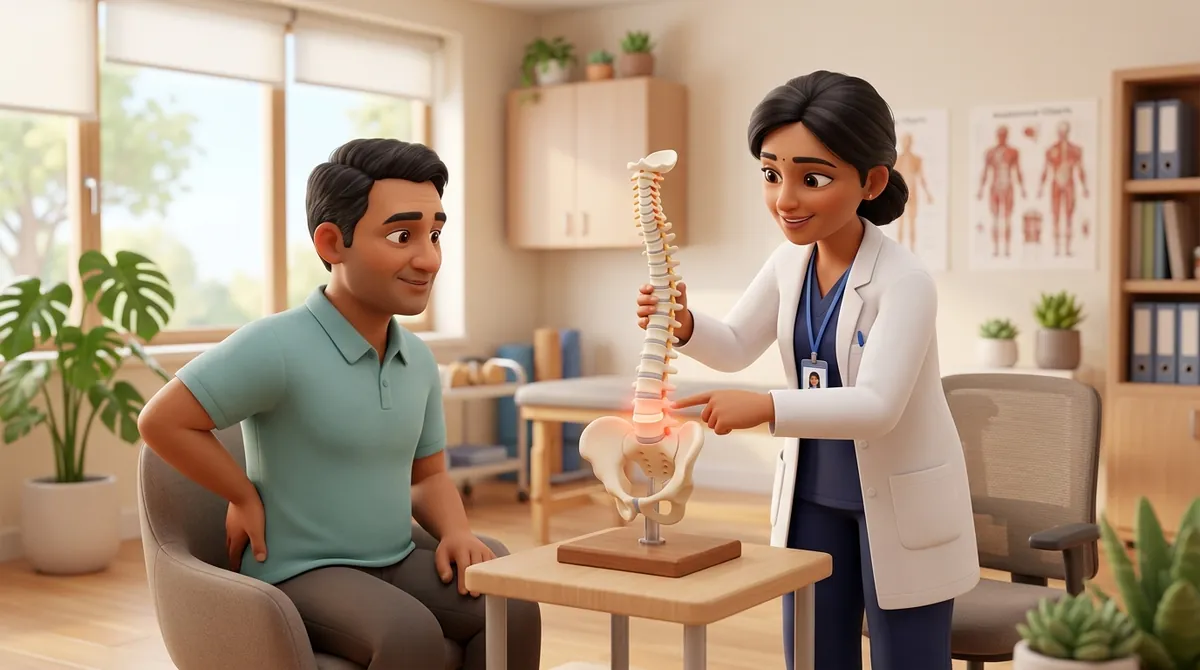
The lumbar spine carries five vertebrae. Between the fourth (L4) and fifth (L5) vertebrae rests an intervertebral disc designed like a tough, hydraulic shock absorber. This disc consists of two main structures: the tough outer fibrous ring (annulus fibrosus) and the gel-filled inner core (nucleus pulposus).
Under cumulative compressive force, repetitive bending, or prolonged sedentary loading, micro-tears can develop in the outer ring. The softer inner material pushes outward against the weakened wall, creating a bulge. Because the L4-L5 junction is one of the most mobile and weight-bearing segments in the human body, this displacement often sensitizes adjacent nerves, specifically the L5 nerve root which travels down the buttock, the outer side of the leg, and into the big toe.
The science of natural disc healing (resorption)
A common misconception in India is that once an MRI report mentions a disc bulge or protrusion, the spine is permanently broken and can only be repaired with surgical cutting. Modern spine research tells a very different biological story.
When disc material bulges or extrudes past its normal boundary, the immune system recognizes it as foreign material. Macrophages and enzymatic mediators migrate to the site, initiating natural dehydration and enzymatic breakdown of the displaced tissue. Longitudinal MRI studies reveal that conservative care allows the body to reabsorb or shrink displaced disc fragments over several months, relieving pressure on the nerve root while inflammation resolves.
The three phases of conservative physiotherapy rehabilitation
Recovery is not about lying in bed until the pain vanishes. Prolonged bed rest deconditions stabilizing muscles and delays healing. Physiotherapists follow a progressive, evidence-informed three-phase framework.
| Rehabilitation Phase | Primary Clinical Objective | Targeted Therapeutic Interventions |
|---|---|---|
| Phase 1: Acute Relief & Centralization (Weeks 1 to 3) | Reduce chemical nerve irritation, find directional preference, and teach spine-sparing movements. | Prone extension postures, gentle sciatic nerve sliders, ice or heat pacing, and avoiding loaded spinal flexion. |
| Phase 2: Dynamic Stabilization & Load Tolerance (Weeks 4 to 8) | Build muscular endurance around the lumbar spine without imposing excessive compressive loads. | McGill big-3 core exercises, hip-hinge retraining, glute activation, and graded walking programmes. |
| Phase 3: Functional Capacity & Relapse Prevention (Weeks 9 to 12+) | Restore full functional mobility, rotational stability, and confidence in daily and occupational activities. | Progressive resistance training, lifting mechanics, workstation ergonomics, and sport-specific drills. |
Evidence-based exercises for an L4-L5 disc bulge
Every spine is unique, and exercises should always be guided by the principle of centralization: movements that shift pain out of the leg and calf back toward the midline of the lower back indicate the nerve is decompressing. If any movement drives pain further down into your foot, pause and consult your physiotherapist.
Prone on Elbows (Passive Lumbar Extension)
Objective: Utilize directional preference to encourage anterior migration of disc material and relieve posterior nerve root compression.
- 1Lie face down on a firm, supportive mattress or floor mat with arms alongside your chest.
- 2Gently prop yourself up onto your forearms, placing your elbows directly below your shoulders.
- 3Relax your lower back, gluteal muscles, and abdominal wall completely, letting your pelvis sink into the surface.
- 4Breathe deeply and hold the position calmly. If pain concentrates in the lower back and recedes from the leg, remain in this position for 1 to 2 minutes.
McGill Bird-Dog (Spine-Sparing Core Activation)
Objective: Develop high endurance in the back extensor muscles and glutes while placing minimal compressive load on the lumbar discs.
- 1Position yourself on all fours with your wrists beneath your shoulders and knees beneath your hips.
- 2Maintain a neutral lumbar curve without letting your lower back sag downward or arch upward excessively.
- 3Brace your abdominal muscles lightly, as if bracing for a light touch.
- 4Slowly reach your right arm straight forward while simultaneously reaching your left leg straight backward until both are level with your torso.
- 5Hold the extended position steadily for 6 to 8 seconds without letting your pelvis tilt or rotate.
- 6Return slowly to the starting position and repeat on the opposite side.
Sciatic Nerve Flossing (Seated Slider Technique)
Objective: Restore smooth gliding mobility to the sensitized L5 and sciatic nerve roots without provoking tensile strain.
- 1Sit upright on a sturdy chair with your thighs supported and both feet resting flat on the ground.
- 2Slowly straighten your affected leg out in front of you while concurrently tilting your head back to look toward the ceiling (relaxing tension at the neck while tensioning at the foot).
- 3As you lower your foot back toward the floor, tuck your chin downward toward your chest (tensioning at the neck while releasing tension at the foot).
- 4Perform the movement rhythmically and smoothly, never forcing the motion into tingling or sharp shooting pain.
Movements and habits to avoid during acute flare-ups
- Loaded spinal flexion under rotation: Bending forward while twisting to lift a heavy parcel, a bucket of water, or luggage creates maximal shear stress across the posterior disc wall.
- Slouching in deep, soft sofas: Low, plush seating rolls the pelvis backward, flattening natural lumbar lordosis and increasing intradiscal pressure by up to 50 percent compared to upright sitting.
- Aggressive toe-touching hamstring stretches: Pulling vigorously on tight hamstrings with a rounded back stretches the irritated sciatic nerve over the inflamed disc bulge, increasing neural sensitivity.
- Prolonged bed rest exceeding 48 hours: Remaining completely immobile weakens spinal stabilizers, reduces disc nutrient exchange, and leads to heightened pain perception.
When is spine surgery actually needed?
Modern clinical guidelines recommend spinal surgery (such as a microdiscectomy) in fewer than 5 percent to 10 percent of lumbar disc cases. Elective surgical consultation is generally considered only when severe, debilitating nerve pain fails to improve after 6 to 12 weeks of structured conservative physiotherapy, or when a patient suffers from intractable pain that prevents sleep and basic daily functioning.
Critical red flags requiring emergency medical evaluation
Seek immediate emergency medical attention at a hospital if you develop loss of bladder or bowel control, numbness or altered sensation in your saddle area (groin, genitals, buttocks, or inner thighs), or sudden progressive muscular weakness such as foot drop (tripping or inability to lift the front of the foot). These symptoms indicate cauda equina syndrome or severe spinal cord compromise, which requires urgent surgical decompression within 24 to 48 hours.
In-clinic vs home visit physiotherapy for disc pain
During the acute phase of an L4-L5 bulge, travelling by car or auto-rickshaw over bumpy roads can provoke severe muscle spasms and heighten nerve pain. In this stage, home visit physiotherapy allows a council-registered clinician to assess your spine, verify neurological reflexes, and teach safe bed-mobility and positioning techniques directly in your living environment.
As acute symptoms settle and tolerance improves, clinic visits provide access to specialized equipment, progressive resistance tools, and therapeutic assessment spaces. On BookPhysio.in, in-clinic sessions typically range from ₹300 to ₹1,500, while home visit sessions range from ₹400 to ₹2,000 depending on travel distance and clinician qualifications. Patients pay their chosen physiotherapist directly with zero platform commissions.
Frequently asked questions
Does an MRI showing an L4-L5 bulge mean I will always have back pain?
No. High-quality radiological studies demonstrate that more than 30 percent of healthy, completely pain-free adults have lumbar disc bulges on MRI scans. The scan reflects tissue structure, not your pain level or functional future. With proper muscular strengthening and movement habits, most people live completely active, pain-free lives even if structural imaging findings remain.
How long does an L4-L5 disc bulge take to heal with physiotherapy?
Most patients experience notable relief within 4 to 6 weeks of consistent physiotherapy, positional changes, and core endurance training. Full functional recovery and biological remodeling generally occur across 8 to 12 weeks.
Is walking good for an L4-L5 disc bulge?
Yes. Walking is one of the most effective natural therapies for lumbar discs. It promotes gentle cyclic pressure changes that nourish the disc, activates postural muscles, and stimulates natural endorphin release. Take short, frequent walks (5 to 15 minutes) on flat surfaces, resting before fatigue sets in.
Can I do yoga if I have an L4-L5 disc bulge?
Gentle restorative yoga with an emphasis on neutral spinal posture and supported extensions (such as Sphinx pose) can be helpful. However, forward-bending poses like Paschimottanasana and deep seated spinal twists should be avoided during the acute and subacute recovery phases.
Evidence reviewed 7 October 2026. General information only.
Sources reviewed
North American Spine Society (NASS) Evidence-Based Clinical Guidelines for Multidisciplinary Spine Care: Diagnosis and Treatment of Lumbar Disc Herniation with Radiculopathy; National Institute for Health and Care Excellence (NICE) Guideline NG59: Low back pain and sciatica in over 16s; McGill SM, Low Back Disorders: Evidence-Based Prevention and Rehabilitation; Jensen MC et al., Magnetic resonance imaging of the lumbar spine in people without back pain (N Engl J Med).
How do urban Indian commuting conditions affect L4-L5 disc healing?
Commuting on uneven roads in two-wheelers, autorickshaws, or crowded local buses transmits repeated vertical shock and vibration directly through the lumbar spine. For an inflamed L4-L5 disc, this continuous micro-impact increases intradiscal pressure and delays resorption. Patients are advised to use lumbar support rolls in cars, stand with knees slightly unlocked during bus commutes, or temporarily switch to low-vibration transit during the initial 4 to 6 weeks of rehabilitation.
Related condition guides

BookPhysio.in Editorial Team
The BookPhysio.in editorial team writes and maintains this content, checking it against reliable clinical sources. Content follows our medical review policy: general information only, and no page claims a clinical review until a named registered physiotherapist has signed it off.
Read our medical review policy