
Cervicogenic Headache: C1-C2 Flexion-Rotation Test, Mulligan SNAG Mobilization & Suboccipital Release
In short
A throbbing unilateral headache that originates in the neck and radiates behind your eye is often a cervicogenic headache. Learn how C1-C2 mobilization stops the pain.
In this guide (5 sections)
Pathophysiology: The Trigeminocervical Nucleus Convergence
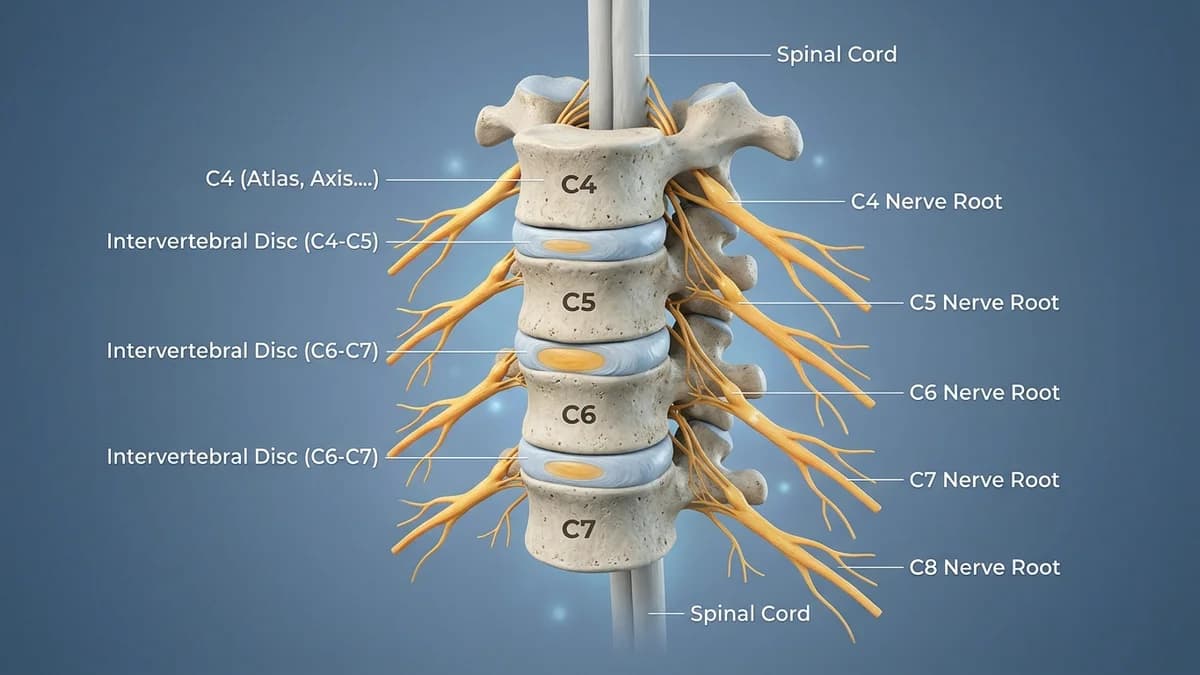
Cervicogenic Headache (CGH) is a secondary headache disorder characterized by unilateral head pain referred from musculoskeletal dysfunction in the upper cervical spine (specifically the C1-C2 atlantoaxial joint, C2-C3 zygapophyseal facet joint, and upper cervical spinal nerves).
The anatomical mechanism of pain referral lies in the trigeminocervical nucleus within the upper cervical spinal cord. Here, sensory nociceptive fibers from the upper three cervical nerves (C1, C2, C3) converge directly with primary sensory fibers from the ophthalmic division (V1) of the trigeminal nerve. The brain's sensory cortex misinterprets noxious inputs arising from a stiff, inflamed C1-C2 joint as pain originating from the forehead, temple, and retro-orbital eye space (the classic 'ram's horn' headache distribution).
Diagnostic Gold Standard: The Cervical Flexion-Rotation Test (FRT)
Developed by Dr. Toby Hall and colleagues, the Flexion-Rotation Test (FRT) is the validated clinical physical exam for diagnosing upper cervical joint hypomobility and cervicogenic headache, demonstrating a diagnostic sensitivity of 91% and specificity of 90%.
With the patient lying relaxed in supine, the examiner fully flexes the cervical spine to end-range (which locks out rotation from C3 down to C7) and then passively rotates the head to the left and right. Normal physiological C1-C2 rotation in full flexion is 44 degrees to each side. A restriction greater than 10 degrees (rotation < 32-34 degrees) or asymmetry greater than 10 degrees with reproduction of the patient's headache confirms a positive test.
| Diagnostic Feature | Cervicogenic Headache (CGH) | Migraine without Aura | Tension-Type Headache (TTH) | |
|---|---|---|---|---|
| Pain Laterality | Strictly unilateral (side-locked); never shifts | Unilateral or bilateral; can switch sides | Bilateral diffuse 'tight band' around head | |
| Pain Characteristics | Deep, dull ache, throbbing at peaks; non-pulsatile | Intense, pulsating, throbbing, disabling | Dull, non-pulsatile pressing tightness | |
| Neck Motion Trigger | Reproduced by neck rotation or pressure over C1-C3 | Not provoked by mechanical neck joint testing | Not reproduced by isolated segmental rotation | |
| Autonomic Symptoms | Rare; mild nausea or dizziness only | Severe nausea, vomiting, photophobia, phonophobia | Zero nausea; photophobia or phonophobia mild | |
| C1-C2 Flexion-Rotation Test | Positive: Significant range restriction (< 32 deg) | Negative: Normal symmetrical rotation (> 40 deg) | Negative: Normal symmetrical rotation |
Targeted Physiotherapy: Mulligan C1-C2 SNAG Mobilization
The primary breakthrough treatment is the Mulligan Sustained Natural Apophyseal Glide (SNAG). A trained physiotherapist hooks their thumb or a mobilization strap over the posterior arch of the atlas (C1) or the broad spinous process of the axis (C2), applying a sustained anterior glide while the patient actively rotates their head toward the restricted side.
This pain-free glide restores physiological joint gliding, immediately abolishing the trigeminocervical nociceptive barrage.
- Self-SNAG with a Towel Strap: Patients are taught a self-mobilization technique using a narrow strap or rolled towel held across the C1 arch, applying gentle sustained forward traction while rotating the head into end-range.
- Suboccipital Manual Decompression: Gentle sustained traction applied beneath the superior nuchal line releases hypertonic rectus capitis posterior and obliquus capitis muscles.
- Deep Neck Flexor Endurance Training: Retraining the longus capitis and longus colli muscles with a craniocervical flexion cuff prevents recurrence by stabilizing the upper cervical motion segments.
Long-Term Prognosis and Recovery Timelines
Randomized controlled trials confirm that 6 to 8 weeks of specialized manual upper cervical mobilization combined with deep neck flexor exercises achieves complete resolution or over 75 percent reduction in headache frequency and intensity in the majority of patients.
Frequently Asked Questions
How do I know if my headache is coming from my neck?
If your headache is strictly on one side, starts at the base of your skull, wraps around behind your ear to your temple or eye, and gets worse when you turn your head or sit at a computer, it is very likely a cervicogenic headache.
Can medications like paracetamol or triptans cure cervicogenic headaches?
Medications provide only temporary, partial pain relief because they cannot fix a mechanically stiff C1-C2 facet joint. Manual physiotherapy joint mobilization is needed to resolve the root cause.
Is upper cervical mobilization safe?
Yes. When performed by a qualified physiotherapist using gentle, low-velocity techniques like Mulligan SNAGs (without forceful high-velocity thrust cracking), upper cervical mobilization is exceptionally safe and highly effective.
Related condition guides

Related recovery guides & articles
BookPhysio.in Editorial Team
The BookPhysio.in editorial team writes and maintains this content, checking it against reliable clinical sources. Content follows our medical review policy: general information only, and no page claims a clinical review until a named registered physiotherapist has signed it off.
Read our medical review policy