
Pelvic Organ Prolapse: How Pelvic Floor Physiotherapy Helps Without Surgery
In short
Pelvic organ prolapse is common, manageable, and often significantly improved without surgery. Learn how pelvic floor physiotherapy, structured PFMT, and lifestyle adaptations restore pelvic support.
In this guide (9 sections)
Pelvic organ prolapse affects up to 50 percent of women who have given birth, yet remains widely shrouded in silence. High-quality clinical trials confirm that targeted pelvic floor muscle training can improve prolapse stage, relieve symptoms of heaviness or dragging, and prevent the need for surgical repair in mild to moderate prolapse.
Understanding pelvic organ prolapse and POP-Q staging
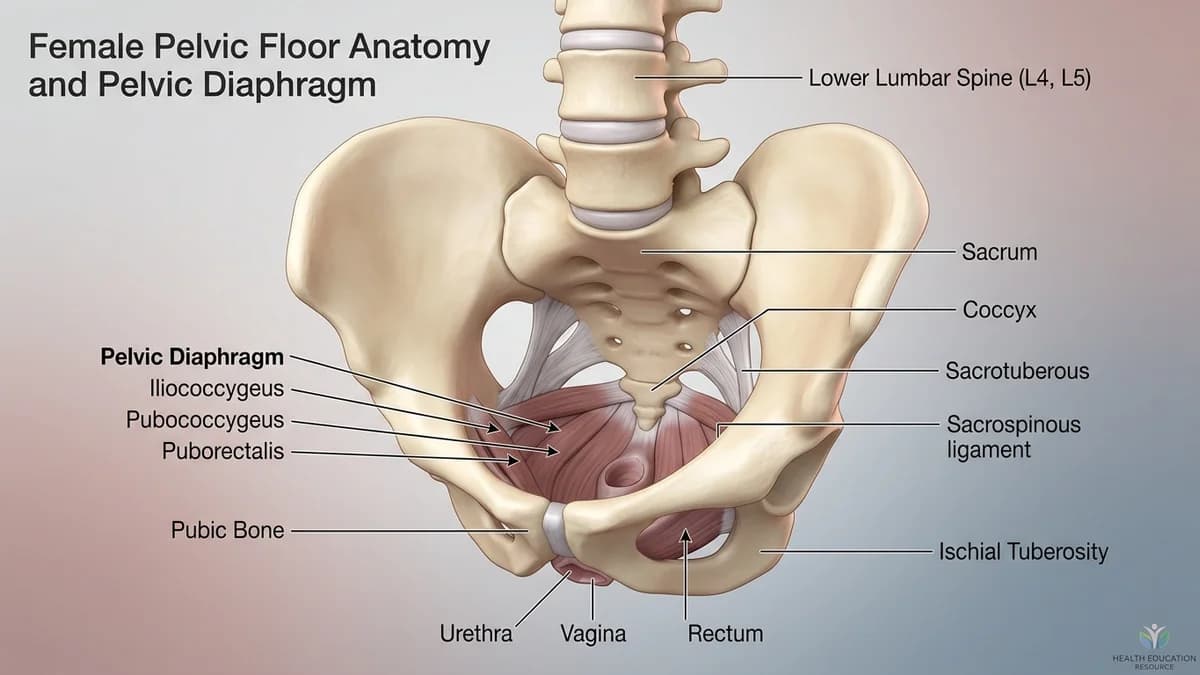
Pelvic organ prolapse occurs when the pelvic floor muscular hammock, endopelvic fascia, and suspensory ligaments stretch or weaken, allowing one or more pelvic organs (the bladder, uterus, or bowel) to descend into the vaginal canal. Depending on which compartment descends, prolapse is classified as anterior wall prolapse (cystocele), apical prolapse (uterine or vaginal vault prolapse), or posterior wall prolapse (rectocele).
Urogynecologists and pelvic health physiotherapists use the Pelvic Organ Prolapse Quantification (POP-Q) system to measure descent objectively relative to the hymenal ring. Understanding your clinical stage provides clarity on what conservative care can accomplish.
| Stage | Anatomical Position | Primary Clinical Management |
|---|---|---|
| Stage 0 | No descent; pelvic organs remain in normal anatomical position. | Preventative pelvic floor awareness, safe exercise mechanics. |
| Stage 1 | Leading edge of the prolapse is more than 1 cm above the hymen. | First-line supervised pelvic floor muscle training (PFMT); excellent response. |
| Stage 2 | Leading edge is between 1 cm above and 1 cm below the hymenal ring. | Targeted PFMT, intra-abdominal pressure modulation, and optional support pessary. |
| Stage 3 | Leading edge extends more than 1 cm beyond the hymen but without total eversion. | Pessary fitting combined with pelvic floor strengthening; surgical consultation if symptomatic. |
| Stage 4 | Complete eversion of the vaginal walls and exteriorisation of the uterus. | Surgical repair often indicated; preoperative and postoperative pelvic rehabilitation. |
The Knack technique: Bracing against downward pressure
One of the most powerful tools taught by pelvic health physiotherapists is "The Knack". Whenever you sneeze, cough, blow your nose, or lift your child, intra-abdominal pressure spikes sharply. If your pelvic floor is relaxed, that pressure hammers down on your pelvic organs like a piston.
The Knack is a conscious, well-timed contraction of the pelvic floor muscles performed just before and maintained through any increase in abdominal pressure. Clinical studies demonstrate that activating The Knack before a cough reduces downward organ displacement by more than 50 percent, protecting healing connective tissues from cumulative strain.
Targeted pelvic floor muscle training exercises
Effective pelvic floor training is not simply squeezing randomly throughout the day. It requires conscious control, proper breathing coordination, and full muscle relaxation between contractions to prevent hypertonic muscle tension.
Supine Diaphragmatic Breath with Pelvic Floor Re-education
Objective: Establish coordination between the respiratory diaphragm and the pelvic floor sling.
- 1Lie comfortably on your back with your knees bent and feet flat on the mattress or floor, placing a pillow under your knees.
- 2Place one hand on your upper chest and the other on your lower belly.
- 3Inhale slowly through your nose, allowing your lower abdomen to expand softly and picturing your pelvic floor gently lengthening and descending like an opening blossom.
- 4Exhale gently through pursed lips, drawing your lower belly inward and visualizing your pelvic floor gently lifting inward and upward (as if gently stopping the flow of urine or drawing up a marble).
- 5Release the contraction completely on the subsequent inhale. Never hold your breath.
Supported Glute Bridge with Adductor Engagement
Objective: Strengthen pelvic floor endurance and deep core stabilizers under mild gravity assistance.
- 1Lie on your back with knees bent and feet hip-width apart. Place a soft yoga block or rolled towel between your knees.
- 2Take a calm breath in to prepare.
- 3As you exhale, gently squeeze the block between your knees, engage your pelvic floor upward, and press through your heels to lift your hips 2 to 3 inches off the ground.
- 4Maintain the bridge for 5 seconds while breathing smoothly without straining.
- 5Inhale slowly as you lower your hips back down and fully relax your pelvic floor.
Wall-Supported Squat with Exhalatory Lift
Objective: Train functional pelvic floor support during functional upright movements.
- 1Stand with your back supported against a smooth wall, feet shoulder-width apart and placed about 12 inches away from the wall.
- 2Inhale as you slide down the wall into a comfortable partial squat (no deeper than 45 to 60 degrees). Allow your pelvic floor to remain soft and relaxed.
- 3Pause briefly at the bottom of the squat.
- 4Exhale, initiate a gentle pelvic floor contraction (The Knack), and push through your heels to return to standing.
- 5Fully release the pelvic floor once upright.
Bowel mechanics: Stopping the cycle of straining
Chronic straining during bowel movements is one of the leading causes of prolapse progression. Straining places tremendous mechanical shear on the rectovaginal septum. Adopt the following three adjustments to protect your pelvic floor:
- Use a footstool to change the anorectal angle: Elevating your feet on a 7-to-9 inch bathroom footstool places your hips in a natural squatting angle. This relaxes the puborectalis muscle, opening the rectal canal for effortless evacuation.
- Breathe instead of bearing down: Never hold your breath while having a bowel movement. Keep your mouth soft, blow out gently (the "moo" or "blow" technique), and let abdominal relaxation move the stool naturally.
- Optimize hydration and dietary fiber: Drink adequate water and include both soluble and insoluble fiber (such as psyllium husk, flaxseed, lentils, and oats) to achieve soft, formed bowel motions that do not require physical straining.
The role of vaginal pessaries
A vaginal pessary is a medical-grade silicone device fitted inside the vagina to provide direct structural support to prolapsed organs. Pessaries are non-surgical, removable, and highly effective for women with stage 2 or stage 3 prolapse who wish to exercise, work, or care for children without discomfort. Working with a pelvic health physiotherapist alongside your gynaecologist ensures the pessary fits comfortably and is paired with strengthening exercises.
In-clinic vs home visit pelvic floor physiotherapy
Pelvic health requires a safe, dignified, and comfortable environment. Many women prefer initial consultations in private specialized clinics where diagnostic biofeedback and private examination rooms are available. For new mothers or those with limited mobility, home visit physiotherapy allows a specialist to assess posture, lifting techniques, and baby-carrying mechanics in your own living space.
On BookPhysio.in, specialized women’s health physiotherapy sessions typically range from ₹500 to ₹1,800 for clinic visits and ₹600 to ₹2,000 for home visits in Indian cities. All fees are paid directly to your verified practitioner with zero platform commission.
Indian domestic realities: Squatting, heavy water buckets, and pelvic floor load
In Indian households, daily chores place substantial repetitive downward pressure on the pelvic floor. Lifting heavy steel buckets of water, carrying toddlers on one hip, and straining during chronic constipation from low fluid intake hammer against the levator ani muscular hammock. Modifying lifting mechanics and managing bowel habits are foundational elements of clinical pelvic floor rehabilitation.
Frequently asked questions
Can pelvic floor physiotherapy cure pelvic organ prolapse completely?
While physiotherapy may not completely reverse severe anatomical stretching of fascial ligaments, it reliably improves stage 1 and stage 2 prolapse by one full POP-Q stage, builds muscular baseline support, and dramatically reduces or eliminates symptoms of heaviness, bulging, and urinary leaking.
Can I continue running or weight training with prolapse?
Yes, but high-impact jumping and heavy maximal lifting should be temporarily modified during the initial strengthening phase. Your physiotherapist will teach you how to manage intra-abdominal pressure, progress through low-impact aerobic conditioning, and safely return to resistance training.
Is surgery always inevitable for prolapse?
No. International clinical guidelines from NICE and the International Continence Society recommend structured conservative care as the mandatory first-line treatment. Many women successfully manage their symptoms indefinitely through pelvic floor rehabilitation and lifestyle modifications without ever requiring surgery.
Evidence reviewed 7 October 2026. General information only.
Sources reviewed
National Institute for Health and Care Excellence (NICE) Guideline NG123: Pelvic floor dysfunction: prevention and non-surgical management; Hagen S et al., Conservative management of pelvic organ prolapse in women (Cochrane Database of Systematic Reviews); International Urogynecological Association (IUGA) / International Continence Society (ICS) Joint Report on the Terminology for Female Pelvic Floor Dysfunction; Bump RC et al., The standardization of terminology of female pelvic organ prolapse and pelvic floor dysfunction (Am J Obstet Gynecol).
Can pelvic floor exercises prevent the need for prolapse surgery in Indian women?
Yes. For mild to moderate pelvic organ prolapse (Stage 1 and Stage 2), intensive pelvic floor muscle training under a specialized physiotherapist elevates prolapse symptoms, reduces bulge sensation, and prevents surgical intervention in over 70 percent of women. For severe Stage 3 or 4 prolapse, physiotherapy remains essential pre- and post-operatively to support surgical repairs.
How do I access certified female pelvic health physiotherapists on BookPhysio.in?
BookPhysio.in connects women across India with certified female pelvic health physiotherapists in complete privacy. Patients can schedule clinic appointments (₹400 to ₹1,500) or discreet home visits (₹600 to ₹2,000), receiving tailored one-on-one care with direct per-visit payment and zero platform commission.
Related condition guides


BookPhysio.in Editorial Team
The BookPhysio.in editorial team writes and maintains this content, checking it against reliable clinical sources. Content follows our medical review policy: general information only, and no page claims a clinical review until a named registered physiotherapist has signed it off.
Read our medical review policy