
TMJ Pain and Jaw Clicking: Physiotherapy Exercises for Night Clenching, Chewing Ache, and Bruxism
In short
Painful jaw clicking, ear fullness, and morning temple headaches frequently stem from TMJ dysfunction and teeth grinding. Discover how physiotherapy restores pain-free chewing.
In this guide (5 sections)
Temporomandibular Joint Disorder (TMD), commonly referred to simply as TMJ pain, is a painful musculoskeletal condition affecting the hinge joint connecting the jawbone (mandible) to the temporal bone of the skull, along with the surrounding muscles of mastication. In India, TMJ dysfunction is surging rapidly among young corporate professionals, IT workers, and students, driven by chronic work stress, poor laptop ergonomic postures, sleep bruxism (teeth clenching and grinding), and daytime jaw clenching. Patients frequently consult multiple specialists: dentists for tooth pain, ENTs for ear fullness, and neurologists for migraines: before discovering that the root cause is a treatable musculoskeletal disorder.
The temporomandibular joint is one of the most frequently used joints in the human body, opening and closing over 2,000 times each day during speaking, chewing, swallowing, and yawning. It contains a delicate fibrocartilaginous articular disc that glides smoothly between the mandibular condyle and the mandibular fossa. When chronic stress, muscle spasm, or cervical spine misalignments disrupt this delicate movement, the disc becomes displaced, producing audible clicking, locking, chewing fatigue, and severe facial pain.
1. Biomechanics: The Articular Disc and the Cervical Spine Link
Under normal physiological conditions, when the mouth opens, the mandibular condyle first rotates in the lower joint space for the initial 20 to 25 millimeters, followed by an anterior translation (sliding forward and downward) in the upper joint space to achieve full mouth opening (40 to 50 mm). The biconcave articular disc sits atop the condyle, acting as a dynamic cushion controlled by the superior head of the lateral pterygoid muscle.
In the classic presentation of Disc Displacement with Reduction (DDwR), the disc is displaced anteriorly when the mouth is closed. As the mouth opens, the condyle clicks over the posterior edge of the disc to pop back into normal alignment (the "opening click"). When closing, the condyle slips back off the disc with a second "closing click". If left untreated, the disc can become permanently displaced without reduction (Disc Displacement without Reduction / Closed Lock), restricting mouth opening to less than 25 mm.
| Diagnostic Feature | Myofascial TMD (Muscular) | Disc Displacement with Reduction | Disc Displacement without Reduction (Lock) |
|---|---|---|---|
| Primary Pain Site | Masseter (cheek), temporalis (temples), radiating to neck and forehead | Localized directly over TMJ joint capsule (just anterior to tragus) | Severe, sharp pain localized to TMJ; deep preauricular ache |
| Audible Joint Sound | Usually silent; occasional dull grating crepitus without click | Reciprocal clicking/popping during opening and closing | No clicking sound (disc is permanently stuck forward) |
| Maximum Mouth Opening | Normal (40-50 mm) or mildly restricted by muscular tightness | Normal or mildly restricted with S-shaped deviation | Severely restricted (< 25-30 mm); hard mechanical end-feel |
| Physiotherapy Focus | Masseter/pterygoid trigger point release, dry needling, stress pacing | Rocabado 6x6 stabilization, disc retraining, cervical postural alignment | Gentle joint distraction, capsular mobilization, dental splint synergy |
2. The Indian Diet, Screen Habits, and Forward Head Posture
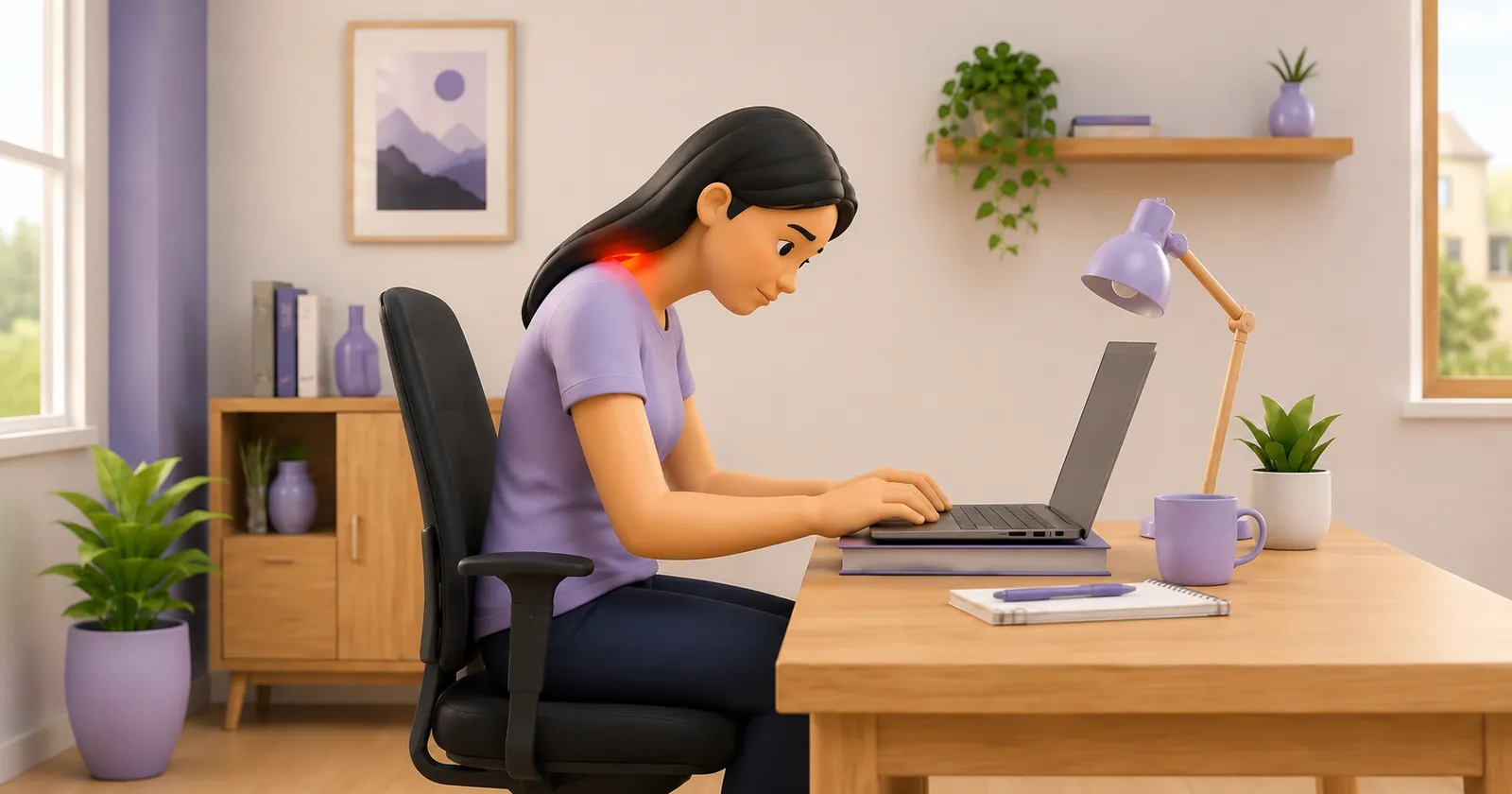
Two major lifestyle factors drive TMJ dysfunction across India. The first is modern tech-worker ergonomic posture: slumping forward over laptops and smartphones creates Forward Head Posture (FHP). For every inch the head migrates forward, the weight of the head on the cervical spine doubles. Biomechanically, forward head posture pulls the mandible backward into retrusion via tension in the hyoid musculature, compressing the highly sensitive, vascular retrodiscal tissue behind the TMJ condyle.
The second factor is dietary stress on mastication. Chewing tough, hard foods commonly consumed in Indian diets: such as roasted chana, hard supari (areca nut), sugarcane, hard crunchy rotis, or chewing gum: overloads the masseter and temporalis muscles. Patients experiencing acute TMJ flare-ups should temporarily switch to a soft-food diet (khichdi, dalia, idlis, smoothies, soft cooked vegetables) to allow inflamed joint tissues to rest.
3. Three-Phase Rocabado 6x6 and Stabilization Protocol
Physiotherapy for TMJ utilizes the internationally acclaimed Rocabado 6x6 exercise protocol to re-center the mandibular condyle and down-regulate overactive masticatory muscles.
Three-Phase TMJ Stabilization and Rocabado Protocol
Objective: Rest-position neuromuscular retraining, elimination of jaw deviation during opening, and myofascial decompression.
- 1Phase 1 (The Resting Tongue Position - The "N" Sound): Say the letter "N" out loud. Notice where the tip of your tongue rests: on the roof of your mouth, just behind your front teeth. This is the physiological resting posture of the jaw. Maintain this posture throughout the day: tongue on roof of mouth, lips gently together, teeth slightly apart (1 to 2 mm space between upper and lower molars). Never allow your teeth to touch unless actively chewing food.
- 2Phase 2 (Controlled Opening with Tongue on Palate): Keep the tip of your tongue firmly suctioned against the roof of your mouth. Slowly open your mouth as wide as possible without allowing your tongue to peel away from the palate. This limits opening to pure condylar rotation (preventing anterior translation of the disc). Hold for 3 seconds, then close slowly. Repeat 6 times, 6 times daily.
- 3Phase 3 (Self-Myofascial Masseter and Temporalis Release): Wash your hands thoroughly. Place the pads of your two index fingers on your cheeks, roughly one inch forward from your earlobes (over the fleshy masseter muscle). Gently clench your teeth for one second to locate the muscle, then relax your jaw completely. Apply firm, gentle downward circular pressure along the muscle belly for 60 seconds to release tight trigger points. Repeat over the temporalis muscle on your temples.
- 4Safety Cue: Never forcefully force your jaw open if it feels locked. Forceful opening can tear delicate disc ligaments.
4. Critical Red Flags: Recognizing Closed Lock and Giant Cell Arteritis
While TMJ disorders are typically benign, certain severe presentations demand prompt medical attention. Seek urgent specialist consultation if your jaw suddenly "locks closed" and you physically cannot open your mouth more than two finger-widths (acute disc displacement without reduction), which requires gentle manual distraction within 48 to 72 hours before fibrotic adhesions form. In individuals over 50 presenting with severe, throbbing temple headache, jaw clenching pain, fever, and visual blurring, seek emergency medical care for Giant Cell Arteritis (temporal arteritis) to prevent permanent blindness.
Frequently Asked Questions
Can TMJ dysfunction cause ear pain, ringing (tinnitus), or fullness?
Yes, very frequently. The temporomandibular joint sits directly adjacent to the external auditory canal. Furthermore, the tensor tympani muscle (which dampens loud sounds in the ear) and the tensor veli palatini muscle share common trigeminal nerve innervation with the muscles of mastication. Spasm in the pterygoids often refers deep aching pain into the ear, causes clicking sounds during swallowing, and produces a false sensation of ear fullness.
Should I wear a night guard (dental splint) if I grind my teeth?
A custom hard acrylic occlusal splint (night guard) fabricated by a dentist is highly beneficial for patients with nocturnal bruxism. While a splint does not stop the subconscious brain impulse to grind, it protects tooth enamel from catastrophic wear, creates joint space decompression, and reduces nighttime masseter muscle strain. Splint therapy works synergistically with physiotherapy.
Why does neck physiotherapy help relieve jaw pain?
The upper cervical spine (C1-C3) and the trigeminal nerve (which supplies the jaw) converge at the trigeminocervical nucleus in the brainstem. Nociceptive pain signals from forward head posture or stiff upper neck joints refer pain directly into the jaw, temple, and face. Realigning the cervical spine directly relieves tension in the muscles of the jaw.
Is surgery necessary to fix a clicking jaw?
No. Painless jaw clicking alone requires zero invasive treatment. Even when clicking is painful, conservative physiotherapy, behavioral stress modification, dietary softening, and dental splints resolve symptoms in over 90 percent of patients. TMJ surgery (such as arthrocentesis or joint replacement) is reserved strictly for severe, refractory closed locks or bony ankylosis.
How do I schedule specialized TMJ physiotherapy via BookPhysio.in?
BookPhysio.in connects patients across India with certified physiotherapists specializing in temporomandibular and craniofacial rehabilitation. Transparent fees range between ₹400 and ₹1,500 for in-clinic evaluations and ₹600 to ₹2,000 for home visits, with direct payment to your clinician and zero platform booking fees.
Related condition guides

BookPhysio.in Editorial Team
The BookPhysio.in editorial team writes and maintains this content, checking it against reliable clinical sources. Content follows our medical review policy: general information only, and no page claims a clinical review until a named registered physiotherapist has signed it off.
Read our medical review policy