
C-Section Scar Tissue Mobilisation: Preventing the Postnatal Shelf and Rebuilding Core Stability in India
In short
Caesarean scars frequently adhere to the bladder and abdominal fascia, causing persistent belly overhang and back pain. Discover clinical scar mobilisation and rehab.
In this guide (5 sections)
In urban India, Caesarean delivery rates have soared over the past decade, frequently exceeding 45 to 55 percent in private tertiary maternity hospitals according to data from the National Family Health Survey (NFHS-5). Yet, while surgical obstetric care is world-class, comprehensive postnatal rehabilitative guidance remains critically neglected. Millions of new mothers are discharged with standard instructions to "rest for six weeks" and avoid lifting heavy objects, with zero guidance on how to care for their surgical scar.
Months after surgery, women are often distressed by an unsightly, stubborn "C-section shelf": a fold of tissue and fat overhanging a tight, puckered, indented scar line: accompanied by persistent lower abdominal numbness, hypersensitivity to clothing, painful intercourse, or chronic lower back and pelvic pain. Rather than stubborn fat, this overhang is primarily driven by dense, restricted fibrous adhesions between surgical tissue layers. Clinical scar tissue mobilisation and specialized pelvic health physiotherapy restore soft tissue mobility, wake up dormant core stabilizers, and flatten the abdominal wall.
1. Surgical Anatomy: The Multi-Layered Pfannenstiel Incision and Fascial Adhesions
A standard lower-segment Caesarean section (LSCS) utilizes a transverse Pfannenstiel or Joel-Cohen incision measuring 10 to 15 centimeters across the lower abdomen just above the pubic hairline. To deliver the infant, the obstetrician must systematically cut or bluntly separate seven distinct anatomical layers: 1. Epidermis and dermis. 2. Subcutaneous adipose tissue (Camper's and Scarpa's fascia). 3. Anterior rectus sheath (dense aponeurosis). 4. Rectus abdominis and pyramidalis muscles (separated along the linea alba). 5. Parietal peritoneum. 6. Loose uterovesical serosa. 7. Myometrium (uterine muscular wall).
Following delivery, the body repairs these divided layers through an aggressive biological cascade of fibroblastic proliferation and disorganized Type III collagen synthesis. Under normal physiological conditions, distinct anatomical layers glide smoothly over one another during trunk flexion, rotation, and breathing. However, without directed mechanical shear forces, newly formed scar collagen forms random, multi-directional cross-links, tethering the rectus sheath directly to the overlying skin and the underlying bladder serosa.
This tethering creates an anatomical bottleneck. The deep scar acts as a rigid, non-compliant drawstring cinched across the lower pelvis, forcing the tissues above it to spill forward into the classic "post-C-section shelf." Furthermore, tethering mechanically entraps the anterior cutaneous branches of the iliohypogastric and ilioinguinal nerves, producing burning neuropathy, chronic groin pain, or paradoxically numb skin that feels unpleasant when touched.
| Post-Surgical Timeline | Histological Healing Phase | Mechanical Scar Status | Physiotherapy & Mobilisation Protocol |
|---|---|---|---|
| Weeks 0 to 6 (Acute Healing) | Haemostasis, inflammatory response, early collagen deposition | Immature scar; fragile tensile strength; wound edges sealing | Zero direct scar touch; diaphragmatic breathing, gentle pelvic tilts, walking |
| Weeks 6 to 12 (Proliferation) | Active fibroblastic collagen cross-linking; angiogenesis | Fully closed incision; hyperaemic; high risk of dense adhesion | Initiate indirect periscar mobilisation; skin rolling; sensory desensitisation |
| Months 3 to 6 (Remodelling) | Type III collagen gradually replaced by stronger Type I fibers | Contracting scar; mature adhesion formation; potential shelving | Direct multi-directional scar friction; cupping; deep fascial shear release |
| Months 6 to 24 (Maturation) | Final vascular regression; permanent collagen realignment | Fully mature fibrous scar; resistant to passive stretching | High-load core progressive loading; visceral bladder glide; functional fitness |
2. Indian Domestic Traditions: Traditional Postpartum Binding and Oil Massages
In Indian postpartum tradition, the classical 40-day recovery period (known as "Jaapa" in North India, "Sutika Paricharya" in Ayurveda, or "Pathiyam" in the South) is rich in supportive family rituals but presents specific hazards for Caesarean scars. A ubiquitous practice is traditional postpartum abdominal binding using a tightly wound cotton saree or stiff elastic belt, combined with vigorous daily whole-body oil massages (maalish) delivered by an untrained local masseuse (daai / jhadu-wali).
While gentle, supportive pelvic compression can aid early mobility, excessively tight rigid binding increases intra-abdominal pressure, pushing down violently against the healing pelvic floor and bulging the lower abdomen. More critically, vigorous, aggressive deep abdominal rubbing by an untrained masseuse across a fresh surgical scar can tear delicate healing microvessels, induce painful subcutaneous seromas, or introduce bacterial infections through contaminated massage oils.
Postnatal care requires modern clinical precision. New mothers should replace aggressive traditional rubbing with evidence-based, hygienic scar desensitisation and gentle multi-layered fascial gliding under the guidance of a qualified pelvic health physiotherapist.
3. Three-Phase Scar Remodelling and Deep Core Restoration Protocol
Three-Phase C-Section Scar Tissue Mobilisation and Core Reconnection Protocol
Objective: Release restricted fascial layers, eliminate the scar shelf, and reactivate the deep transversus abdominis and pelvic floor.
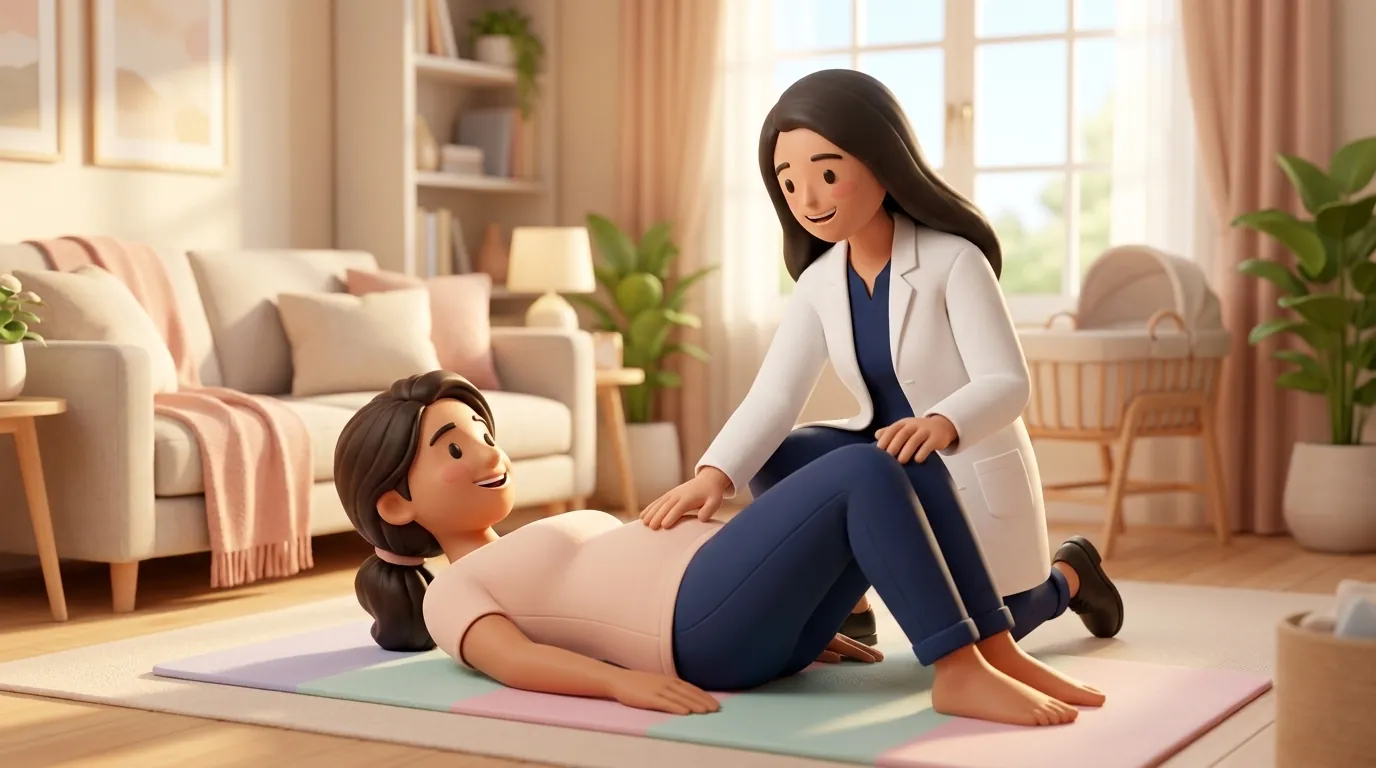
- 1Phase 1 (Sensory Desensitisation and Peri-Scar Priming - Weeks 6 to 8 Post-Op): Only begin after your obstetrician confirms complete wound closure with zero scabbing or open drainage. Wash hands thoroughly. 1. Sensory Desensitisation: gently stroke the skin around your scar for 2 minutes using textures of increasing roughness (soft cotton ball, then a silk scarf, then a terrycloth towel) to calm hyperactive sensory nerves. 2. Clock Mobilisation: place index and middle fingers 2 centimetres above the scar; gently push the skin toward 12 o'clock, 3 o'clock, 6 o'clock, and 9 o'clock, holding directions of restriction for 10 seconds; repeat 2 cm below the scar.
- 2Phase 2 (Direct Multi-Directional Scar Shear and Skin Rolling - Weeks 8 to 12 Post-Op): 1. Direct Cross-Friction: place your fingertips directly on top of the scar line; apply gentle downward pressure and gently slide the tissue up and down (perpendicular to the scar) along its entire length for 3 minutes. 2. Skin Rolling: gently pinch a small fold of skin containing the scar between your thumb and index fingers and slowly roll the tissue between your fingers like a wave; this releases adhesions binding the skin to the rectus sheath.
- 3Phase 3 (Core-Breath Integration and Transversus Abdominis Reactivation - Ongoing): 1. Diaphragmatic Lateral Expansion: lie on your back with knees bent; breathe deeply into your lower ribs; as you exhale slowly through pursed lips, gently draw your lower abdomen inward away from your underwear waistband (visualize drawing your two hip bones together); hold for 5 seconds without holding your breath; repeat 10 times. 2. Supported Glute Bridges: raise your hips while maintaining deep core tension, squeezing gluteals at the top; perform 3 sets of 10 repetitions.
- 4Hygiene and Lubrication Rule: Always use a pure, fragrance-free medical-grade oil or silicone scar gel. Never massage an open, oozing, or inflamed incision.
4. Critical Red Flags: Recognizing Infection, Incisional Hernia, and Endometriosis
While localized stiffness and mild numbness are normal sequelae of surgery, certain symptoms require immediate medical or surgical attention. Consult your obstetrician immediately if you notice localized redness, warmth, swelling, or foul-smelling discharge from the scar line accompanied by fever or chills (indicating surgical site infection), a firm, painful lump directly inside the scar that swells and bleeds or throbs intensely in sync with your menstrual cycle (suggestive of Scar Endometriosis), a visible bulge that pops out through the incision when you cough, laugh, or stand up (indicating an Incisional Hernia), or sudden severe lower abdominal pain with inability to pass urine or gas.
Frequently Asked Questions
Is it ever too late to perform scar tissue mobilisation on an old C-section scar?
No! While the ideal window for rapid remodelling is during the first 6 to 12 months, fascial tissue remains responsive to mechanical shear and mobilisations for years after surgery. Women with 5-to-10-year-old C-section scars frequently achieve marked reductions in scar tethering, lower back pain, and tissue tightness with consistent therapy.
Why does my lower abdomen feel completely numb and detached after a C-section?
During the surgical incision, microscopic sensory nerve endings (terminal branches of the iliohypogastric and ilioinguinal nerves) that supply sensation to the lower abdominal skin are unavoidably severed. These nerves regenerate slowly at approximately 1 millimeter per day. Scar mobilisation and sensory desensitisation help stimulate nerve sprouting and restore normal sensory integration.
Will traditional tight belly binding (maalish belts) flatten my post-C-section shelf?
No. Tight belly binding compresses the abdomen externally but does nothing to release the internal fascial tethering causing the shelf. In fact, prolonged rigid binding weakens deep abdominal muscles by replacing their natural stabilizing function and increases downward pressure on the pelvic floor.
How does C-section scar tightness contribute to chronic lower back pain?
The abdominal wall fascia connects directly to the thoracolumbar fascia of the lower back via the transversus abdominis. A tight, contracted C-section scar pulls the front of the pelvis into an anterior tilt, shortening the hip flexors, inhibiting gluteal activation, and placing continuous compressive shear across the lumbar spine.
How do I book a specialized postnatal pelvic health physiotherapist on BookPhysio.in?
BookPhysio.in connects postnatal mothers across Indian cities with certified female pelvic health physiotherapists skilled in C-section scar release, diastasis recti management, and pelvic floor restoration. Transparent fees range from ₹400 to ₹1,500 for clinic sessions and ₹600 to ₹2,000 for comfortable home visits, with direct payment and zero platform commission.
Related condition guides


BookPhysio.in Editorial Team
The BookPhysio.in editorial team writes and maintains this content, checking it against reliable clinical sources. Content follows our medical review policy: general information only, and no page claims a clinical review until a named registered physiotherapist has signed it off.
Read our medical review policy